
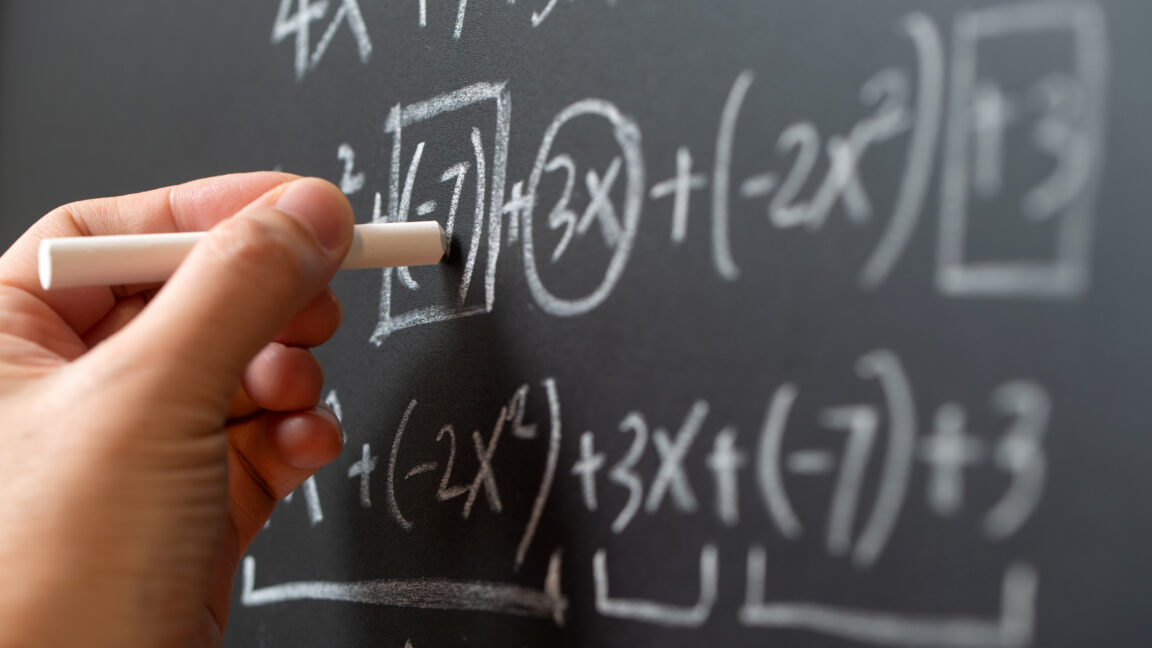
Our modern world runs on math, from social media algorithms, package delivery, and weather prediction to medical imaging and machine learning. The rise of computers helped fuel its dominance, enabling us to work with increasingly large numbers that would otherwise be beyond the capacity of our finite human brains. But with the rise of large language models, AI chatbots, and, soon, quantum computing, so-called “big math” is beginning to outstrip its creators entirely. What that means, and how we might adapt, is the focus of a new book, Big Math: The Hidden Codes That Run Our World, by applied mathematicians Steven Strogatz and Alex Townsend.
Strogatz is perhaps best known in his field for his co-authorship of a seminal 1998 paper with Duncan Watts on the collective dynamics of small-world networks. He has also studied chaos theory as applied to physics, the geometry of supercoiled DNA, and the biological collective oscillators, such as swarms of synchronously flashing fireflies and crickets that chirp in unison. In 2005, Strogatz extended his study of synchronicity to the crowds that caused the wobbling of London’s Millennium Bridge.
An award-winning communicator, Strogatz wrote three series of columns on mathematics for The New York Times in 2010, 2012, and 2025 and hosted a podcast for Quanta magazine from 2020–2021. He has written four popular books: Sync (2003), The Calculus of Friendship (2009), The Joy of X (2012), and the New York Times bestseller Infinite Powers (2019).
This time around, Strogatz has found a well-matched co-author in Townsend, a younger colleague recently hired at Cornell who studies numerical analysis and deep learning. As senior faculty, Strogatz was assigned to mentor Townsend, and the two men began regularly lunching together in Risley Hall. Strogatz was intrigued by the popular book potential of Townsend’s course on the top 20 algorithms of the 20th century and suggested co-authorship. That concept slowly morphed into a book about big matrix calculations, and then into what became Big Math.
“There are so many books about pure math, as if computers didn’t exist,” Strogatz told Ars. “Alex and I are both very applied mathematicians. We thought there should be a book on computers and math, especially the class of really big problems with billions of variables or parameters that you just can’t approach in your head. A lot of the math we’ve had for centuries perfectly scales up to this computer moment. What the abacus did for arithmetic, the fangcheng (“rectangular array”) board did for systems of linear equations. It was a matrix you could manipulate with your hand and bamboo sticks. So this externalizing of math outside of our heads into our tools is a 2,000-year-old idea.”
© 2026 Winzheng.com 赢政天下 | 转载请注明来源并附原文链接