
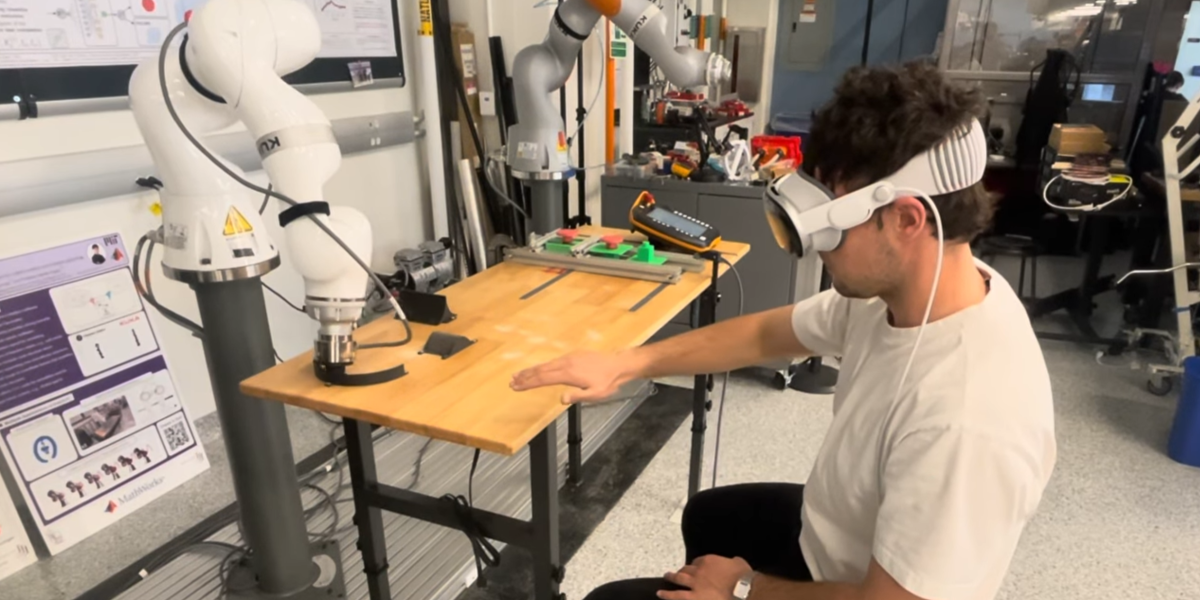
Strokes leave 5 million people with long-term impairments each year, and a growing shortage of physical therapists makes it hard for them to get the care they need. A new approach tries to solve that problem by combining artificial intelligence and human therapy.
Johannes Lachner, a former MIT postdoc who is now an assistant professor at Purdue University, and Noah Geiger, a former visiting student at MIT, developed a robotic system that uses generative AI and real-time force feedback to learn from real therapists. Drawing on what it’s learned, it gives patients just the right amount of assistance during physical rehabilitation exercises like reaching, lifting their arms, and performing tasks of daily living.
The goal is “not to replace therapists, but to extend their reach,” Lachner says.
“Initial robotic experiments have already demonstrated the feasibility of this approach,” he reports. “The next phase of the project aims to develop therapist-specific models and evaluate them in a long-term clinical study with the same patients who previously received manual therapy.” Beyond that, he envisions possible applications in contact-rich industrial settings or collaborative workspaces.
Keep Reading
Most Popular
Don’t be fooled—LLMs don’t reason
Ten years after AlphaGo’s match against Go champion Lee Sedol, today’s AI still isn’t tapping into the machinery that made that win possible.
ByDon’t be fooled by this summer of AI hype
Breathless claims about AGI and new capabilities fall apart pretty quickly under scrutiny.
ByAn AI “mind-reading” tool can reconstruct what you’re looking at from a brain scan
Scientists hope it could be used to reconstruct a person’s inner thoughts, mental images, or even dreams.
ByThe inside story on why OpenAI agents hacked Hugging Face
The underlying models had been rewarded for cheating and communicating with each other, a new OpenAI report finds.
ByStay connected
Illustration by Rose WongGet the latest updates from
MIT Technology Review
Discover special offers, top stories, upcoming events, and more.
© 2026 Winzheng.com 赢政天下 | 转载请注明来源并附原文链接