
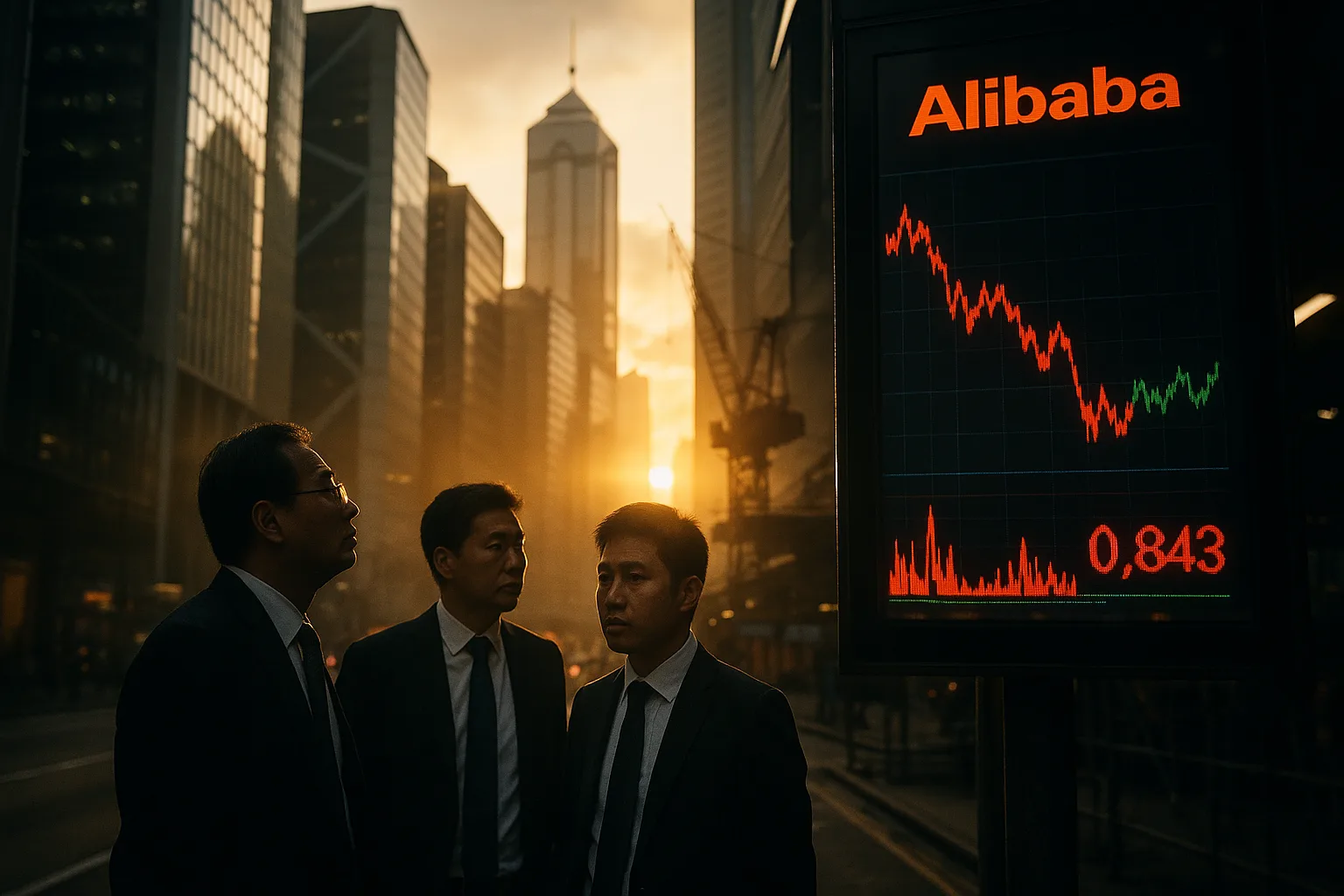
On August 23, 2026, Alibaba announced the issuance of 710 million new shares at HK$112.70 per share, raising approximately HK$80 billion (US$10.2 billion), with all proceeds earmarked for full-stack AI capability building, covering AI chips, data centers, and large model R&D. This marks Alibaba's first new share placement since its secondary listing in Hong Kong in 2019, and one of the largest follow-on placements on record in the Hong Kong market. After the announcement, its Hong Kong-listed shares fell by as much as 10% during trading; at the same time, subscription demand was roughly three times the offering size, with sovereign wealth funds and global long-term institutional investors among the buyers.
These two events happening simultaneously—a sharp share price decline and oversubscription—reveal a real market divergence: short-term shareholders pay the price for dilution, while new investors are betting on the returns of AI infrastructure before the eventual winners have been decided. Understanding this contradiction requires first looking at why Alibaba chose to raise external capital despite holding approximately US$70 billion in cash on its balance sheet.
Equity Financing Instead of Using Cash: A Judgment Call on Timing
As of the end of June, Alibaba held approximately US$70 billion in cash and liquid investments. In theory, this AI investment could have been fully self-funded—but Alibaba chose otherwise. The logic is not about filling a funding gap, but rather a precise judgment of timing.
Equity financing is most advantageous when demand is strong. The placement was completed at a modest discount to the market price, but with a subscription multiple of approximately 3x, indicating that the market was willing to pay near-full price for AI infrastructure. Alibaba was thus able to transfer part of the execution risk to new investors while preserving its own liquidity for chip R&D, data center construction, and even future acquisitions. The new shares represent approximately 3.7% of existing share capital—a limited dilution, but enough to displease long-time shareholders.
Hedge fund manager Michael Burry, while criticizing the placement, shifted his Alibaba position to JD.com, but still described Alibaba as "a significant force in the low-cost large language model space." Questioning the financing method is not the same as denying the technological value.
Capital Expenditure Approaching US$10 Billion Per Quarter: Where the Money Is Going
This financing is not Alibaba's first large-scale AI investment—it is simply refueling an engine already running at high speed. In the June quarter, Alibaba's capital expenditure rose 75% year-over-year, approaching US$10 billion in a single quarter; free cash flow correspondingly turned negative, with a net outflow of approximately US$6.6 billion. Meanwhile, net profit fell 75% year-over-year, and overall revenue growth was just 9%.
But the trajectory of the AI cloud business is the exact opposite. Alibaba's AI cloud and computing services segment saw revenue grow 45% year-over-year in the June quarter, reaching approximately RMB 48.4 billion; adjusted EBITA more than doubled year-over-year to approximately RMB 5.6 billion, with margins moving toward 12%. AI-related product revenue reached approximately US$1.8 billion, sustaining triple-digit growth for 12 consecutive quarters.
These numbers describe a quintessential "burning cash for growth" phase: heavy capital investment compresses current-period profits, but the growth rate and margin improvement in core businesses indicate that the money is not flowing uselessly into a loss-making pit, but rather driving a business that is accelerating.
T-Head and Models: The Strategic Value and Uncertainty of Self-Developed Chips
Alibaba has explicitly directed part of the funds to T-Head chip R&D. This choice carries special strategic significance: in an environment where computing supply is subject to external constraints, self-developed chips are a critical path to reducing dependence on NVIDIA and taking control of AI infrastructure.
Chip development has a long cycle and high validation costs, making it the most uncertain component of this financing. From tape-out to mass production and actual deployment in data centers typically takes several years. Securing funding does not mean securing chip competitiveness. Alibaba has not publicly committed to specific technical specifications or mass production timelines for T-Head chips, making this area one of the core observation points for assessing the real value of this financing.
The Scale Gap with U.S. Hyperscalers: Catching Up or Differentiating
Placing Alibaba's US$10.2 billion in a global context, the gap is immediately apparent. The four U.S. tech giants—Amazon, Microsoft, Alphabet (Google's parent company), and Meta—are expected to spend a combined approximately US$725 billion on capital expenditure in 2026, a more than 70% increase over 2025. Of this, Amazon's quarterly capital expenditure is roughly US$20 billion, Microsoft's roughly US$19 billion, Google's roughly US$17.5–20.5 billion, and Meta's roughly US$12.5–14.5 billion—each company's single-quarter capex is comparable in scale to Alibaba's entire financing round.
This comparison indicates that the logic of Alibaba's financing cannot be to match the absolute scale of U.S. leaders. The more realistic path is differentiation: first, maintaining a dominant position in the Chinese market and in economies decoupled from U.S. technology; second, forming a global usability advantage through a relatively low-cost model approach (the Qwen series), rather than a compute-scale advantage. This is the real competitive logic behind Michael Burry's description of a "significant force in the low-cost large language model space."
Upstream, Downstream, and Developers: What 45% Cloud Growth Means
For enterprise users and developers, the 45% revenue growth of the AI cloud business is a more direct signal. It means that Alibaba Cloud's AI services in the Chinese market have reached a stage supported by clear paid demand, not just subsidy-driven trial-period growth. The cloud segment's adjusted EBITA doubling year-over-year, with margins moving toward 12%, indicates that this growth is beginning to show the contours of commercial returns.
But the cloud business as a whole still operates in a fiercely competitive market-share contest, and profitability has yet to be fully solidified. For enterprise users, Alibaba Cloud's AI infrastructure investment means more abundant computing supply and assured service stability; however, in vendor selection decisions, price and ecosystem lock-in costs remain more critical evaluation dimensions than the scale of capital expenditure.
For small and medium-sized service providers in the GPU cloud market, Alibaba's financing accelerates the trend toward concentration among leading players—those with self-developed chip paths and large-scale data centers will gain stronger cost advantages, further compressing the survival space of smaller computing-power service providers.
Signals to Watch: Three Things That Will Determine Whether This Money Was Worth It
The value of this financing will ultimately be validated by three observable signals.
First, whether the AI cloud profit margin can continue expanding across consecutive quarters. The current adjusted EBITA margin of approximately 12% is an initial improvement, but there is still considerable distance to covering heavy capital investment and generating satisfactory returns for shareholders. If the margin stagnates or contracts over the next two to three quarters, it would indicate a problem with marginal cost control.
Second, whether T-Head chips show quantifiable deployment data. Chip progress cannot be confirmed through press releases alone; future earnings reports need to show actual compute contributions, or traceable use cases need to emerge in the developer ecosystem.
Third, whether AI-related products' triple-digit growth over 12 consecutive quarters can be sustained on a much larger base. High growth rates are easy to achieve at a small base; once AI revenue reaches the tens-of-billions-of-dollars scale, a natural decline in growth is inevitable—the real question is at what level it can still cover current capital expenditure intensity.
The most honest reading of this placement is perhaps neither "Alibaba is short on cash" nor "Alibaba has already won," but rather: with the outcome of the AI infrastructure race still unclear, it has chosen to share this bet with new investors. The 10% stock drop is the price old shareholders pay; the 3x oversubscription is the vote of new investors. Both are true.
© 2026 Winzheng.com 赢政天下 | 转载请注明来源并附原文链接