
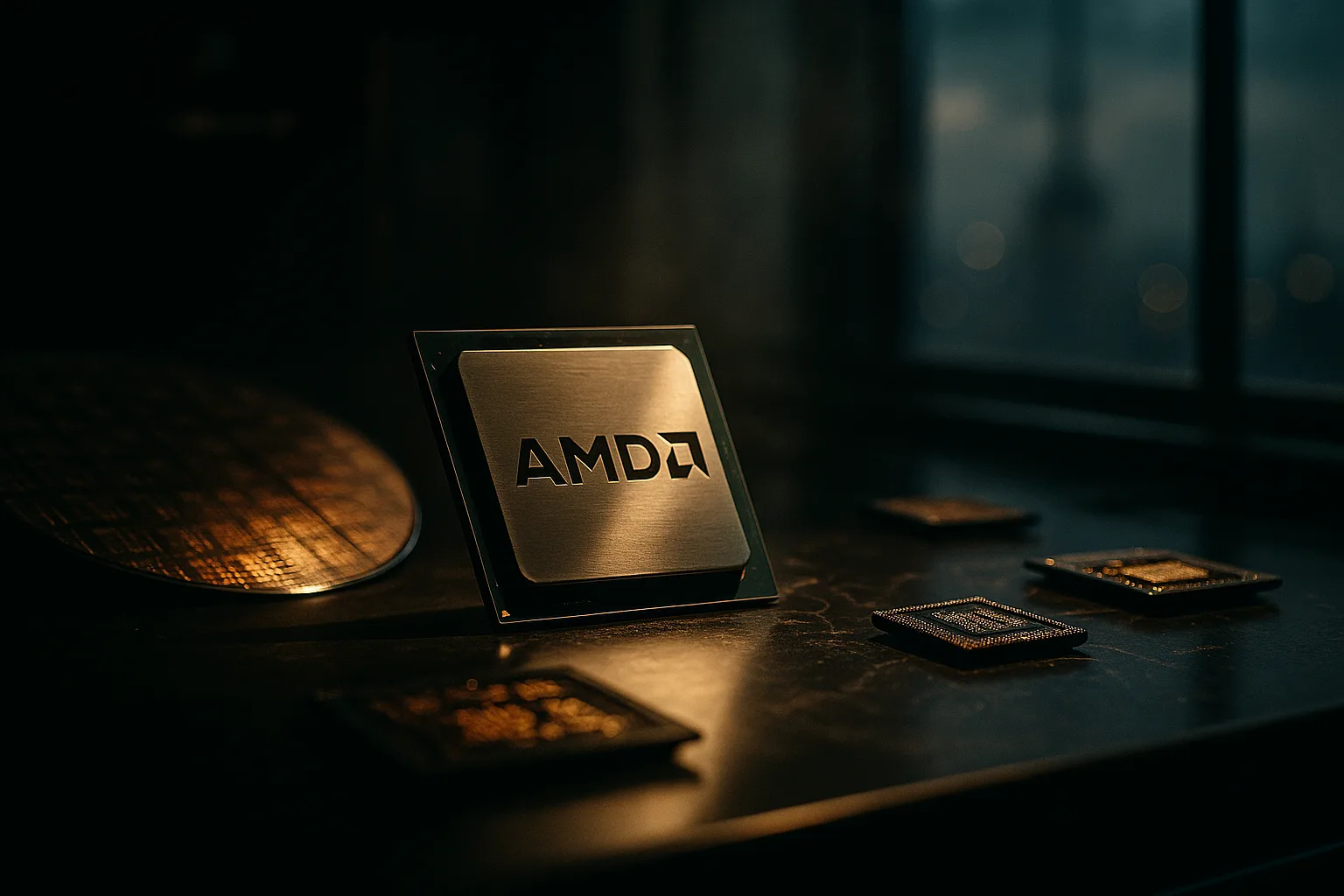
AMD announced on August 6, 2026 that it had reached an agreement to acquire Taalas, a Toronto-based startup founded in 2023 that has developed inference silicon technology that directly etches model weights into chip wiring. According to the official announcement, Taalas' HC1 chip uses TSMC's N6 process, implementing mask ROM storage of the Llama 3.1 8B model across 5.3 billion transistors, claiming single-user throughput of 17,000 tokens per second at approximately 200 watts of power consumption.
Actual Differences in Technical Approach
Taalas' design flow requires customizing only about 2 of the roughly 100 metal layers to generate a chip for a specific model, compressing the tape-out cycle to around two months. This approach directly targets the compute and memory bottlenecks of general-purpose architectures. Vamsi Boppana, senior vice president of AMD's AI division, stated in the announcement that this move will complement the existing full-stack platform, including the Helios rack solution, Instinct GPUs, EPYC CPUs, and ROCm software.
We founded Taalas with the goal of building hardware around models, fundamentally rethinking AI inference.—Ljubisa Bajic, co-founder and CEO of Taalas
Unlike traditional GPUs or TPUs, Taalas' approach hardens weights at the hardware level, reducing overhead from dynamic loading. Brendan Burke, analyst at Futurum Group, noted that AMD also gains the ability to rapidly iterate from model to silicon, which is critical in the context of agentic EDA tools lowering design barriers.
Strategic Intent Within the Industry Context
AI inference has become the fastest-growing market segment, with increasingly specialized workloads. AMD's move is not an isolated event but a continuation of its Canadian expansion, aimed at retaining local talent. The announcement emphasized that after the acquisition closes, the company will develop system-level solutions paired with Instinct GPUs rather than simply replacing existing products.
Potential Impact and Limitations
The hardcoding approach suits high-throughput scenarios with fixed models, but model updates require re-taping-out, which may limit flexibility. AMD plans to integrate it into its accelerator roadmap, complementing general-purpose GPUs rather than fully replacing them. AMD views the Canadian team's engineering expertise as an asset that can help accelerate innovation.
Independent Assessment
The core value of this acquisition lies in shortening the path from model to hardware, rather than purely performance numbers. If AMD can combine Taalas' process with its existing ROCm ecosystem, or achieve cost advantages in specialized inference workloads, it could reshape parts of the market landscape; otherwise, it will merely be a supplement to the existing roadmap.
© 2026 Winzheng.com 赢政天下 | 转载请注明来源并附原文链接