
Chipmaker AMD is taking aim at competitor Nvidia with its latest hardware release: a rack-scale system designed to power computing needs of the world’s largest AI labs.
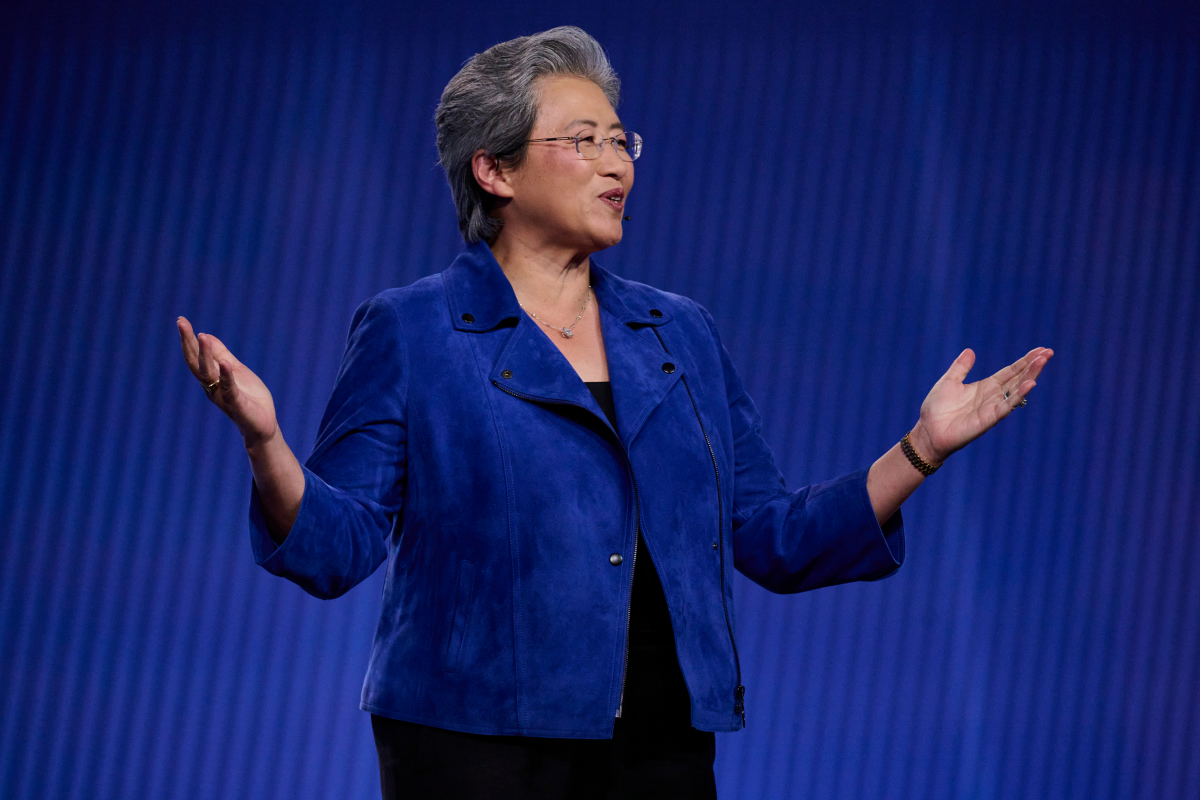
At the company’s sold-out Advancing AI conference in San Francisco on Thursday, AMD Chair and CEO Dr. Lisa Su promoted the new AI rack system known as Helios — along with its growing list of customers, including Microsoft — as the company prepares to ship it later this year. Su also pitched the company’s newest chips that are designed to feed the compute-hungry dragon that is the AI industry.
Rack systems combine many processors into a single high-powered unit. They are built for data centers, where they train and run AI models and other compute-intensive workloads.
Su called Helios the tech industry’s “highest-performance AI rack,” adding that it was “built to train and run the most demanding frontier models in the world at massive scale.” The system will be deployed by leading AI companies at gigawatt-scale, the company said.
Nvidia has historically dominated this market with its Vera Rubin and Grace Blackwell rack-scale systems. AMD is clearly looking to get in on the action. And Helios’ performance metrics appear to give it a real chance, beating out Vera Rubin by a number of metrics, The Register reported.
Helios, which was revealed in 2025 and shown onstage in January at CES 2026, already has several well-known customers, including OpenAI, Meta, Oracle, Anthropic, and Microsoft, all of which have plans to deploy the system. Microsoft CEO Satya Nadella said Monday that the company would expand its Azure infrastructure with Helios. Meanwhile, Anthropic and AMD announced a strategic partnership Wednesday to deploy up to two gigawatts of GPUs via the new rack system.
AMD also introduced Thursday its Venice-X CPU, which is designed for data centers and to handle high-computing workloads. The Venice-X is expected to launch in 2027.
During her remarks, Su commented on the trajectory of the chip industry, claiming that, by the year 2030, chips that power AI will become a massive part of the overall computing market. This is because the industry is “seeing a step change in compute demand” driven largely by the rise of agentic AI, she said.
“When you ask the agent to do something, it actually has dozens of steps, and it has to reason, and it has to call tools, and it has to access data, and it has to keep doing it over and over until it solves the problem, and so you need lots of GPUs to do all that,” the executive said.
“We’re now expecting that by 2030, the AI accelerator market is going to reach about $1.4 trillion,” Su said. “What that means is, by the end of the decade, the AI accelerator market is going to approach the size of the entire semiconductor market today.”
“We do expect that GPUs are going to make up the vast majority of that market because the algorithms are still very much in their infancy, and we’re still continuing to see the workloads change, and that favors programmability in the overall silicon ecosystem,” she added.
© 2026 Winzheng.com 赢政天下 | 转载请注明来源并附原文链接