
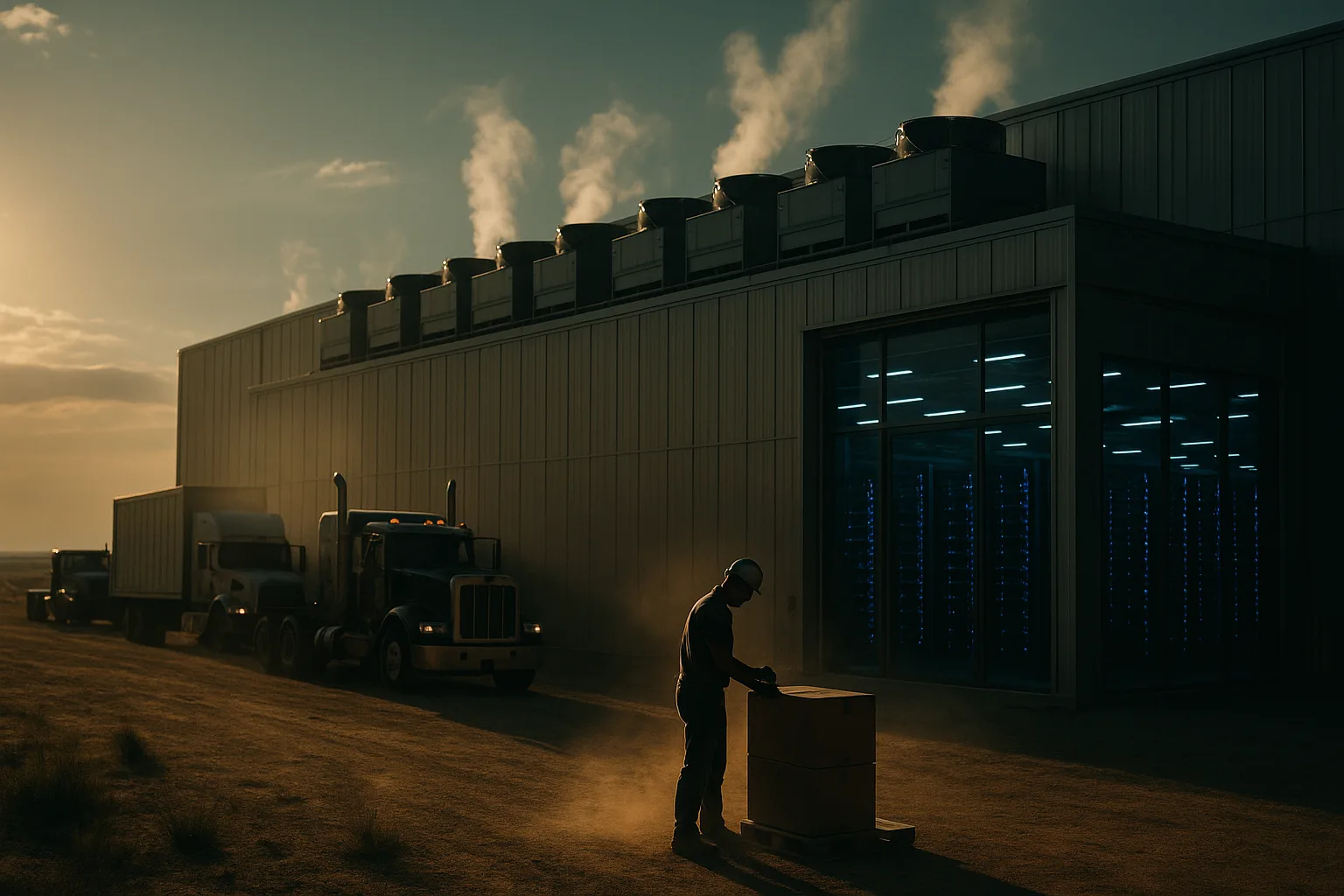
On August 31, 2026, Anthropic signed a $35 billion compute agreement with cloud company Lambda. The data center will be located in Nueces County, Texas, and will be built by Hut 8, an infrastructure developer with roots in Bitcoin mining. The entire Texas campus is planned for 700 megawatts of capacity. Nvidia had already signed a contract with Hut 8 in advance to lock in compute resources and directly holds the lease on the data center.
The structure involves three parties: Hut 8 builds the facility, Nvidia controls hardware deployment rights as the lessee, Lambda installs the chips Nvidia procured into server racks and provides cloud services to Anthropic, and Anthropic ultimately consumes the compute. In this transaction, Nvidia serves simultaneously as chip supplier, data center landlord, and deal facilitator.
Three Deals Totaling Over $100 Billion Within One Month
Over the past few weeks, Anthropic has signed multiple large agreements: a $45 billion agreement with Nscale on August 26, with compute coming from a West Virginia data center; earlier, it signed approximately $50 billion in agreements with FluidStack and approximately $45 billion with SpaceX. Anthropic's forward compute procurement commitments for 2026 have exceeded $150 billion, covering Texas, West Virginia, and multiple undisclosed locations.
This scale is highly unusual for a company that has not yet gone public. Anthropic's current annual revenue is estimated at between $3 billion and $4 billion, while its total compute contracts are already tens of times its annual revenue.
Nvidia's Strategic Upgrade: From Selling Shovels to Collecting Rent
Across the three agreements, Nvidia's role is consistent in direction: penetrating from equipment supplier toward infrastructure controller. In the Nscale transaction, Nvidia is likewise a key supporter; in the Lambda–Hut 8 agreement, Nvidia directly holds the data center lease, thereby controlling hardware deployment decisions at the physical level.
In recent years, Nvidia has taken equity stakes or formed strategic partnerships in emerging cloud companies, including Lambda, Nscale, and CoreWeave, then packages GPU compute through these companies for sale to AI labs. This structure allows Nvidia to collect hardware sales revenue while sharing subscription revenue through affiliated cloud providers, while also locking in customer procurement paths.
For Anthropic, bypassing hyperscale cloud providers such as AWS, Azure, and Google Cloud in favor of the neocloud ecosystem has clear commercial logic. Hyperscale cloud providers are also Anthropic's competitors; buying compute from them is equivalent to funding its rivals. Neoclouds, by contrast, offer pure GPU rental without competing model services attached. In the $45 billion Nscale deal, Google and Microsoft participated in negotiations but failed to secure it.
The Real Question: How Much of These Agreements Can Be Delivered?
The six-year details of the Anthropic–Lambda agreement have not been fully disclosed. Spreading $35 billion over six years comes to roughly $5.8 billion per year, which means Anthropic would need to sustain an extremely high level of compute consumption or resell part of the compute to third-party developers. Anthropic already has a business of selling compute to enterprise customers through its API, but whether that scale can support this volume cannot be independently verified.
Hut 8 got its start in Bitcoin mining and has not been transitioning to AI data center infrastructure for long. For the 700-megawatt planned capacity at the Nueces County campus, from site selection, construction, to delivery, GPU-grade data center timelines are typically measured in years. No public milestones have been disclosed for the time gap between agreement signing and compute actually going live.
Compute Positioning Ahead of the IPO
Anthropic is preparing for an IPO, with market valuation expectations in the $60–80 billion range. In IPO roadshows, compute reserves are a core metric for measuring an AI company's execution ceiling. Large-scale compute agreements, even if execution has flexibility, send a clear signal to prospective shareholders.
OpenAI completed its IPO last year, and its deep compute binding with Microsoft is regarded as an important component of its valuation support. Anthropic's choice to build its compute moat through neoclouds rather than a single hyperscale cloud provider carries higher execution risk financially, but offers greater strategic independence, free from the constraints of Microsoft, Google, or Amazon cloud service terms.
Structural Assessment
The $35 billion Lambda agreement, placed in the full picture of Anthropic's recent series of compute procurements, reveals a new power structure taking shape in AI infrastructure. By holding leases, taking stakes in neoclouds, and locking hardware supply, Nvidia is elevating itself from chip supplier to infrastructure controller. Anthropic's procurement path is both a deliberate avoidance of hyperscale cloud providers and an alignment with the rollout of Nvidia's supply chain restructuring strategy.
In the short term, this supply chain structure gives Anthropic greater negotiating flexibility and strategic independence. But the risk is that if financial pressure or execution delays emerge at the neocloud level, it is Anthropic—which signed the long-term agreements—that bears the consequences, not Nvidia, which has already collected payment. The information disclosed so far is insufficient to assess the default clauses and exit mechanisms in the contracts of all parties, details that investors will need to dig into during the IPO phase.
© 2026 Winzheng.com 赢政天下 | 转载请注明来源并附原文链接