
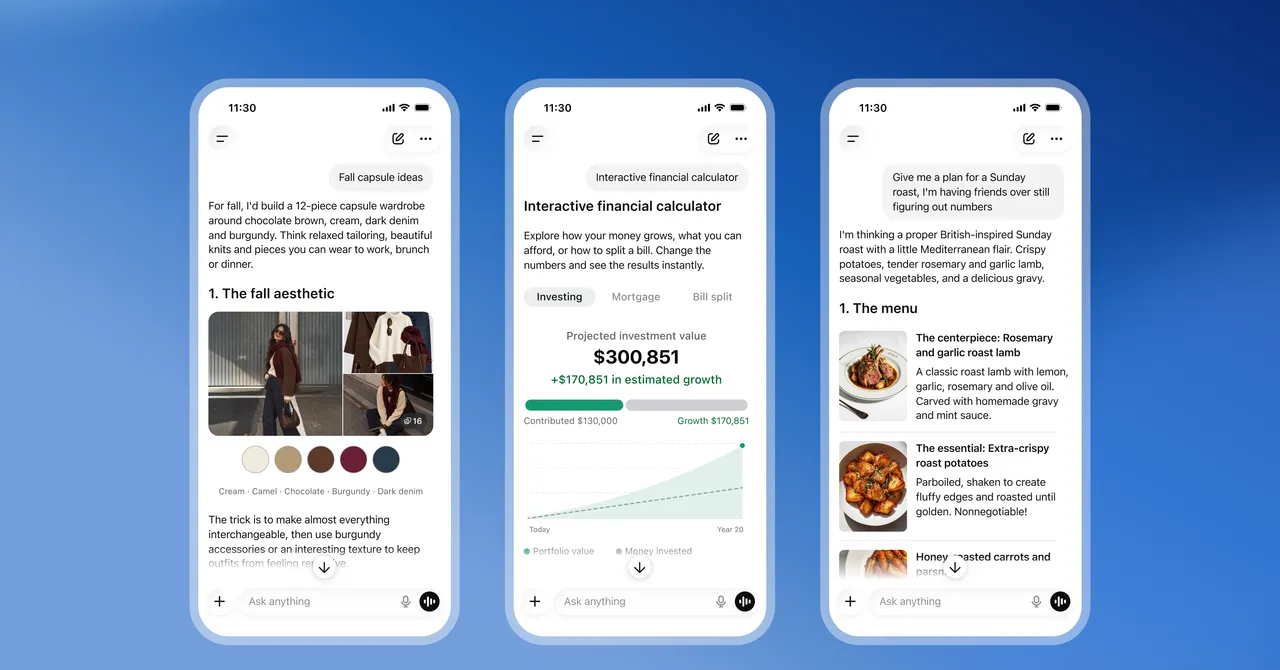
a chatbot a question, you’ll often get a wall of text back, maybe with an image or two pulled from the web. That may no longer be the case soon as OpenAI overhauls how ChatGPT answers prompts.
On Wednesday, OpenAI unveiled an “Intelligent UI” update for ChatGPT that generates visual, custom elements—when helpful—for answering a user's questions. The company's new experience is powered by its recent GPT-6 model, which rolls out to paid users today and free users tomorrow.
I got a quick test of the user interface before launch, and these visual elements felt like a welcome change. When I asked for a diagram of a slug, ChatGPT generated an anatomy-focused visual with buttons I could press for each different part, from the upper tentacles to the muscular foot. I also generated a San Francisco apartment affordability calculator with movable sliders to adjust income and other expenses, showing what percentage of my take-home pay different units would cost.
My favorite part of this quick hands-on with ChatGPT’s Intelligent UI was an airplane seat explorer. I’m not a fan of sitting in the exit rows, so I asked ChatGPT to generate a custom tool to compare the cabin layouts between four different Alaska and Delta planes. In its output, I could tap any seat on the map for more details, and ChatGPT highlighted the exit rows in green.
While useful in some results, every ChatGPT answer won’t suddenly include a chart or graphic. “We have a design team that spent a lot of time figuring out when adding a diagram, chart, or buttons adds value versus when it's starting to feel cluttered,” says Aarush Selvan, a product manager at OpenAI. If a user isn’t interested in visuals, they can tell ChatGPT to generate fewer of those outputs.
These visual results are similar to what Google announced earlier this year for Search when it expanded the bespoke results users may see. Google’s version is called “generative UI.” One example: if you want to understand deep space better, Search can output an adjustable graphic that breaks down how black holes work using multiple sliders.
Chatbot experiences have increasingly become multimodal, meaning that text, images, and voice blend into one user experience. OpenAI's launch of an updated ChatGPT that's easier on the eyes and more interactive for over a billion users signals that the multimodal era is here. However, a larger shift toward generative user interfaces may spark an identity crisis for designers, as AI dictates more of what software looks like for individual users.
With AI tools now able to quickly generate custom software, the future of chatbots is further personalized and attuned to what I want to see, and what I want to see is slug diagrams. Good riddance to walls of text.
© 2026 Winzheng.com 赢政天下 | 转载请注明来源并附原文链接