
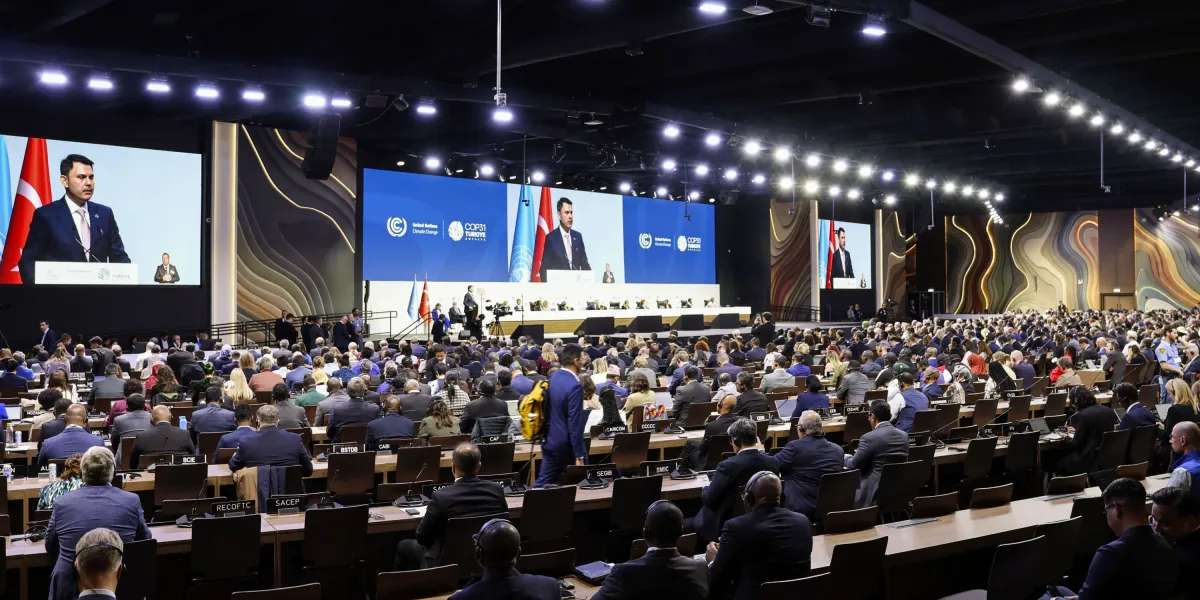
It’s that time of year again: Thousands of delegates, lobbyists, and journalists are gathered for the annual UN climate talks, taking place this time in Antalya, Turkey.
COP31 officially kicked off on November 8, marking the beginning of negotiations on one of the biggest stages of the climate world. Turkey and Australia are cohosting this year’s talks, which are scheduled to wrap up on November 20.
This annual gathering can often serve as an indicator of where the world stands on addressing and adapting to the climate crisis. And this year’s talks are sure to be a doozy—expect a lot of back and forth on fossil fuels and climate finance in particular. Here’s what you should know about COP31.
In recent years, the tension always feels high when COP rolls around. (COP stands for “Conference of the Parties.”) But this year feels especially charged: The world is still grappling with the ongoing war in Iran, which has disrupted the Middle East and sent economic shock waves around the world as energy prices have spiked.
This year’s COP will be the second without a formal delegation from the US. President Trump formally withdrew the country from the Paris Agreement earlier this year and is in the process of withdrawing from the UN Framework Committee on Climate Change. That’s the treaty that allows formal participation in negotiations.
Meanwhile, things aren’t looking good for the Paris Agreement, which was established at UN climate talks 11 years ago, setting a goal of limiting warming to 1.5 °C over preindustrial levels. In a report published in September, the UN Environment Program acknowledged that global warming is set to exceed that 1.5 °C goal, “likely within the next few years.”
So as climate talks kick off, there’s an obvious, urgent question looming about how to quickly cut emissions to limit warming. There’s also the major issue of how to pay for efforts to address emissions and to help a warming world endure the inevitable damage.
Two years ago, talks ended in a goal of mobilizing $300 billion per year by 2035 to help pay to reduce emissions and adapt to climate change. (Rich nations provided $136.7 billion in 2024, according to the Organization for Economic Cooperation and Development.) And last year, the COP30 agreement included a goal of tripling the money for adaptation over that period. (Such funding has been quite flat over the past few years.)
The world got a tragic reminder of just how high the stakes are earlier this year, when a glacier collapse caused devastating flooding in the Himalayas. The flood killed approximately 1,500 people, left over 5,000 missing, and caused nearly $5 billion in damage. The UN loss and damages fund committed $20 million to helping Nepal recover (less than 1% of the total estimated cost to the country).
Another key trend to watch is how the formal negotiations engage with the topic of fossil fuels. Three years ago, the final agreement text explicitly called for a transition away from them. But it felt as if things took a step back last year, when the final agreement didn’t even mention the phrase “fossil fuels” once. This will be an interesting conversation, especially because cohosts Turkey and Australia have both faced criticism over their relationships with these fuels—Australia is a major exporter of coal and natural gas, and Turkey’s grid relies heavily on fossil fuels, including coal.
Outside the formal negotiations, COP31 president Murat Kurum, Turkey’s environment minister, is spearheading a side agenda, including two informal initiatives that will be worth watching. These wouldn’t be part of the official agreement text, but countries could sign on to signal support.
One is a pledge to make AI more sustainable; this is almost comically squishy, even as voluntary COP pledges go. The text includes explicit wording that it creates no new obligations for countries, so don’t expect anything resembling enforcement there.
The COP leadership is also pushing to make electricity a larger part of member countries’ energy use. Today, only about 23% of global energy is used in the form of electricity. Fossil fuels, like gasoline in vehicles or natural gas for heating, make up the bulk of the rest. Shifting to more electricity use, and relying on cleaner sources for that electricity, could help drive down emissions. The new pledge’s target is for electricity to make up 35% of total energy consumption by 2035.
With leadership billing this as an “implementation COP,” it would be great to see some real, tangible progress on the global challenge of addressing climate change. I’m not expecting anything groundbreaking, but we’ll be tuned in to see what the final agreement shapes up to be.
This article is from The Spark, MIT Technology Review’s weekly climate newsletter. To receive it in your inbox every Wednesday, sign up here.
Deep Dive
Climate change and energy
2026 Climate Tech Companies to Watch
ByInside the quest to combat Arctic fires and save the planet’s frozen carbon
These scientists hope that fire-spotting satellites, AI tools and ancient land practices could preserve the world’s vulnerable permafrost—and the vast carbon it stores.
ByHow solid-state transformers could help power the AI boom
New technology could help cut power losses and reinvent a staple of the grid.
ByFervo Energy and its plan to streamline geothermal power
The newly public company is betting that AI’s power boom will help turn enhanced geothermal energy into a scalable reality.
ByStay connected
Illustration by Rose WongGet the latest updates from
MIT Technology Review
Discover special offers, top stories, upcoming events, and more.
© 2026 Winzheng.com 赢政天下 | 转载请注明来源并附原文链接