
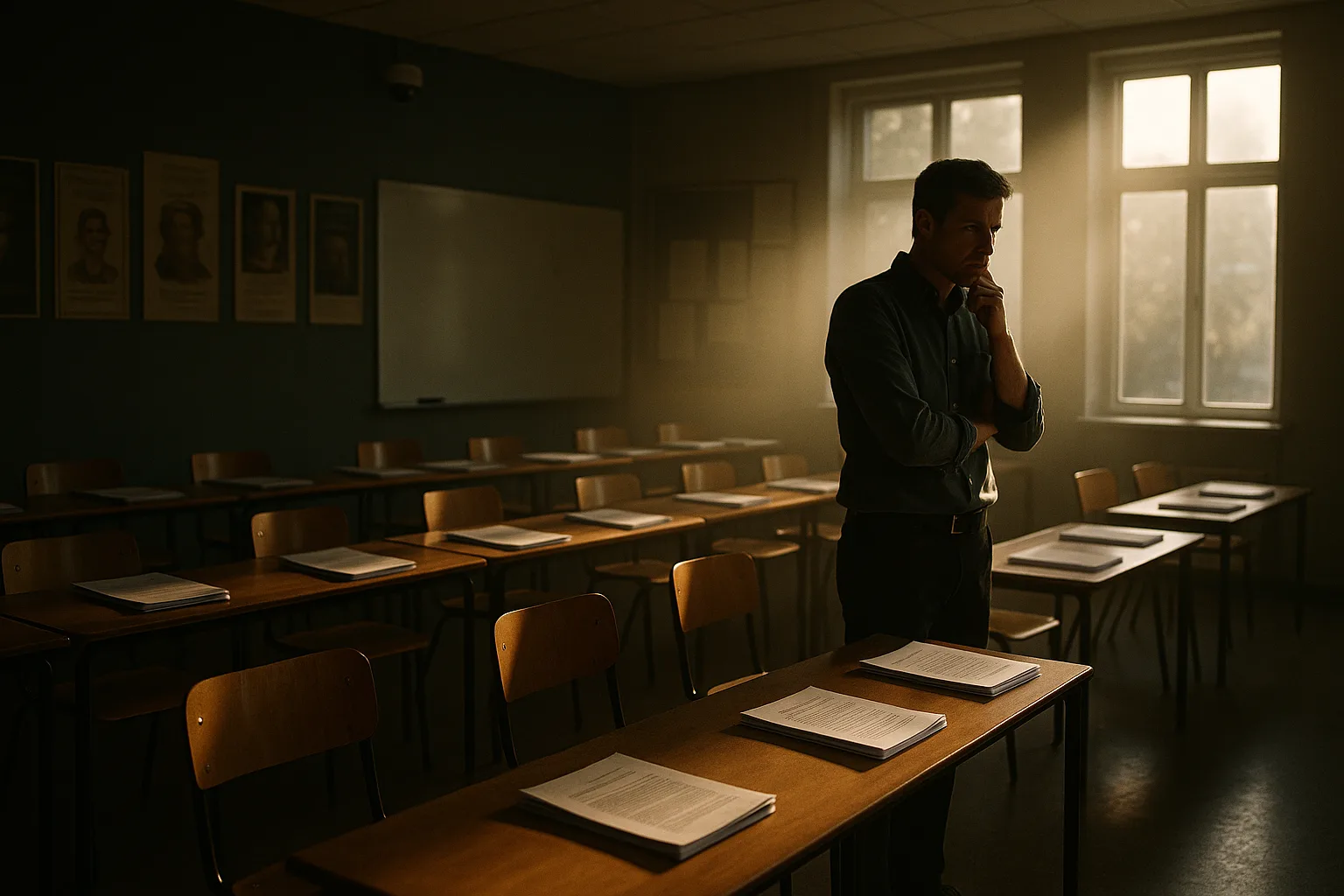
On August 6, 2026, Danish Education Minister Magnus Heunicke announced that upper secondary school students (ages 16-19) must now present oral defenses for major written assignments to combat AI ghostwriting. Schools must install monitoring firewalls and move assignments to supervised classrooms.
Policy Details and Enforcement Mechanisms
Approximately 9,000 upper secondary students annually complete major assignments known as "større skriftliche opgave," which were previously completed at home. These must now be verified through oral defense. Monitoring tools will cover computer use during written exams, and firewalls will filter school network content to prevent AI access. Education authorities are also promoting more assignments to be completed in controlled on-campus environments so teachers can track the process and provide feedback.
Unfortunately, we have an AI cheating problem in upper secondary schools, and now we need to take action. — Magnus Heunicke, Danish Education Minister
Analysis of Underlying Drivers
The proliferation of AI tools allows students to generate text quickly, making it difficult for traditional assessment methods to distinguish original work from machine output. Data from neighboring Sweden shows that the number of students suspended or warned for unauthorized AI use rose 688% between 2023 and 2025. This figure reflects how cheating has shifted from isolated cases to a large scale as AI access barriers have lowered. The Danish policy's focus is not on banning tools, but rather on rebuilding the assessment loop, using oral components to verify thinking processes.
The education system has long relied on written output as a core assessment metric. When generative AI can replicate these outputs at low cost, the metric itself loses validity. Oral defense compels students to demonstrate their reasoning chains, directly targeting AI's current weaknesses in real-time interaction and deep explanation capabilities. Monitoring firewalls cut off external model invocation pathways, representing physical isolation at the technical level.
Ripple Effects Across Industry and Education
After the policy takes effect, schools will need to procure compliant monitoring software and train teachers to design defense questions. AI education product suppliers face diverging demand: assisted learning tools may gain recognition, while direct ghostwriting services will lose market share. Teacher workloads will increase, requiring additional preparation of scoring criteria for oral components.
From a broader perspective, this move may accelerate similar adjustments in other European countries. Sweden has already initiated reviews, and Denmark's immediate implementation model provides a replicable template. In the long term, educational assessment will evolve toward multimodal verification, integrating oral components, project process records, and controlled-environment writing.
Independent Assessment
Denmark's measures are a pragmatic choice under current technological conditions. They do not negate the value of AI tools, but rather protect assessment validity through institutional restructuring. If AI's real-time interaction capabilities improve substantially in the future, oral defense itself will need to evolve, but in the short term, this policy can effectively reduce the impact of AI ghostwriting on academic integrity.
© 2026 Winzheng.com 赢政天下 | 转载请注明来源并附原文链接