
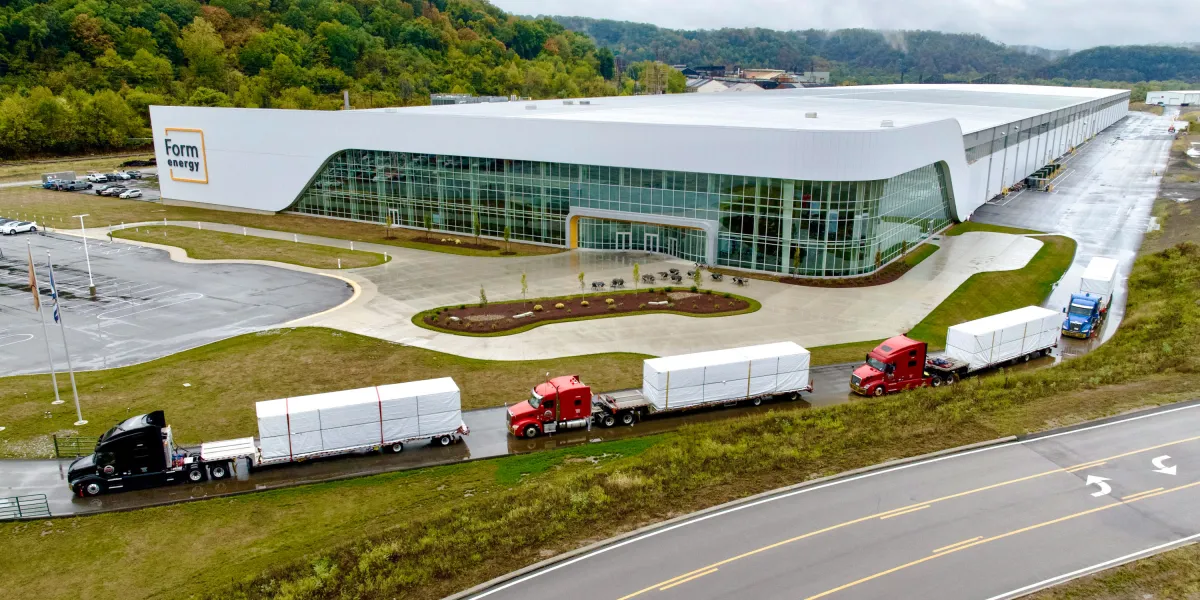
Form Energy is building iron-based batteries that can store energy for multiple days. The company is ramping up supply at its factory and signing deals for commercial projects.
New solar and wind installations produce electricity more affordably than fossil fuels in most places, but their output varies based on season, time of day, and weather. To compensate, utilities are increasingly investing in battery storage systems, which can charge when power is abundant and discharge when the grid needs a boost.
Lithium-ion batteries are the fastest-growing storage technology. Although light and energy-dense, they require pricey metals and are costly to scale, and few of the large batteries of this type used in industry are designed to store energy for longer than four to six hours.
Form Energy wants to build cheaper long-duration energy storage technology. The company has developed a new type of battery, built with a far more abundant and cheaper metal, iron, that can store energy for 100 hours. It uses a process that Form calls “reversible rusting.” During discharge, oxygen from the air converts the iron metal to rust, releasing electrons. When charging, current converts the rust back into iron metal.
Over the past two years, Form has gained commercial traction. It began producing batteries at its West Virginia factory for its first commercial deployment, a 150 megawatt-hour system for Minnesota electricity provider Great River Energy, which is set to come online in 2027. And Form has signed several other deals with power providers. The largest is a project with another Minnesota-based utility, Xcel Energy, where wind and solar power, backed by 30 gigawatt-hours of Form’s batteries, will be used to power a new Google data center. That project is expected to come online in phases between 2028 and 2031.
Key indicators
- Industry: Energy storage
- Founded: 2017
- Headquarters: Somerville, Massachusetts, US
- Notable fact: Once complete, Form’s proposed 30 gigawatt-hour energy storage system at a Google data center in Minnesota could be the world’s largest battery project by energy capacity.
Potential for impact
Wind and solar power play a major role in limiting growth in global carbon dioxide emissions. Still, many grid operators depend on fossil fuel plants, especially natural gas ones, to fill gaps caused by periods of low renewable supply or high demand. Form’s batteries are designed to cover multiday supply-demand imbalances, like those that crop up during heat waves, deep freezes, or periods with little sun or wind. The company declined to share the current cost of its battery systems, but says its goal is to reach $20 per kilowatt-hour, which would make them cost-competitive with the natural gas alternative.
The company’s technology could help reduce emissions from the AI data center boom. AI’s thirst for energy has already delayed closure of aging coal plants, led to the building of new natural gas plants, and caused price hikes for consumers. Cheap energy storage could help renewables meet more of this AI-driven growth in electricity demand.
 FORM ENERGY
 Caveats
The long-duration storage market is still nascent. Form’s iron-air technology faces a crowded field of approaches, including pumped hydropower, compressed gas, fuel cells, gravitational devices, and flow batteries that store energy in liquids. The economics of multiday batteries, which require large capital expenditures yet frequently sit idle, remain tricky.
While funding from data center developers could be a major boost, Form also has to prove it can deliver: Its existing production capacity, 2 gigawatt-hours of battery storage per year, is a fraction of the 80 gigawatt-hours it has promised through commercial agreements. Success will hinge on its ability to scale.
Another remaining question is the technology’s physical footprint. Form’s batteries, which are stacked together in enclosures the size of shipping containers, require an acre for every two to three megawatts. That means its Google installation would take up the equivalent of at least 75 football fields.
Next steps
In addition to finalizing its first commercial project, Form is outfitting its factory with new equipment that will help it scale manufacturing to meet its production backlog. It will do so with the help of new financing, announced in August, that brings its total money raised, in addition to West Virginia state and US federal grants, to more than $2 billion.
Deep Dive
Climate change and energy
Batteries just broke another record in the US
Huge grid-scale batteries are thriving, but smaller residential systems have lagged.
ByWhat’s behind this summer’s heat, and why 2027 could be worse
El Niño? Climate change? All of the above?
ByHow engineered microbes could help feed the world’s crops
Startup Switch Bioworks hopes to use microbes to reduce demand for chemical fertilizer.
ByHow much hydrogen awaits us underground?
The global gold rush for underground stores of hydrogen fuel continues. But researchers are still sorting out how much of the stuff there is.
ByStay connected
Illustration by Rose WongGet the latest updates from
MIT Technology Review
Discover special offers, top stories, upcoming events, and more.
© 2026 Winzheng.com 赢政天下 | 转载请注明来源并附原文链接