
If you are new to AI infrastructure, you may not yet be familiar with MLCommons—the open-source engineering consortium that is the authoritative standards body for global AI performance measurement. Previous MLPerf benchmarks mainly tested isolated silicon performance, while the newly released MLPerf Endpoints v1.0 focuses on larger systems: it measures real-time API endpoint performance under production-like workloads.
This benchmark evaluates the complete AI stack—hardware, models, serving software, batching behavior, and networking—rather than a tuned accelerator in a vacuum, giving buyers and system builders intuitive insight into real-world capabilities.
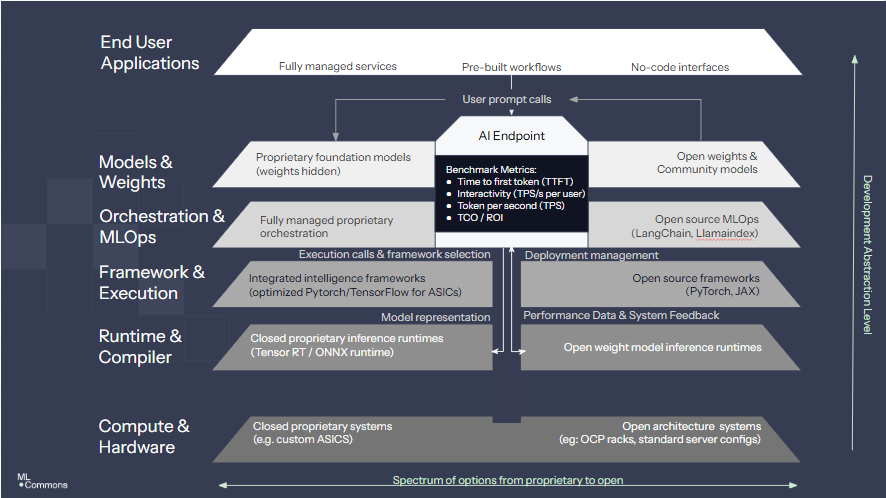
Why MLPerf Endpoints v1.0 Matters to Providers and System Builders
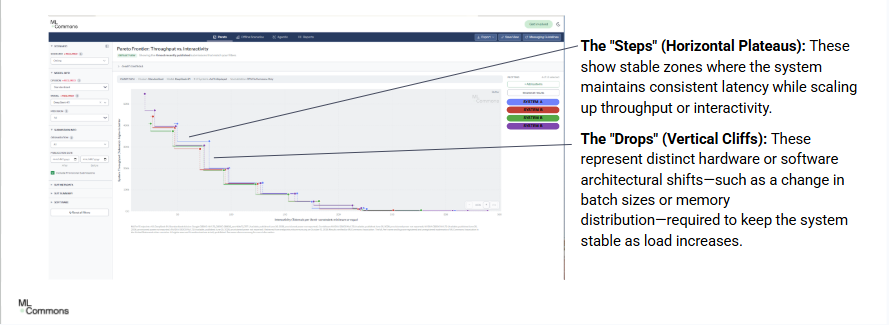
For cloud providers, hardware OEMs, managed service providers, and “neoclouds,” existing AI benchmarks often devolve into tuning contests that do not reflect actual business value. MLPerf Endpoints v1.0 generates a complete Pareto frontier to show how systems actually behave under different workloads, rather than a single peak score. It uses only measured data, with no estimates or interpolation, clearly revealing the performance cliffs customers may encounter.
Enterprise Legitimacy and Full-Stack Innovation Showcase
Submitted systems receive the endorsement of rigorous peer review by industry competitors and third-party auditors, giving engineering, sales, and marketing teams undisputed authority. If you have developed a breakthrough custom scheduler or optimized the network architecture, traditional benchmarks may overlook these innovations, whereas Endpoints measures the entire frontier dataset, allowing software and integration engineering achievements to be demonstrated.
Real Workload Profiles
The v1.0 suite does not use artificial or synthetic tests; instead, it uses workloads customers actually use today, scaling from simple single-turn tasks to complex multi-turn AI agents. Task families include: Summarization (such as Llama 3.1 8B Instruct), Reasoning (DeepSeek-R1), and Agentic Coding (multi-model, multi-turn trajectories such as Qwen 3.6).
Process for Submitting to MLPerf Endpoints v1.0
The benchmark greatly reduces engineering overhead and supports rolling submissions, with release queues formed every few weeks. Specific steps include: signing the CLA to obtain a PRISM API key, installing the reference client, planning the Pareto frontier (7 measurement points for Agentic, 8–32 for non-Agentic), running the inference-endpoint tool to collect metrics such as throughput and TTFT P90, writing system_desc.json and system_power.json disclosure files, locally validating compliance, and finally submitting to create a peer-review PR.
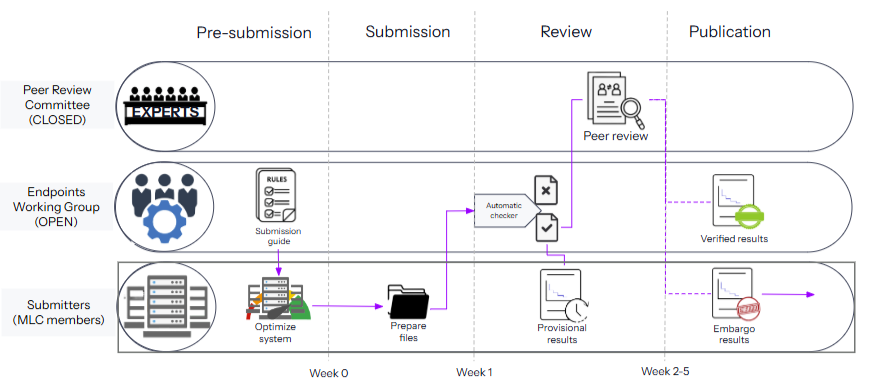
After submission, results enter continuous peer review and ultimately generate intuitive MLPerf LoadStair visualizations. MLPerf also allows temporary results to be shared after automated checks, and final verified results can be placed under a release embargo as needed. For more details, please refer to the official first-time submitter guide.
© 2026 Winzheng.com 赢政天下 | 转载请注明来源并附原文链接