
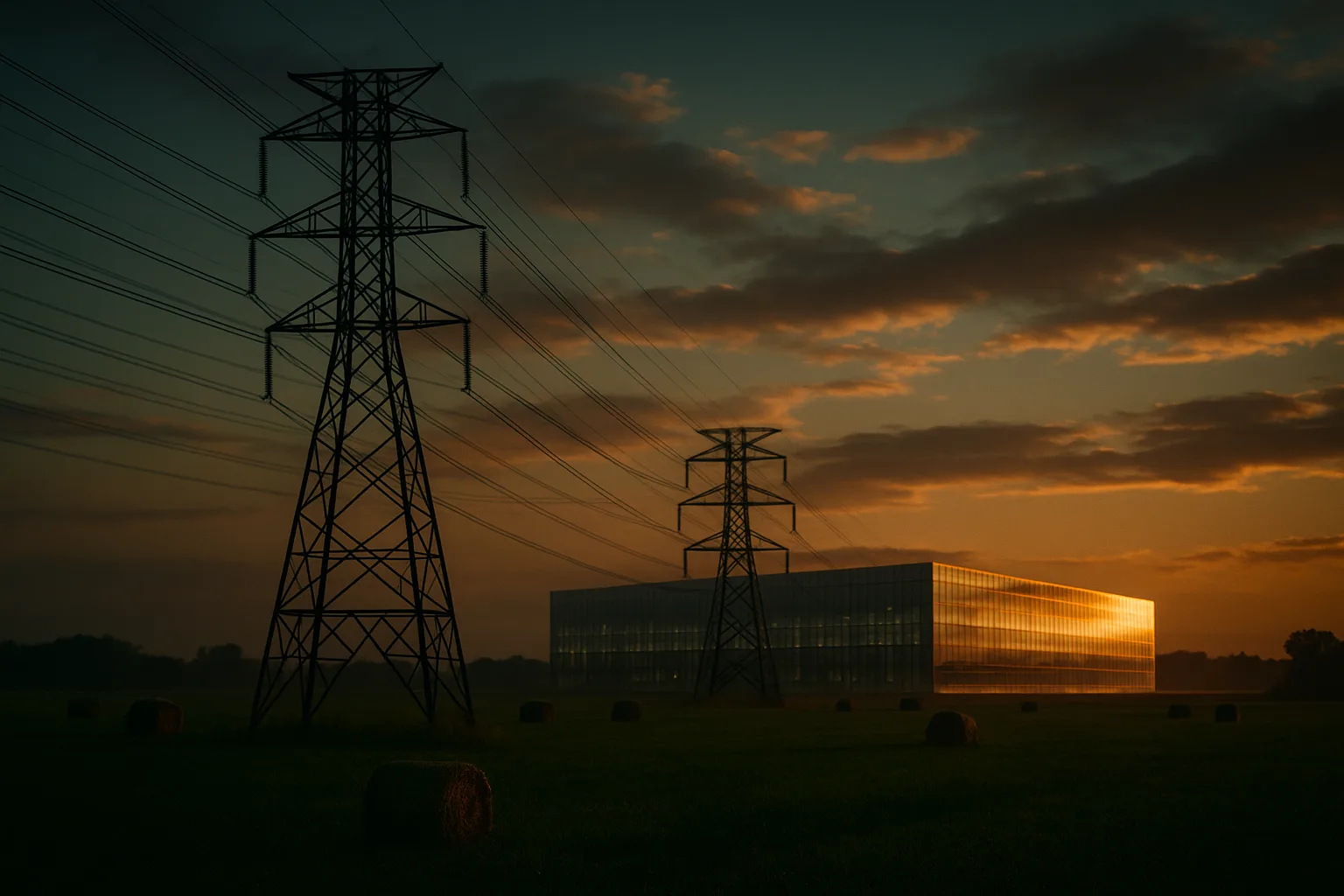
On August 17, 2026, Nvidia announced up to $105 billion in credit guarantees for OpenAI's data center at the PORTS-Pike technology park in Pike County, Ohio, while investing $1.5 billion in SB Energy. OpenAI will serve as the sole tenant under a 20-year lease. The project's initial capacity is 4.25GW, with the first 800MW phase expected to come online in 2028.
Guarantee details and risk boundaries
The guarantee is capped at $105 billion. Nvidia's guarantee covers a portion of lease and electricity payments, as well as a residual value commitment — it does not backstop all of OpenAI's obligations. If OpenAI defaults, Nvidia is only liable for the difference between the minimum guaranteed value and the proceeds from re-leasing or selling the assets.
Nvidia CEO Jensen Huang said the company is leveraging its scale and long-term visibility to help lock in infrastructure, rather than engaging in revolving financing.
The project's total planned capacity reaches 8GW, and Nvidia holds an option for an additional 3.75GW of expansion. Nvidia will be the sole chip supplier for the campus, with each generation of AI factory systems containing approximately 1.5 million GPUs, corresponding to a $150 billion to $200 billion revenue opportunity.
Local opposition and energy realities
NIMBY opponents and AI proponents hold sharply different views. Critics point to the aging U.S. power grid, warning that the data center's high electricity consumption could push up local energy prices and strain water resources. Supporters emphasize that Ohio has already expressed support due to job creation, and that the project includes an $80 million initial community benefit fund alongside hundreds of millions of dollars in long-term commitments.
Land and electricity have become the primary bottlenecks for data center expansion. Nvidia chose PORTS-Pike, adjacent to a retired factory site, with partners including AEP Ohio, the U.S. Department of Energy, and the Department of Commerce.
From selling chips to locking in AI factories
This move extends Nvidia's competitive boundary into land, power, and construction. By leveraging its credit backing to secure long-term exclusive deployment space, the campus can support multiple generations of GPU upgrades rather than losing value at the end of a single chip cycle. OpenAI has committed to deploying approximately 12GW of Nvidia compute capacity by 2030, which could expand to 16GW — corresponding to $600 billion in revenue.
Last week, Nvidia partnered with BlackRock and five other financial institutions to launch a financing platform for AI infrastructure exceeding $500 billion. These arrangements show that frontier AI labs' compute demands have outgrown what their own balance sheets can support.
Industry impact and strategic calculus
This model transforms AI infrastructure from one-time procurement into long-term assets that can continuously roll forward with GPU iteration. Nvidia locks in core sites with limited risk, and CUDA ecosystem compatibility also reduces reliance on a single tenant. If the project materializes, it will become a landmark case of Nvidia's transformation from hardware supplier to AI factory organizer.
The financing structure is not yet fully defined. The equity portion may involve a potential SB Energy IPO and direct investment from SoftBank, while the debt portion includes project loans and bonds.
This guarantee reflects how AI compute demand is breaking through traditional financing models while exposing the real bottlenecks of energy and community constraints. Nvidia's strategy of using its own credit to secure long-term compute deployment space is replicable given a highly certain demand outlook.
© 2026 Winzheng.com 赢政天下 | 转载请注明来源并附原文链接