
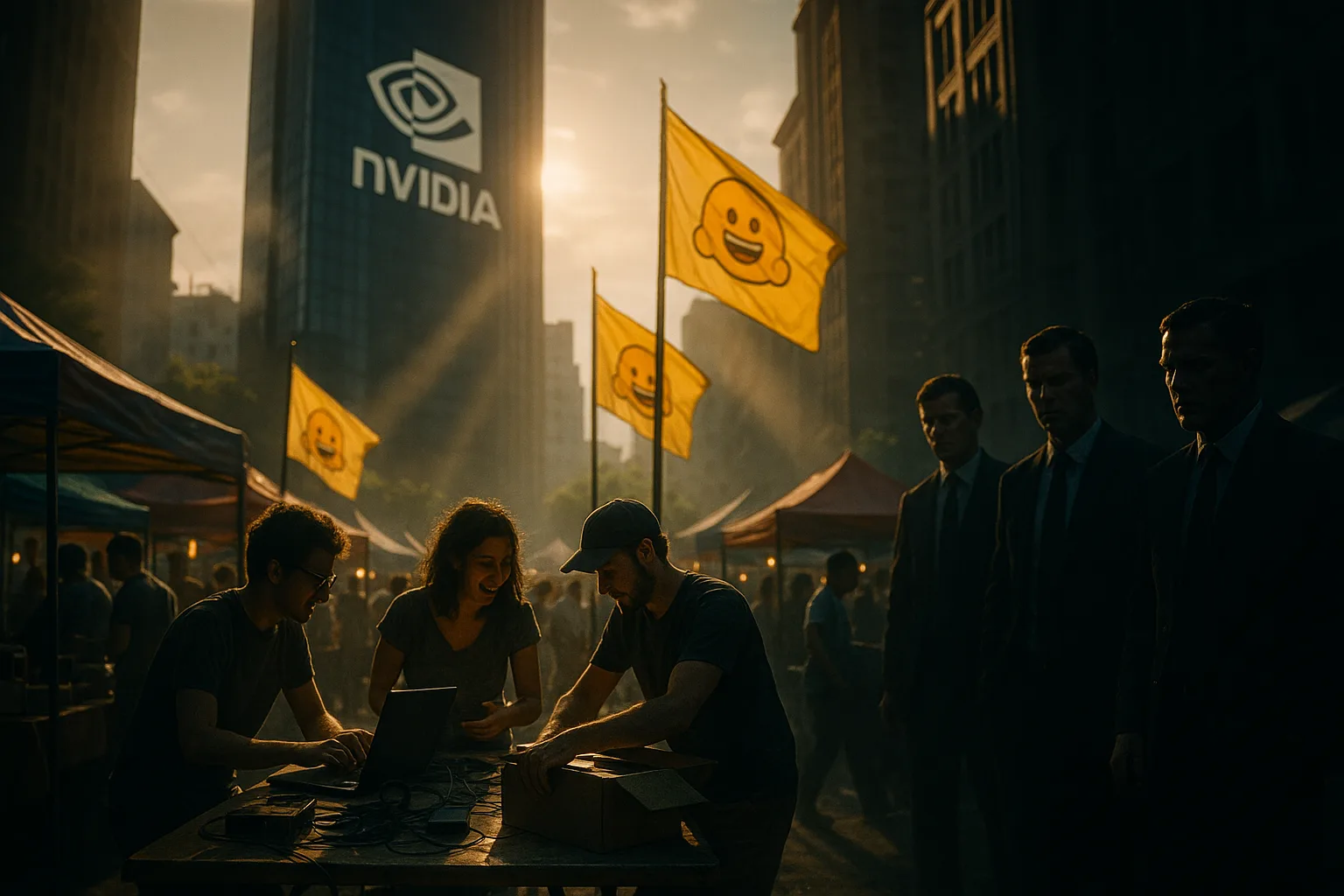
On September 3, 2026, NVIDIA CEO Jensen Huang officially announced in a company blog post that NVIDIA had agreed to acquire the open-source AI platform Hugging Face for $12.93 billion. It is the largest single acquisition in NVIDIA’s history, and the most expensive open-source platform deal to date in the global AI infrastructure sector.
The numbers alone are striking enough: Hugging Face was valued at about $4.5 billion in its last funding round in 2023, making this deal nearly three times that valuation. The platform currently generates about $150 million in annualized revenue, meaning the $12.93 billion purchase price implies an 86-times revenue multiple. NVIDIA is clearly not buying a business; it is buying a strategic position.
What Exactly Is NVIDIA Buying?
Hugging Face’s current scale is almost irreplaceable in the AI industry: the platform hosts more than 3 million AI models, 500,000 datasets, and 1 million applications, serving more than 18 million developers, researchers, and creators. More than 200,000 companies use the platform to discover, evaluate, customize, and deploy models. According to TechCrunch, Huang stated directly in the announcement: “Almost every open model runs on NVIDIA hardware.”
That sentence reveals the true strategic logic behind the deal. NVIDIA is already the seller of water in the AI compute gold rush; now it also wants to become the well itself. Hugging Face is the central hub through which developers around the world access, distribute, and test AI models. Whoever controls this hub controls the traffic gateway to the entire open-source AI ecosystem, intelligence on model trends, and the trust assets of the developer community.
One comparison shows just how valuable that trust is: according to TechCrunch, NVIDIA offered to acquire Hugging Face for $500 million a year ago, but the founding team rejected the bid on the grounds that its principle of openness was under threat. This time, the deal closed at $12.93 billion—about 25 times higher—and Hugging Face accepted.
How Much Is the Promise to “Remain Open” Worth?
NVIDIA made a clearly worded commitment in its announcement: Hugging Face will continue to operate as an open platform for the entire AI ecosystem; developers may freely choose models, frameworks, cloud providers, inference providers, and underlying compute; developing or deploying on Hugging Face will not require the use of NVIDIA computing hardware; and the platform will continue to support open-source models and open-weight models from all model providers.
On paper, these commitments are impeccable. The problem is that history is never written by promises alone.
In 2022, NVIDIA’s planned $40 billion acquisition of Arm was blocked by the U.S. Federal Trade Commission (FTC), the European Union, and the United Kingdom’s competition regulators. The regulators’ core argument was simple: a platform that all competitors depend on should not be owned by one of those competitors. Arm’s position then was highly similar to Hugging Face’s position today—both are industry infrastructure, both claim to “favor no one,” and both were being acquired by a company with dominant market power.
For this reason, the regulatory resistance facing this deal is already far more complex than NVIDIA’s $700 million acquisition of Run:ai. According to TechTimes, the acquisition must pass full antitrust reviews in the United States, the European Union, and the United Kingdom, with closing expected no earlier than early 2027. According to wccftech, NVIDIA has characterized Hugging Face as a “decentralized platform,” attempting to get ahead of the regulatory narrative.
Structural Tension: Open Commitments and Commercial Interests Are Naturally at Odds
Assuming the deal is completed smoothly, the real difficulties for NVIDIA will only gradually emerge afterward.
Hugging Face’s value comes precisely from its neutrality. Model researchers are willing to share their latest work there, and enterprises use it to discover and evaluate models, exactly because it does not belong to any particular hardware vendor or cloud provider. Once that neutrality is even partially called into question—if, for example, NVIDIA hardware inference interfaces receive priority integration, or the exposure weighting of NVIDIA-owned models is quietly increased—the developer community could start leaving far faster than the acquisition negotiations unfolded.
The open-source community is not without concern. According to shattered.io, after the acquisition was announced, voices in the industry were already asking: Is Hugging Face still everyone’s “public square,” or has it become NVIDIA’s “brand showroom”? Competitors such as AMD and Intel, as well as companies such as Meta, Google, and Mistral that have accumulated substantial model assets on Hugging Face, may be the first to pressure regulators, or they may quietly accelerate the construction of their own distribution channels.
Another number is worth noting: according to foreign media reports, NVIDIA will pay up to an additional $1 billion in employee retention bonuses. That is not a small amount. Hugging Face’s core competitiveness lies in the community ecosystem built by its engineers and researchers. If key talent chooses to leave after the lock-up period ends, the platform’s substantive value will be significantly diminished.
The Redistribution of the Open-Source AI Landscape
The timing of this acquisition is no accident. Over the past year, open-weight models have clearly approached—and in some cases surpassed—the competitiveness of closed-source models; enterprise demand for “autonomous and controllable” technology has continued to rise under geopolitical pressure; and the activity and commercialization potential on the Hugging Face platform have been repriced by the market. NVIDIA’s move at this moment is a clear bet on that trend.
In the announcement, Huang co-signed an open letter on the “importance of open-weight models to the AI economy,” using language that directly echoes the U.S. narrative of technological competition with China. Behind this lies a clear policy-level logic: if open models are strategic assets, then controlling the distribution channels for open models means controlling the circulation infrastructure for those strategic assets.
Boosted by news of the acquisition, NVIDIA’s share price challenged the $230 mark on September 3, only about 2.4% below its all-time high of $236. The capital market’s short-term reaction to the deal was optimistic—but stock prices reflect expectations, not outcomes.
Independent Assessment
This $12.93 billion deal is, in essence, NVIDIA’s systematic expansion into the software ecosystem layer after consolidating its hardware monopoly. Hugging Face is not a software company; it is the “model exchange” of the AI era. Its value lies in the network effects that connect supply—model researchers—with demand—enterprise users—not in its own revenue.
Are NVIDIA’s commitments credible? In the short term, most likely yes: the cost of damaging developer trust is far higher than the cost of maintaining neutrality. But the medium-term risk does not lie in active intervention; it lies in passive ecosystem tilt. When NVIDIA’s infrastructure teams decide which features to integrate first, when NVIDIA’s engineers decide how to optimize inference performance, and when NVIDIA’s business teams decide which cloud providers to deepen partnerships with—each seemingly neutral technical decision will quietly alter developers’ perception of “who Hugging Face belongs to.”
The precedent of Arm offers another possibility: regulators could block the deal. If that scenario repeats itself, it may turn out to be an unexpected preservation of the open-source AI ecosystem.
© 2026 Winzheng.com 赢政天下 | 转载请注明来源并附原文链接