
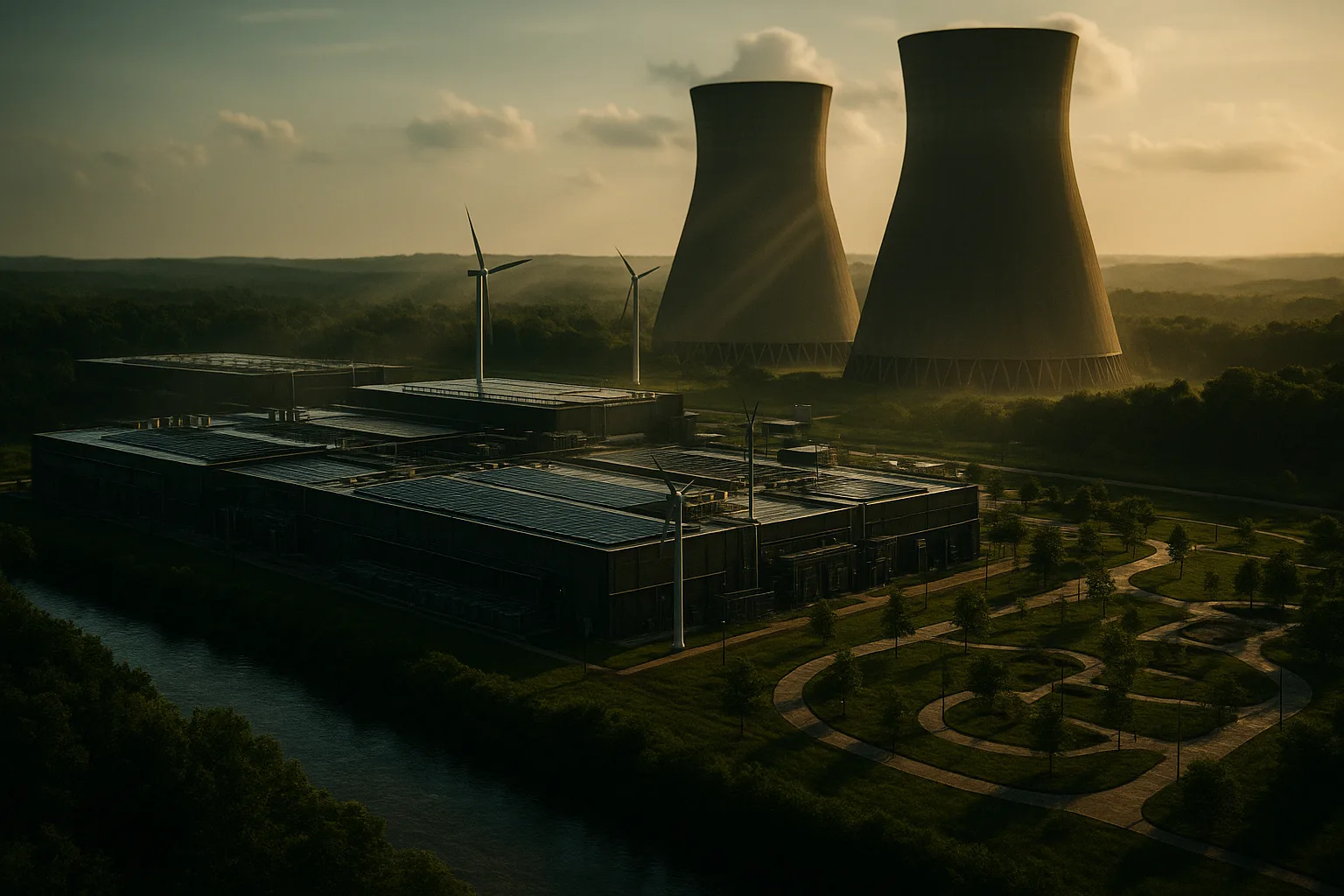
OpenAI announced on July 23 that it will build the Project Camellia data center campus in Effingham County, Georgia, spanning approximately 1,400 acres with an investment of $20-30 billion. The campus will be developed in phases through 2032, with a maximum power capacity of 3.2 gigawatts delivered by Georgia Power in stages.
Facts
This project is OpenAI's first self-designed, self-built, and self-operated data center. Previously, OpenAI primarily relied on Microsoft Azure for computing power. The campus, located in the Savannah Gateway Industrial Hub, includes four buildings and will provide 400 permanent positions when the first phase begins operations in 2028, increasing to approximately 1,000 positions by 2032. Georgia Power has signed a 25-year agreement with OpenAI, under which OpenAI will bear all infrastructure and power service costs and commit to providing up to 1,000 megawatts of flexible demand response during peak periods.
Mechanism Breakdown
Project Camellia uses a closed-loop water system, primarily serving office areas such as restrooms and kitchens, avoiding continuous water extraction from or discharge into local sources. For power, OpenAI pays for all new infrastructure costs, and existing residential customers will not face additional electricity charges as a result. The agreement also requires OpenAI to reduce power usage during periods of high grid load—a commitment described by Georgia Power as one of the largest single-facility demand response pledges in the United States. OpenAI will also receive a 50% property tax reduction for 15 years, though it will still become Effingham County's largest taxpayer and provide $80 million in community benefit funds for schools, public safety, housing, workforce training, and other areas.
From a business logic perspective, OpenAI's shift to building its own infrastructure stems from the need for scale. As model services transition to continuously running AI agents, the cost curve and control requirements of renting cloud computing power no longer align. Directly owning hardware can reduce the cost per token over the long term while providing direct control over training and inference infrastructure.
Industry Impact
For the competitive landscape, this move by OpenAI breaks its single dependency on Microsoft Azure, and other AI companies may face similar pressure to build or diversify their computing power sources. For upstream and downstream power companies, Georgia Power gains a long-term, stable large customer while reducing the need to build new generation capacity through demand response. For developers and enterprise users, the future may bring more stable but initially higher-cost computing power supply. Local communities gain employment and tax benefits, though some residents have raised questions about transparency.
Strategic Assessment
Based on available facts, other large AI labs are most likely to follow up by evaluating the feasibility of building their own data centers. Verification signals include the public announcement timing of subsequent similar-scale projects, and whether Georgia Power delivers the first phase of 3.2 gigawatts of power by 2028.
© 2026 Winzheng.com 赢政天下 | 转载请注明来源并附原文链接