
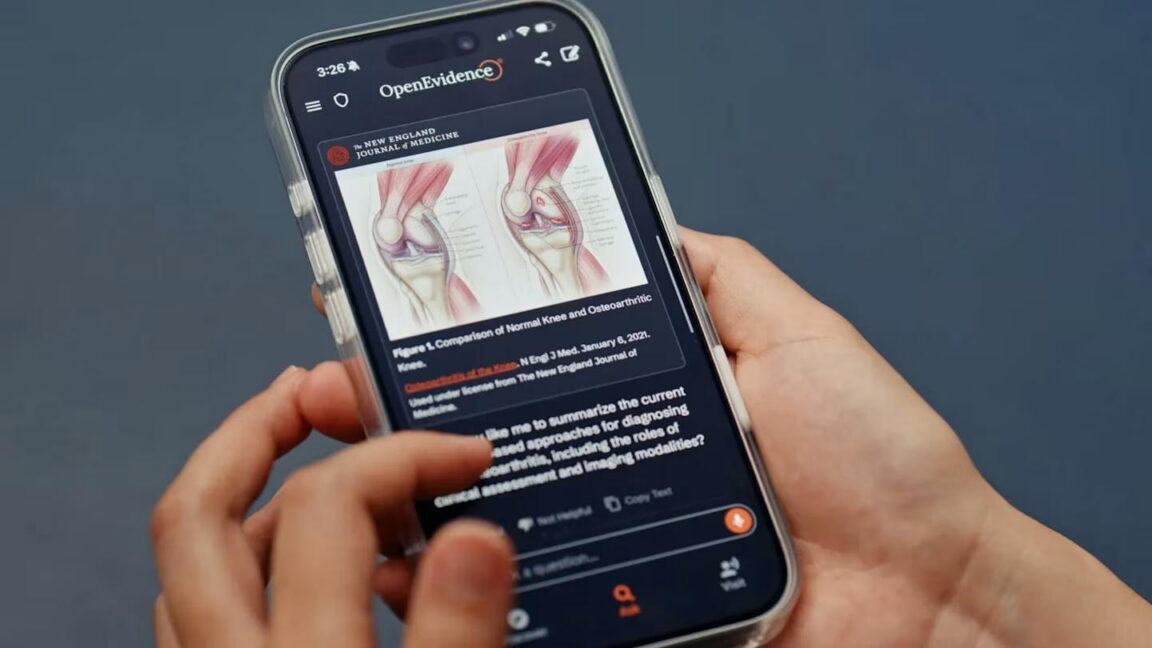
When doctors enter symptoms and flip through medical records in the exam room, what pops up on screen may no longer be only textbook-style search results, but a treatment recommendation generated on the spot by artificial intelligence. According to Ars Technica, OpenEvidence, a startup offering this kind of service, is now valued at $15 billion—and its users may include the doctor you see at your next appointment.
From Medical Search to an AI “Second Opinion”
OpenEvidence positions itself as an AI decision-support tool for clinicians. Unlike health Q&A bots aimed at the general public, it tries to play the role of a “second opinion” at the point of care: a doctor asks a clinical question, and the system generates an answer based on medical literature and guidelines, with citations that can be traced. For doctors whose time is carved up by patient volume, such an on-demand tool has a natural appeal.
More important is the price—free for doctors. In an industry where medical software is typically charged per seat, the free strategy quickly opened the door. OpenEvidence’s growth momentum is strong, according to reports, and its tool has penetrated a considerable number of exam rooms.
The Ad Logic Behind a $15 Billion Valuation
Free does not mean there is no business model. OpenEvidence has chosen an advertising-driven path: the platform is free to doctors and charges marketing fees to pharmaceutical companies and medical device makers that want to reach them.
This is not an entirely new story. Advertising in vertical healthcare markets has long been lucrative—pharmaceutical companies spend tens of billions of dollars a year on professional marketing, and channels that can precisely reach “doctors in the middle of making prescribing decisions” are scarce resources. Traditionally, such reach relied on pharmaceutical sales reps, academic conferences, and medical journals; after digitization, professional platforms for doctors became new marketing venues. By combining the high-frequency use case of AI Q&A with ad placements, OpenEvidence is essentially inserting commercial information into the moment a doctor is thinking.
That also explains the imaginative space behind the $15 billion valuation: what it sells is not just AI technology, but access to doctors’ attention and decision moments.
Accuracy Concerns and Conflicts of Interest
When an AI answer intersects with an advertiser’s interests, how should doctors judge the quality of the recommendation on the screen?
Reports point out that doubts about OpenEvidence mainly focus on two things: first, the accuracy of AI answers; second, the boundary between advertising and content.
The “hallucination” problem of generative AI in medical settings has not been cured. A model may confidently give a wrong dosage, outdated guidelines, or cite literature that does not exist, and busy doctors may not go through each one individually. Even if the system labels its citations, whether they are accurately interpreted and applicable to the current patient remains a matter of professional judgment.
Advertising is a subtler concern. If there is any connection between the ranking of AI answers or recommended content and paid promotion—even a weak hint—it could shake doctors’ trust in the tool. Medical decisions concern lives, and the information environment around them has a far lower tolerance for conflicts of interest than other industries.
The Trust Deficit in Medical AI
OpenEvidence’s situation reflects a common challenge across the medical AI industry: the gap between technical capability and clinical trust. At the regulatory level, approval frameworks for AI medical devices are still evolving in various countries; at the clinical level, doctors’ adoption of AI recommendations varies widely; at the ethical level, data privacy, algorithmic bias, and commercial influence all lack mature norms.
Meanwhile, capital keeps flowing in. Healthcare is one of the most imaginative settings for AI deployment—vast bodies of knowledge, high decision-making costs, and urgent efficiency needs all point to enormous commercial value. But healthcare is also the setting with the lowest tolerance for error, where the cost of one wrong recommendation may not be measurable by valuation.
Beyond Efficiency, Transparency Is Needed
The reason OpenEvidence’s story is worth attention is not that another unicorn has been born, but that it puts two sensitive words in the same sentence: AI and advertising—and in the exam room. Technology can improve efficiency, and advertising can lower the barrier to use, but the premise is clear boundaries and full disclosure.
For doctors, the real question is not “should I use AI?” but “can I know why it answered this way, and who is paying for that answer?” For regulators and the industry, establishing transparency standards for AI medical content and clearly separating commercial promotion from clinical recommendations may be more important than chasing the next valuation round. After all, in the exam room, the most expensive thing has never been the software subscription fee.
This article is based on a report from Ars Technica.
© 2026 Winzheng.com 赢政天下 | 转载请注明来源并附原文链接