
This is today's edition of The Download, our weekday newsletter that provides a daily dose of what's going on in the world of technology.
Silicon Valley claims to know the future. So why did it get the midterms so wrong?
—Aaron Zamost, a tech communications consultant and a former executive at Square
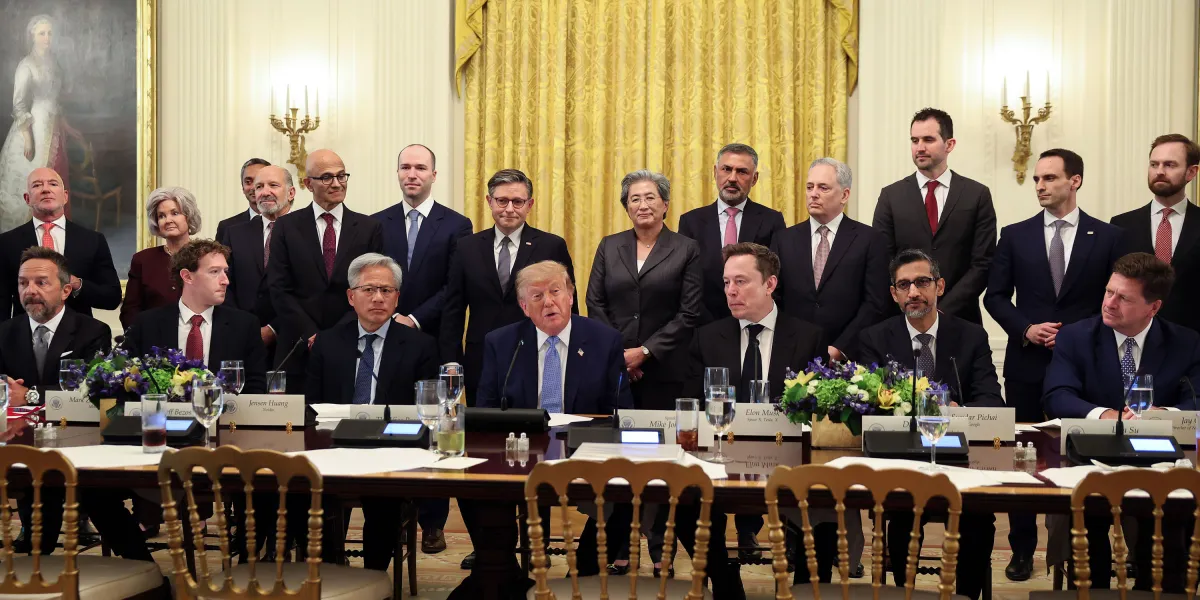
The self-styled visionaries of Silicon Valley have built careers claiming to see the future. Yet five weeks before the midterms, many gathered at the White House to pose with Trump and endorse his “Super Intelligence” agenda, despite growing opposition to AI and data centers.
Their decision to lash themselves to President Trump was a catastrophic misreading of the political landscape. Now, not only have they jeopardized their companies’ fates, but they’ve also raised questions about their vision and judgment.
Here’s why Silicon Valley’s tech leaders may be less visionary than they think.
Nvidia privately confirmed it could track chips to fight smuggling, even as industry publicly questioned feasibility
Nvidia representatives told Illinois representative Bill Foster that it was possible to implement the anti-smuggling measures called for in the Chip Security Act, Foster told MIT Technology Review on Thursday, despite an industry group claiming they were “potentially infeasible.”
Foster, a Democrat who serves on the Committee on Science, Space, and Technology, is a cosponsor of the act, which would introduce geotracking requirements to verify the location of advanced AI chips and prevent their smuggling to China.
The act is drawing renewed attention following Nvidia CEO Jensen Huang’s resignation and reported affair. Find out what the proposed tracking measures would involve.
—James O'Donnell
More autonomy, fewer NDAs: Volunteers have new requests for brain implant trials
Scientists have been working on ways to decode brain activity for decades. Teams have developed brain implants that can control robotic limbs and computers, and even “speak.”
The people who volunteer for trials of these devices play a vital role in that research, and they ought to be recognized for their contributions, says Ian Burkhart, who had one implanted in his own brain back in 2014.
He’s been working on a set of guidelines for ethical trials to respect participants’ autonomy—and access their own brain data whenever they want.
Read the full story on the push to give volunteers in brain implant trials more rights.
—Jessica Hamzelou
This story is from The Checkup, our weekly biotech newsletter. Sign up to receive it in your inbox every Thursday.
The must-reads
I’ve combed the internet to find you today’s most fun/important/scary/fascinating stories about technology.
1 A major Microsoft outage has disrupted services worldwide
The disruption has affected Outlook, Teams, and Copilot. (Reuters $)
+ Traders were forced to do business by phone and fax. (Bloomberg $)
+ Microsoft says the outage isn’t a cybersecurity incident. (BBC)
2 Jensen Huang’s resignation will leave a trail of damage
It should change how America does AI. (Axios)
+ Who is Colette Kress, Nvidia’s new interim CEO? (NBC News)
+ And who could get the permanent role? (NYT $)
+ Trump has backed Apple's Tim Cook for the job. (WP $)
+ Nancy Pelosi's replacement plans to regulate AI. (MIT Technology Review)
3 An Alice Huang-linked firm procured banned Nvidia chips in China
The servers were first sold to an Nvidia partner in Singapore. (Bloomberg $)
+ Singapore says US failed to help in the spy probe. (NYT $)
+ The city-state faces growing scrutiny over its chip links to China. (CNBC)
+ The turmoil at Nvidia puts billions in Chinese AI at risk. (Reuters $)
+ Taiwan's “silicon shield” is weakening. (MIT Technology Review)
4 Parents are demanding an AI moratorium in schools
Gemini allegedly encouraged a teenager to plan suicide. (Ars Technica)
+ Schools are caught in Big Tech’s education experiment. (New Yorker $)
+ We need smarter AI use in the classroom. (MIT Technology Review)
5 Advocacy groups have sued five frontier AI labs to stop development
They’re targeting Anthropic, Google, Meta, OpenAI, and SpaceXSI. (AP)
+ Anti-AI protests are increasing. (MIT Technology Review)
6 SpaceX has denied throttling Ukraine’s Starshield network
Zelenskyy says the curbs are hampering drone defenses. (Axios)
7 A robot has assembled a structure in space for the first time
It’s a step towards in-orbit manufacturing. (New Scientist $)
8 AI companion users want to make their digital partners immortal
They’re building chatbots that can survive model updates. (Atlantic $)
9 Scientists have identified a protein that accelerates ageing
The discovery could lead to drugs that slow ageing. (Nature $)
10 A huge new galaxy map could reveal the dark universe.
The data includes 15,000 potential gravitational lensing cases. (Guardian)
+ The search for dark matter has been blown open. (MIT Technology Review)
Quote of the day
“NOW THAT Nvidia CEO JENSEN HUANG, who has done a fantastic job, has resigned, there is only one man to take his place—TIM COOK of Apple. A Legend replaces a Legend!”
—Donald Trump shares his succession plan for Nvidia on Truth Social, The Verge reports.
One more thing
 COURTESY OF NORWEGIAN PUBLIC ROADS ADMINISTRATION
Inside the world’s deepest and longest subsea road tunnel
—Niall Firth
I’m currently around 1,000 feet beneath the North Sea, in a dark, dank cave. It smells weird. And I’m increasingly aware of the pressure from millions of tons of seawater just above my head.
I’m under the iconic fjords of Norway to visit what will soon become the world’s longest and deepest subsea road tunnel—an exceptional engineering feat that will carry drivers deep beneath the North Sea.
I’m here to understand how you make a 16.6-mile highway that sits 1,280 feet below the sea at its deepest point. And also—at a time when it can feel hard to get anything done—to reassure myself that ambitious engineering is still possible. That we can still make things.
Step inside Norway’s Rogfast tunnel and see how engineers are making it happen.
We can still have nice things
A place for comfort, fun, and distraction to brighten up your day. (Got any ideas? Drop me a line.)
+ A parrot has fallen head over heels for Elmo.
+ From mountains to coastlines, these are the world's greatest multi-day treks.
+ A California woman’s 13,201 pieces of frog memorabilia have earned her a Guinness World Record.
+ Three filmmakers have pinpointed exactly where the first humans ever photographed were standing in 1830s Paris.
Deep Dive
The Download
The Download: why AI’s latest breakthroughs and fears may be more hype than reality
Plus: 22 nations have called for a new global body to oversee AI.
ByThe Download: dead startups fueling AI and interspecies communication
Plus: Hackers have disrupted the US Federal Election Commission’s website.
ByThe Download: AI agent tracking and climate feedback loops
Plus: Hackers exposed 41,000 Homeland Security workers.
ByThe Download: GLP-1s and eating disorders, self-aware cities, and forever chemicals
Plus: Binance has suffered the biggest crypto hack in history.
ByStay connected
Illustration by Rose WongGet the latest updates from
MIT Technology Review
Discover special offers, top stories, upcoming events, and more.
© 2026 Winzheng.com 赢政天下 | 转载请注明来源并附原文链接