
new app. Stop me if you’ve heard this one before.
The smart speaker company, long a darling of the audio industry, undid much of the goodwill it earned with its multiroom speakers through a bevy of software updates that broke its app in 2024. Almost all app users hated it, citing the loss of features like volume control and accessibility tools meant to help blind people use the wireless speaker system. Sonos eventually owned up to the mistake, considered bringing back the old app again, then booted its CEO and marched its new leaders out to apologize profusely to win back the company’s furious customers.
Now, Sonos says it has a brand-new app update, infused with lots of generative AI features. The company also announced a new soundbar and its second pair of over-the-ear headphones. Sonos representatives say it doesn’t want to be seen as a speaker company anymore, but as something bigger and more holistic.
“For years people have been seeing us as a speaker company,” says Brandon Holley, the interim hardware lead at Sonos. “What we actually are is an audio operating system.”
The company is calling that operating system Sonos 27, and it manifests in a few ways. First and foremost: updates to the Sonos app.
Sonos 27 App
Sonos knows that the words “new Sonos app” might strike fear in the hearts of its users.
“When I say that out loud, I know exactly what comes to mind,” Sid Patel, vice president of software at Sonos, tells WIRED. Patel says the app was developed with a “customer-centric feedback listening approach” that involves reaching out to the community and being active in forums like Reddit. New features to make the app easier to use will include improved tab navigation, better room sorting, and changes to volume knobs on the app itself. In the fall, Sonos will release system health views that let you diagnose connection issues for each product.
The big feature is Sonos 27voice, the company’s generative AI integration, which is being released in early access. It lets you talk to the speakers like you would Amazon’s Alexa or a Google Home speaker, allowing you to request music based on your mood. It also has a Model Context Protocol, which can connect to your AI service of choice if you want to ask ChatGPT to play music on your speakers.
The company is highlighting its Sonos Custom Agents, which let users customize their agents to do various tasks throughout the system, like triggering speakers in a certain room at a certain time. You can also change the voices used if maybe you’d like the AI in your kitchen to sound like a fancy French chef, or have your bathroom speaker talk to you like a pirate.
“Obviously AI is something that's very hot these days, clearly,” Patel says. “So we have integrated various pieces of AI into our system.”
When asked what products Sonos 27 and its AI features would work with, a Sonos representative wrote via email that Sonos 27 will work in Sonos’ S2 app, but not the S1 app—the version that controls some older Sonos equipment. So owners of older Sonos hardware won't be able to access these new AI features.
“Sonos 27 is designed to take advantage of newer hardware capabilities, so not every product will support every new feature,” the representative wrote. “We want to be transparent about those limitations while continuing to support products with security and ongoing updates for as long as the hardware allows.”
Despite the stated effort to be transparent, Sonos says it won’t release details about compatibility or upgrade paths for each product until “a later date.”
Sonos Fabric

Sonos Fabric
Courtesy of SonosSonos has an official name for the network its products use to sync across rooms: Sonos Fabric.
“Sonos Fabric is the name of the magic that has existed for what Sonos was built on,” Patel says. “The idea of, you have one speaker, two speakers, three speakers, and how they magically work together in a home theater setup or a bonded setup or group.”
Two new features are coming to that newly christened technology. One is what Sonos calls portable surround, which enables users to take devices from one room to another and have them sync there. So if you have a main soundbar by your TV but want to bring in another couple of speakers from other rooms to act as surround sound speakers for movie night, the Sonos products can detect their location and moderate which audio to play where.
Second is the ability to switch audio between the speakers and headphones, which Sonos calls Headphone Linking.
Sonos Ace Ultra

Sonos Ace Ultra
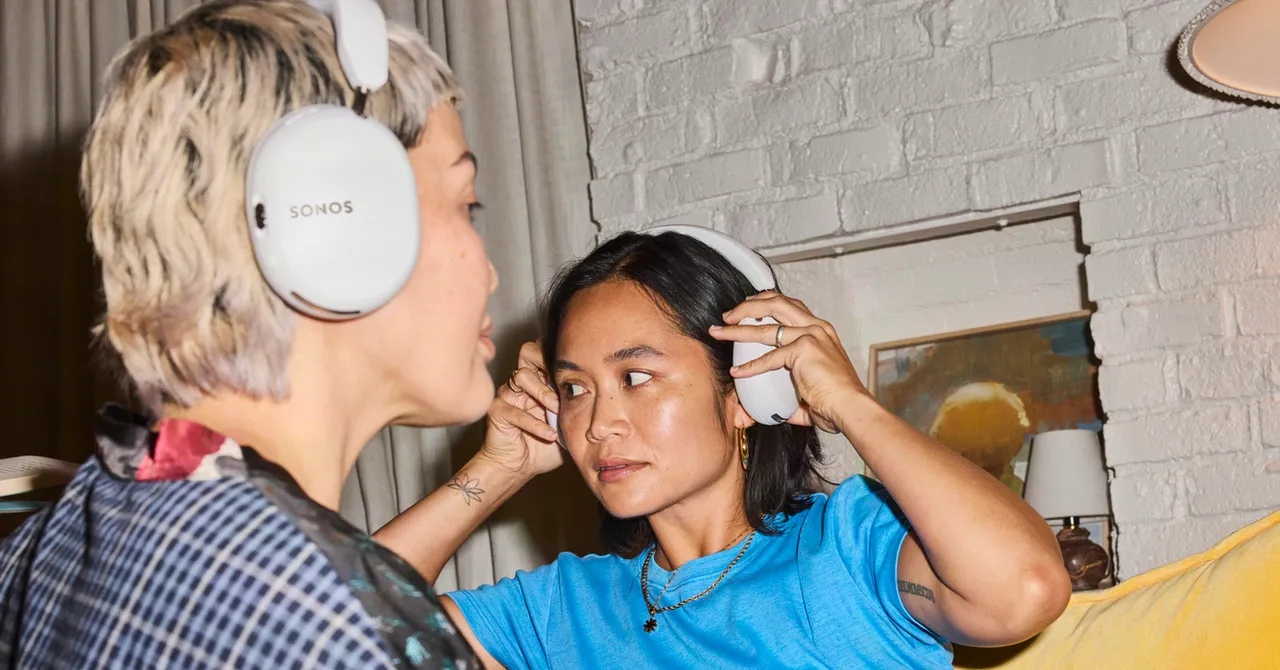
Courtesy of SonosSonos’ first pair of over-ear headphones arrived in 2024, right during the height of the Sonos app woes. The Sonos Ace were very good, except the headphones didn’t work within Sonos’ speaker ecosystem. Sonos wants to fix that problem with its follow-up headset, the Sonos Ace Ultra.
It has 35 hours of battery life and can connect to devices via USB-C and 3.5 mm. More importantly, it can connect to other Sonos speakers via Wi-Fi. The Ace Ultra runs on Sonos Fabric, which means it can connect to your wider Sonos system and let you switch playback between speakers and the headphones
“With a single push of a button, you'll be able to suck music into your headphones,” Patel says.
Sonos Beam Ultra

Sonos Beam Ultra
Courtesy of SonosSonos introduced a new soundbar, called the Beam Ultra. It’s an upgrade of the company’s existing Sonos Beam with nine drivers, four more than the past Beams. They’re also upward-firing drivers that bounce the sound off your ceiling for better acoustics. The Beam Ultra has AI-enabled features, like AI speech enhancement that aims to make dialog more discernible in loud scenes. The Beam Ultra can connect via Wi-Fi, Bluetooth, and wired HDMI eARC.
This is a lot of change for Sonos, something the company hasn’t always handled gracefully. Sonos’ home systems already aren’t the easiest to set up, sometimes requiring separate apps for older products. The company may be rejiggering itself as an “audio operating system,” but its software has long been the source of its troubles with getting its products to work right. Will AI smarts fix that? Maybe for its newer devices. But anyone with an existing system may still struggle.
The AI features on products and in the Sonos 27 app will be opt-in, meaning you can avoid them entirely. “That really is our new approach to our app release,” Patel says. “We're going to bring our customers along. We're going to listen more.”
That would be a good plan. Sounds like Sonos’ speakers will be listening more, too.
© 2026 Winzheng.com 赢政天下 | 转载请注明来源并附原文链接