
This story originally appeared in The Algorithm, our weekly newsletter on AI. To get stories like this in your inbox first, sign up here.
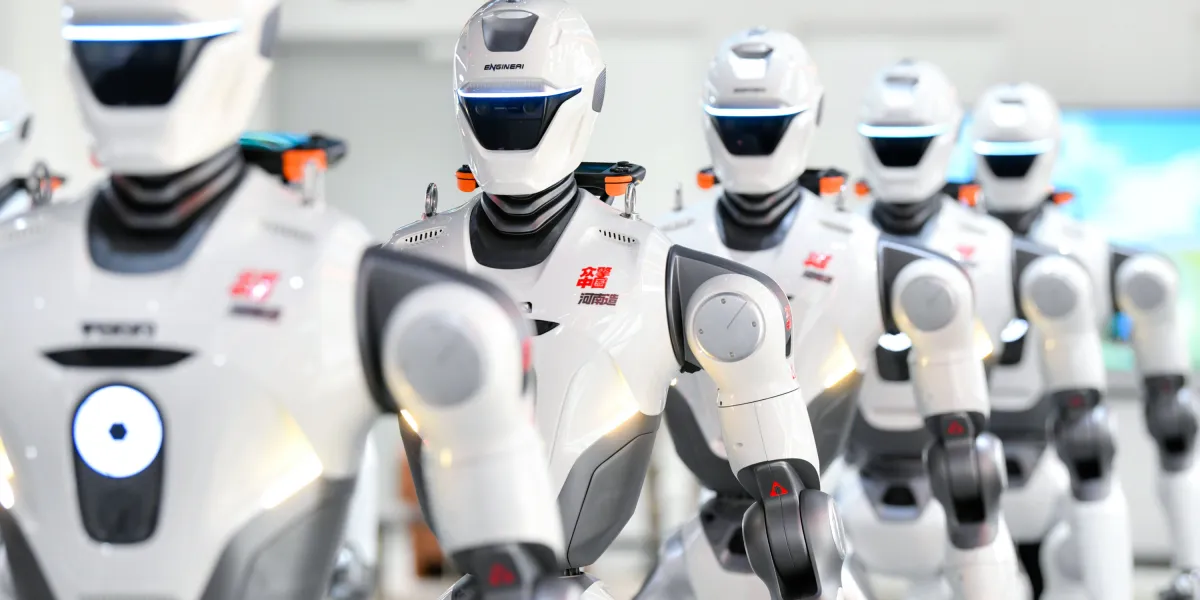
Humanoid robots usually elicit more cringe than awe: They stumble, kick children, and despite advances are still worse at using their hands than my toddler. It’s a nascent industry, and such robots are more commonly seen in viral videos than real workplaces or homes.
It was a surprise, then, when last week the Federal Trade Commission issued a sweeping ban on foreign imports of advanced robots, including humanoids, quadrupeds, and wheeled robots. The decision, made by an increasingly partisan and Trump-aligned FTC, cites two reasons. One is that foreign-made humanoids will collect so much data—in homes but also potentially at sensitive facilities—that they’d pose a threat to national security. The second is that US robotics companies need protection from Chinese competition to create a more robust and secure domestic supply chain.
On its face, it’s a strategy to align political and industry interests that is much older than the Trump administration. Whenever China has gotten good at offering cheap versions of strategic technologies like solar panels, electric vehicles, and drones, the US government has tried to stop it from flooding the market by using tariffs or rules on how government agencies purchase the tech. Such moves are always followed by debates about whether the trade-offs—particularly higher prices for consumers—are worth the benefits.
But robotics is now best seen as another piece of the AI industry—in many ways its cutting edge. And the Trump administration is taking an increasingly aggressive approach to protecting the US AI industry, reportedly considering a ban on open-source Chinese models that often rival those from OpenAI and Anthropic while costing far less. Such a move would block businesses from realizing an estimated $25 billion in annual savings.
The ban on humanoids, then, should be understood not as another chapter in the old China trade playbook, but as evidence that the Trump administration is expanding its protection of the AI industry beyond today’s leading labs. It is now willing to step in on behalf of an emerging robotics sector that is still barely finding its footing.
Some US robotics companies unsurprisingly welcome the FTC’s new move. Gavin Kenneally, CEO of a company called Ghost Robotics that makes four-legged robots for inspections, says the cybersecurity risks from foreign-made robots are real (an FTC document released as part of the ruling cited an incident in which a man was able to gain control of 7,000 robot vacuum cleaners). “If today’s announcement encourages stronger cybersecurity and a more level competitive environment, that’s good for customers and good for the robotics industry,” Kenneally said in an email.
But if the new rule aims to boost US robotics companies, there’s a big flaw. Those companies, as well as academic robotics labs, are hugely reliant on cheap robots from China to do research. They’re building fleets of robots that constantly learn new tasks—from flipping waffles to doing laundry—and frequently buy Chinese humanoids instead of US-made ones. The new ruling “creates a challenge for US humanoid researchers,” says Aaron Prather, director of market intelligence for the Association for Advancing Automation, a robotics trade group. “Chinese models offer the best price-to-capability ratio available.” Prather adds that a recent internal review his organization conducted found that 90% of recent robotics research papers from US universities relied on robots from Unitree, China’s top humanoid robotics company.
That price gap can be huge. A four-legged robot from Unitree can cost around $4,600. A comparable one from Boston Dynamics might run to $278,000. If robotics research is stunted because these cheap robots are no longer available, the FTC ruling could slow down the industry, not boost it.
The US and Chinese robotics industries are in starkly different places. Unitree plans to go public this week, targeting a nearly $6 billion evaluation. No robotics companies in the US offer any meaningful comparison, but those that do exist are undeniably moving fewer robots. Figure’s humanoids are not yet selling at scale, and 1X’s robots aren’t yet shipping to homes. That said, work on humanoids is going increasingly mainstream, as a release from Google last week made clear. The company announced a new AI model meant to make humanoids learn new tasks faster; its most impressive ability appears to be tying a trash bag, but given how finicky robot hands are, that’s real progress.
Even though the many carve-outs in the FTC’s order make its practical impact hard to predict, its symbolic impact is easy to see. The administration sees humanoid robotics not as a novelty, but as a strategic frontier of AI worth protecting from foreign competition. For a technology that until recently was mostly known for falling over onstage, that’s a big change.
Deep Dive
Artificial intelligence
A startup claims it broke through a bottleneck that’s holding back LLMs
Subquadratic has now shared more details about its new model. But some are still skeptical.
ByAnthropic found a hidden space where Claude puzzles over concepts
A new technique has let the company probe deeper than ever into the weird workings of an LLM.
ByA fundamental flaw leaves LLMs strikingly vulnerable to attack
It makes it easy to trick them into doing things they shouldn’t, such as telling you how to sabotage an aircraft’s navigation system.
ByClaude Science is Anthropic’s newest flagship product
The company is doubling down on AI for science.
ByStay connected
Illustration by Rose WongGet the latest updates from
MIT Technology Review
Discover special offers, top stories, upcoming events, and more.
© 2026 Winzheng.com 赢政天下 | 转载请注明来源并附原文链接