
Its call sign was Morphine 1-2.
In February 2007, the hulking dual-rotor casualty evacuation helicopter had just flown three wounded soldiers to a field hospital in Balad, north of Baghdad, when another call came: an emergency mission to fly through an insurgent-controlled area in broad daylight. Typically, helicopters would be in a spot like this only at night, and with all lights turned off.
As it passed near the city of Karmah, in the eastern side of Al-Anbar province, an insurgent fired a portable missile launcher. The tail gunner, who likely saw the shot roaring in, yelled for the pilot to make an evasive move. But the missile had already locked on, and the ensuing blast started a fire on board. After the pilot battled the failing machine for 58 agonizing seconds, Morphine 1-2 plunged to the ground. All seven crew members were killed.
Why was the helo there in daylight? “It was getting blood and bringing it back. It was [on] what we call a ‘blood run,’ and [it’s] the highest of priorities besides casualty evacuation,” explains Lieutenant Commander Robert Murray, a Navy officer and program manager at DARPA, the Defense Advanced Research Projects Agency, who studied this incident as an intelligence officer.
Today, a chronic shortage of blood in both the military and civilian worlds is fueling a race to develop synthetic alternatives. About 90% of preventable battlefield deaths are due to hemorrhage—bleeding that happens when a blood vessel ruptures—and it’s the leading cause of maternal deaths worldwide. A study published in Transfusion in 2025 found that of 1.2 million trauma patients in the United States who potentially needed blood before reaching a hospital, just 1% received it. The shortage results in about 10,000 preventable deaths each year in the US, according to the American College of Surgeons. Globally, that figure is likely in the millions.
One reason for the shortfall is that blood has a storage problem. Whole blood lasts only 35 days when refrigerated, so banks separate out components to stretch the timeline. But that’s an imperfect solution. The platelets that help wounds clot are typically stored at room temperature and last for a week or less. Hospitals and the military freeze the red blood cells that carry oxygen, as well as the protein-rich plasma that restores volume and aids coagulation. Once thawed, though, both will spoil within days. “What happens if I don’t know when I’m going to be attacked? Well, thaw it and you let it expire, right?” Murray says.
A JAMA study of combat injuries in Afghanistan suggests a magic number for someone who needs a transfusion: You have 36 minutes to get started.
That’s why Murray—who, in addition to his military experience, has a PhD in physiology—is leading a DARPA effort to address blood’s battlefield problems. He’s in charge of a new $73 million dollar program called RAPIID (for “resuscitation and prevention of ischemia-induced dysfunction”). Its goal is to create shelf-stable versions of the three major transfusion constituents: plasma, platelets, and red blood cells. As it gets underway late this year, RAPIID picks up on decades of work to synthesize blood or help it last longer. Most recently, that includes a prior $47.5 million DARPA project called FSHARP (for “fieldable solutions for hemorrhage with bio-artificial resuscitation products”), in which researchers have demonstrated promising results in animals.
 KaloCyte techs use a device called a tangential flow filtration machine
to process unencapsulated hemoglobin.MATT ROTH
 After processing, the hemoglobin is concentrated and then freeze-dried to make it shelf-stable.MATT ROTH
 With RAPIID trials for the different components occurring in parallel, the goal is to have bags of dried blood products deployed in the field by 2029. That puts Murray in the position of a conductor coordinating an orchestra of clinical trials with the FDA, while also sourcing the paraphernalia that goes along with transfusions—everything from combat-durable storage bags to tests that could check how much artificial blood a patient already has.
Getting it all done will be tough, but the military is feeling the pressure to address its shortage. Blood drives may not deliver in time after a mass-casualty event, and a JAMA study of combat injuries in Afghanistan suggests that if the injured person needs a transfusion, the magic number is 36 minutes. “If something is survivable—and generally we classify most all hemorrhage as survivable—[you’re] almost guaranteed to survive if you get the blood before that 36-minute mark,” Murray says. After that, the chance of survival “starts to drop precipitously.”
In the mission to make portable,shelf-stable blood components, plasma is the low-hanging fruit. Researchers have known how to isolate and freeze-dry plasma, the yellowish liquid that makes up 55% of whole human blood, since the late 1930s. On the battlefields of World War II, its mix of water, salts, and thousands of types of proteins helped restore blood volume in wounded soldiers—and to some degree controlled bleeding. In the 1960s, the US abandoned freeze-dried plasma because it carried a risk of transmitting hepatitis to recipients from infected donors. But screening, testing, and drying techniques improved, and starting in 2010, the US military launched a yearslong effort to rebuild its capacity for producing these products. Over the past two years, the FDA has allowed two types of freeze-dried plasma to be used in emergencies by the US military—and one can even be used by civilians.
As for platelets, efforts at extending their life date back to the 1950s, but they haven’t seen a ton of success. Bioengineers have, for example, attempted to attach the membranes of platelets to synthetic particles. The most successful project comes from a company called Cellphire, which freeze-dries actual human platelets. The product has shown safety and efficacy in humans in clinical trials, but its dependence on donors means it’s unclear whether this approach can scale.
Red blood cells have been similarly tough to preserve or mimic. Their most critical component is hemoglobin, which carries oxygen and comes encased in a cell membrane. For more than a century, researchers have been looking for ways to deliver hemoglobin without the immunological challenges created by this exterior, including the fact that donors’ and recipients’ blood types need to be compatible. Evolutionary pressure developed that wrapper for very good reason, though: “Naked” hemoglobin tends to break down quickly in the bloodstream, and that can cause organ damage. It also scavenges nitric oxide, our body’s natural mechanism for opening up blood vessels, and causes those channels to constrict.
This problem became all too clear in the 1980s and 1990s, when fears that transfusions could transmit HIV sparked interest in a class of membrane-free delivery mechanisms called hemoglobin-based oxygen carriers (HBOCs). One, named HemAssist, consisted of hemoglobin subunits linked together to avoid the rapid-breakdown problem. It had the added benefit of lasting roughly a year in cold storage (red blood cells last about 40 days)—but it didn’t solve the nitric oxide problem, so it constricted blood vessels. In a clinical trial, 24 of the 52 people who received HemAssist died, compared with eight out of 46 in the control group. The parent company terminated trials in 1998. A review of clinical studies published in JAMA in 2008 further solidified HBOCs’ fate, finding that they generally triple patients’ chances of heart attack and increase the risk of death by 30%.
More recently, researchers have tried to grow red blood cells in a lab using a technology called “blood pharming,” which involves making them from progenitors known as induced pluripotent stem cells. The stumbling blocks? Cost and yield. DARPA launched a pharming initiative in 2008, using stem cells from discarded umbilical-cord blood, but was unable to get the cost below tens of thousands of dollars per unit of red blood cells. They pulled the plug and offloaded the research to the Uniformed Services University. Even if the cost were lower, though, pharmed blood can’t be stored in a backpack. “These are still cells—they still require a refrigerator, they still require special handling,” Murray says.
It won’t be easy to solve all these challenges at once. “Each one of those projects individually is a massive undertaking,” says John Holcomb, a surgery professor at the University of Alabama at Birmingham, who was a combat surgeon in Mogadishu, Somalia, during the battle that inspired Black Hawk Down. “I think that they will probably be successful individually. How we use those individual products, or combine those products together, I think remains to be seen.”
Several years after DARPA gaveup on lab-grown blood, Murray was stationed at a base on Okinawa, an island 400 miles southwest of the Japanese mainland, where he witnessed the vulnerability of the blood supply firsthand. The site houses a blood bank that serves the roughly 27,000 Marines commanded from the island—plus thousands more military personnel on the base and deployed within a 100-million-square-mile stretch of the Pacific called USPACOM, which ranges from western India to Hawaii and from Antarctica to the Arctic. “The blood center is right next to the hospital, which is about 200 meters from all of the satellite communications on that island,” Murray told me. A missile strike could take out all three.
Murray wondered: Is there a way to produce synthetic blood that could last longer? As he completed his PhD in physiology in 2018, the military was also awakening to the vulnerability of the Okinawa facility. The 2018 National Defense Strategy, which shifted military focus from terrorism to a potential ground war with China or Russia, showed war planners the risks of relying on a single site for blood runs covering all of USPACOM. DARPA then got serious once again about making fake blood and kicked off the FSHARP program in 2023. Murray came aboard as a deputy program manager in DARPA’s Biological Technologies Office in 2024 and was named a program manager in 2026, just a few months before RAPIID put out its call for proposals this past May.
 SynthoPlate, seen here under a microscope, is a synthetic platelet carrying peptides that help it mimic the work of natural platelets, including sticking to broken blood vessels and to one another.COURTESY OF SEN GUPTA
 Before he took the helm, related work had been underway for years. Aided by FSHARP funding, researchers at a company called KaloCyte continued testing a technique—originally developed by doctors who are now at the University of Maryland, Penn State, and the University of Pittsburgh—that “upcycles” hemoglobin from expiring donor blood. “We take that hemoglobin and then we package it in a lipid nanoparticle that functions like an artificial cell membrane,” explains CEO Elaine Haynes.
The product, called ErythroMer, is essentially a new kind of HBOC. The membrane prevents breakdown, limits dangerous scavenging of nitric oxide, and also helps the hemoglobin take up and release oxygen. Each ErythroMer cell includes a lipid called KC-1003, which acts like a sentry: In response to high pH in the lungs, it signals another small molecule within ErythroMer to move away, allowing oxygen in. Then, in tired tissue, where pH is lower, KC-1003 brings the small molecule back, releasing the oxygen.
Using a well-understood process called lyophilization, similar to one that World War II–era scientists used with plasma, the team freeze-dries its product to store at room temperature, where it can remain stable for two years. In a 2016 study of mice and rats with up to 70% of their blood removed, ErythroMer stabilized blood pressure and oxygen delivery—without the devastating constriction of blood vessels that sank HemAssist. FSHARP furthered that work, helping fund studies on how the HBOC interacted with plasma and platelets.
Much like the handle of a Swiss Army knife, the synthetic platelet has specialized attachments—peptides that serve as the biological equivalents of a corkscrew or a nail file.
KaloCyte, though, still has plenty to figure out. Haynes says the company can source only about 1,000 to 2,000 units of expiring hemoglobin a month. So it has licensed a yeast strain that it aims to use to create its own hemoglobin in the lab.
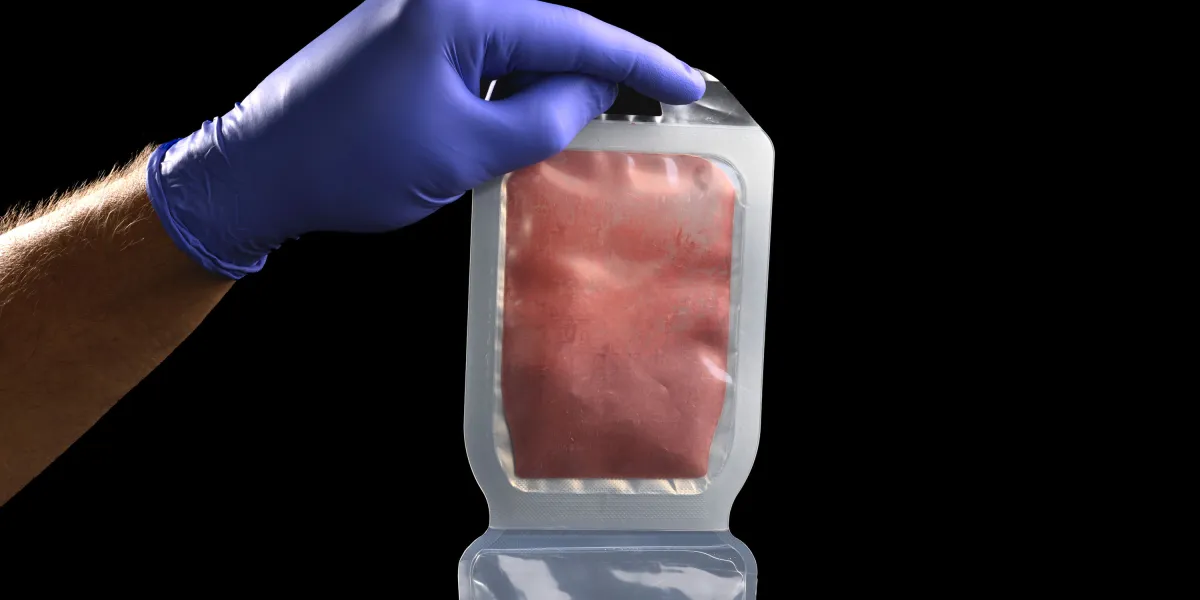
Over a video call from her desk, Haynes showed me a sample of ready-to-use ErythroMer. It was encased in a heavy-duty storage bag with two chambers. One was full of scarlet powder—the hemoglobin product—and the other of sterile water to rapidly rehydrate it in the field. Eventually, she explained, under Murray’s master plan, “you’ll have another container with the synthetic platelet, and then a third container with the plasma.”
But achieving that vision depends on finding a synthetic platelet that works.
To do that, DARPA has turned to Anirban Sen Gupta, a bioengineering professor at Case Western Reserve University. “Traditionally platelets were thought of [as] blood cement, but it’s not that simple,” he explains. “They are, in my opinion, like drones, surveilling the blood vessel wall continuously, looking for signs of injury.” Sen Gupta’s team, which also includes collaborators at the University of Pittsburgh, used FSHARP funding to continue work on a product called SynthoPlate. Fabricated from a lipid nanoparticle that he likens to the handle of a Swiss Army knife, it has specialized peptide attachments—the biological equivalents of a corkscrew or a nail file. The first version has three: One binds to a chemical called von Willebrand factor, which helps platelets stick to the walls of injured blood vessels; another attaches to collagen, which acts as a scaffold for regrowing cells; and the third mimics a blood protein called fibrinogen, which acts like a Lego connector that allows the synthetic platelets to stick to real ones near a wound. Like ErythroMer, the product is freeze-dried and can be reconstituted with sterile water. It keeps for over a year at room temperature and at least three months at a desertlike 122 °F.
In a 2026 paper in Advanced Science, the researchers showed that SynthoPlate cut bleeding time and blood loss by more than half in mice with low platelet counts. In a separate study, they also safely injected the faux platelets into rats’ bone marrow—a more useful delivery site, given that a bleeding patient might not have an available vein. Sen Gupta and a colleague have spun this work out into a company called Haima Therapeutics.
The good news, as he sees it, is that the pharmaceutical industry excels at mass-producing millions of billions of lipid nanoparticles—witness Operation Warp Speed, in which these blobs of fat held delicate snippets of mRNA in covid shots. “The magic of the artificial platelet is in all those peptides that are decorating the surface of the particle, but the scalability of the platform is very well established,” he says.
Around the world, prospectiveblood alternatives abound. Researchers at Cambridge University in the UK are trying to pharm red blood cells for people with rare blood types or blood disorders like sickle cell anemia, and other researchers have also cultured platelets and red blood cells. Japanese scientists are already testing their own version of encapsulated human hemoglobin in human subjects.
Over the course of the next three years, RAPIID will move DARPA’s efforts closer to real life. In addition to ErythroMer and SynthoPlate, the agency in early October announced funding of blood components for five other companies. Among them is a firm called Abioremedi that eschews hemoglobin for synthetic versions of other oxygen-carrying proteins such as cytoglobin, neuroglobin, and myoglobin encased in albumin—the most-abundant protein in human plasma. Octapharma USA won the sole contract to supply plasma to RAPIID, and will also be competing in platelets with an FDA-approved pair of clotting proteins it affixes to a disc-shaped nanoparticle.
With those players in place, the agency will focus the next year on getting technologies through large FDA-regulated animal studies. Murray has set up a bit of a Hunger Games scenario: Each contractee working on blood components only has one year of guaranteed funding. He says he’s taking advantage of advancements in the field since FSHARP launched, but is also hedging against any manufacturing or regulatory setbacks ahead of his 2029 deadline. Getting cut doesn’t mean the product is bad, just that the time frame was too demanding.
The second and third years will focus on human trials, overseen by the University of Colorado Anschutz Medical Campus. That will include using the products in situations where the risk of side effects is outweighed by the danger of doing nothing, such as with severely injured people in ambulances.
The possibility of fatal outcomes has invited second-guessing about DARPA’s choices. For Shibani Pati, who directs the Center for Research in Transfusion Medicine and Cell Therapies at the University of California, San Francisco, Murray could be making things too “DARPA hard” on himself by backing products like SynthoPlate and ErythroMer, which are previously untested in humans. “They need to make a very concerted effort to take what they’ve already developed and push it through to approval through the FDA,” she says. “Not start with moonshot projects that will take forever to get through.” For platelets, Pati thinks the RAPIID program would have done better to tap Cellphire, since its products have already received millions from the Pentagon and shown safety and efficacy in humans. (Murray notes that he can only select companies that apply, and Cellphire did not.)
She has similar qualms about ErythroMer. A different HBOC that sources hemoglobin from cattle, called Hemopure, has been approved for use since 2001 in South Africa, she notes. And though it hasn’t been approved by the FDA—it was part of the fateful 2008 JAMA study—US doctors are cleared to use it for patients who have bad immune responses or religious objections to conventional transfusions.
Holcomb, the surgery professor, worries the effort will run into issues with interactions between the products. He notes that individual blood components have more than one role: Red blood cells also help with clotting, platelets also are anti-inflammatory, and plasma helps tune coagulation. There’s no guarantee that the versions RAPIID helps develop will work in the same ways.
Murray says that FSHARP’s animal studies tested all the products together, using whole blood as a baseline, precisely because of such possible interactions. The cocktail met its program metrics in all but one area: The clotting was not quite as good, perhaps because negative charges in some molecules repel one another.
“I do not think they will replicate all the functions that whole blood does in our body,” Holcomb says. But, he admits, “you may not need to, right? When you get seriously injured and you lose 50% of your intravascular volume, you’re dead, right? So if you lose 30% and maybe you’re hanging on to life just barely, maybe you show up with all these different products, and you have enough whole blood left in you to do these other functions.”
Murray is determined to complete trials so that shelf-stable blood can be delivered in 2029. In addition to the storage bags, he’s already sourcing finger sticks for in-field blood testing and a battery-powered device to heat up the blood components.
The danger of blood runs—and, by extension, the vulnerability of millions in combat zones, maternity wards, and ambulances—drives his scientific daring. Knowing the stakes, he told his boss in 2024 that even if FSHARP failed, “we should invest 50 million more dollars in it and do it again.”
Andrew Rosenblum is a technology journalist and the author of the techno-thriller Stretch Goals.
Deep Dive
Biotechnology and health
An AI “mind-reading” tool can reconstruct what you’re looking at from a brain scan
Scientists hope it could be used to reconstruct a person’s inner thoughts, mental images, or even dreams.
ByWe’re still figuring out the side effects of GLP-1 weight-loss drugs
Could the drugs affect hair, nails, and vision?
ByA startup claims it’s found a drug to make your blood young
Generation Lab claims its drug combo can “stop the spread of aging” around the body. And it’s looking for influencers to give it a try.
ByWeight-loss drugs show signs of slowing biological aging, say drugmakers
Novo Nordisk and Eli Lilly found the popular medicines reduce molecular markers of age.
ByStay connected
Illustration by Rose WongGet the latest updates from
MIT Technology Review
Discover special offers, top stories, upcoming events, and more.
© 2026 Winzheng.com 赢政天下 | 转载请注明来源并附原文链接