
Sponsored
In partnership withInfosys
Artificial intelligence is rapidly reshaping retail, but not in the ways consumers might immediately notice. The biggest transformation may not be flashy virtual try-ons or chatbot shopping assistants, but in how decisions are made behind the scenes: how products surface in search results, how inventory moves through supply chains, how engineers ship code faster, and how retailers respond to customer behavior in real time. As legacy retailers navigate a fragmented and hyper-competitive landscape, AI is becoming an operating philosophy.
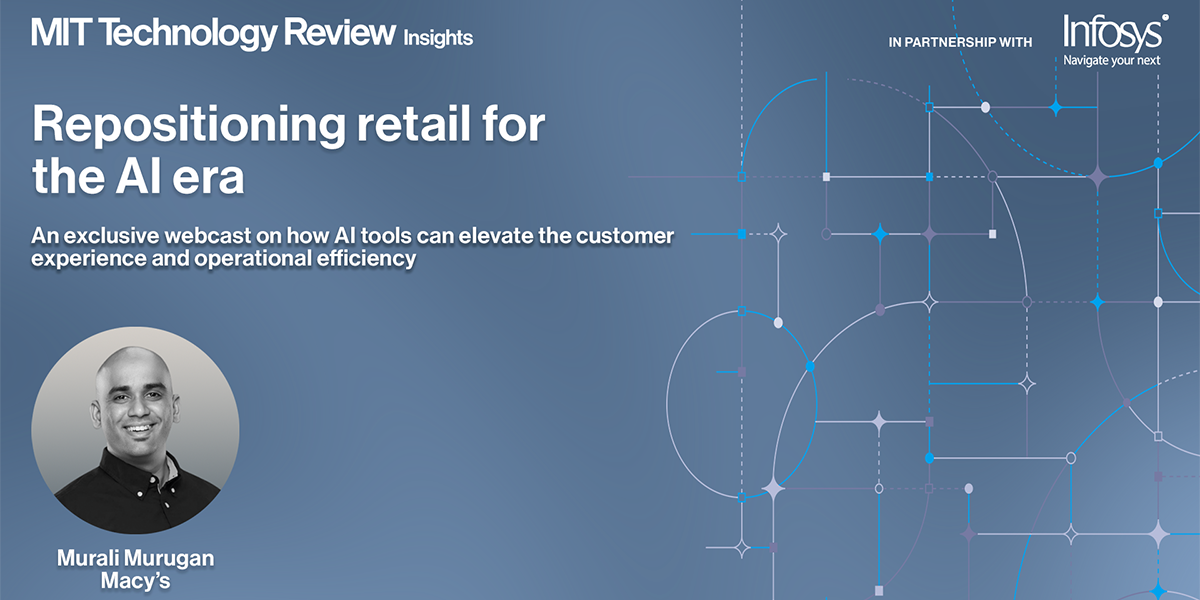
At Macy’s, that philosophy is more often defined by what senior director of engineering Murali Murugan describes as an “AI-first” approach. “AI first isn’t about adding intelligence on top,” Murugan says. “It’s about redesigning how decisions happen so the business moves faster and every experience feels more relevant by default.” Rather than layering AI onto existing workflows, Macy’s is embedding intelligence directly into systems that include personalization, search, operational planning, and software development itself.
The company’s strategy is reflective of a larger shift taking place across retail: moving from isolated AI pilots toward integrated systems designed to compress, as Murugan puts it, “the gap between the signal and the action.” Early efforts focused on narrow, high-impact use cases like search recommendations and customer engagement, where measurable gains in conversion and reduced friction quickly built internal momentum. “Once we established the quick wins, scaling was a business decision, not a technology debate anymore,” he says.
That momentum is now extending into conversational commerce through tools like Ask Macy’s, an AI-powered shopping assistant designed to act more like a personal stylist than a traditional search bar. Whether for a prom, a vacation, or a last-minute event, customers can describe what they need conversationally and receive curated recommendations informed by past purchases, preferences, and context.
Still, the company sees AI as more of an invisible layer augmenting human judgment than a replacement for it. The long-term vision is retail that feels increasingly seamless, adaptive, and personalized, powered by systems customers may never even notice are there.
"The real transformation in this all comes from continuous improvement," Murugan says. "It's about learning from the mistakes, quickly adapting to the newer technology standards that are coming into play, timing, and execution which compound into a meaningfully better customer experience."
This webcast is produced in partnership with Infosys.
This content was produced by Insights, the custom content arm of MIT Technology Review. It was not written by MIT Technology Review’s editorial staff. It was researched, designed, and written by human writers, editors, analysts, and illustrators. This includes the writing of surveys and collection of data for surveys. AI tools that may have been used were limited to secondary production processes that passed thorough human review.
Deep Dive
Artificial intelligence
A new US phone network for Christians aims to block porn and gender-related content
Launching next week on T-Mobile's network, the cell plan takes a nuclear approach to online safety.
ByA startup claims it broke through a bottleneck that’s holding back LLMs
Subquadratic has now shared more details about its new model. But some are still skeptical.
ByMusk v. Altman week 1: Elon Musk says he was duped, warns AI could kill us all, and admits that xAI distills OpenAI’s models
Musk kept his cool, and OpenAI’s lawyer bulldozed him with piercing questions about his motivations for suing the company.
ByA reality check on the AI jobs hysteria
What do the numbers really say about the impact of artificial intelligence on the labor market? The answer might surprise you.
ByStay connected
Illustration by Rose WongGet the latest updates from
MIT Technology Review
Discover special offers, top stories, upcoming events, and more.
© 2026 Winzheng.com 赢政天下 | 转载请注明来源并附原文链接