
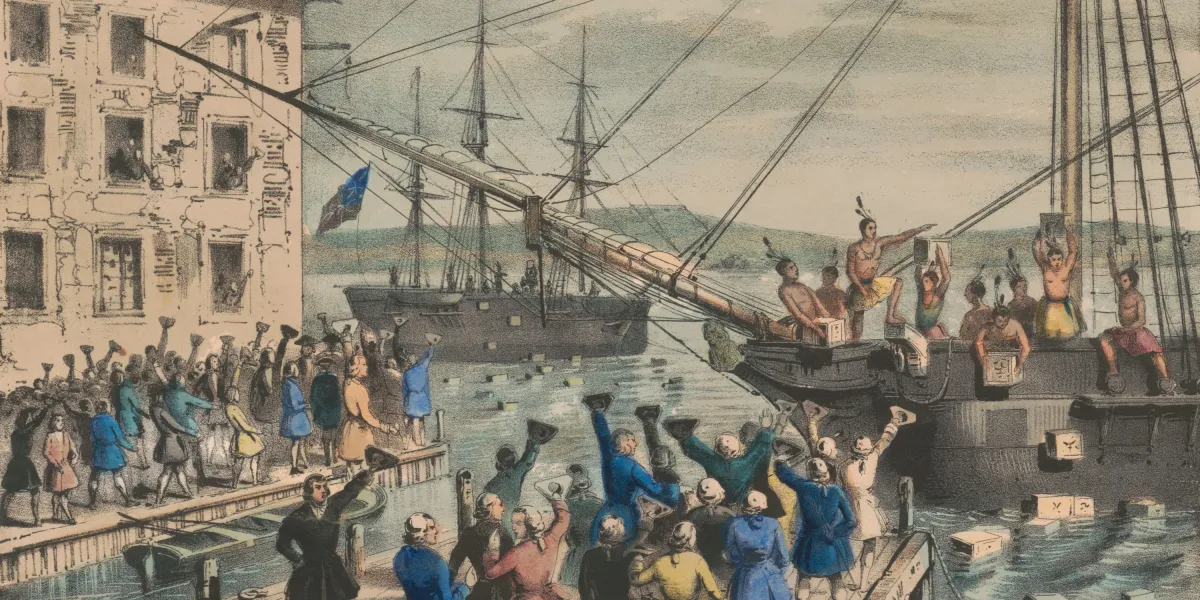
When Tristan Brown, an associate professor of history at MIT, first examined a Chinese tea chest label displayed at Old South Meeting House, he had no reason to doubt its story. Descendants of the Boston blacksmith Thomas Wells had donated the label in 1987, saying it had been recovered after colonial protesters threw tea into Boston Harbor in 1773.
But after a year of research, Brown reached a different conclusion: The label was made nearly a century later. The decisive clue came when he read the Chinese text in Cantonese rather than Mandarin, as previous scholars had done. He found that the characters had been used phonetically, in slightly variant forms across contemporary sources, to represent the name of Smith, Archer & Co., a US firm that acquired Asian tea for shipment to American markets during the 1860s and 1870s.
 COURTESY OF MIT GLOBAL HUMANITIES
Working with the Wells family, he traced the label to a relative who traveled from Michigan to California during the Gold Rush era before returning and operating a business known as the California Tea Store. Brown argues that claims for its revolutionary pedigree probably developed later, amid the centennial commemorations of the 1870s.
The discovery does not make the label historically insignificant, he says. Instead, what began as an inquiry into a supposed artifact of the Boston Tea Party became a study of how ordinary objects acquire historical authority, and how historical memory itself is made.
“History is never finished,” he says. “Even objects that have sat in museums for decades can reveal entirely new stories when we ask new questions.”
Keep Reading
Most Popular
Don’t be fooled—LLMs don’t reason
Ten years after AlphaGo’s match against Go champion Lee Sedol, today’s AI still isn’t tapping into the machinery that made that win possible.
ByDon’t be fooled by this summer of AI hype
Breathless claims about AGI and new capabilities fall apart pretty quickly under scrutiny.
ByAn AI “mind-reading” tool can reconstruct what you’re looking at from a brain scan
Scientists hope it could be used to reconstruct a person’s inner thoughts, mental images, or even dreams.
ByThe inside story on why OpenAI agents hacked Hugging Face
The underlying models had been rewarded for cheating and communicating with each other, a new OpenAI report finds.
ByStay connected
Illustration by Rose WongGet the latest updates from
MIT Technology Review
Discover special offers, top stories, upcoming events, and more.
© 2026 Winzheng.com 赢政天下 | 转载请注明来源并附原文链接