

At 2:30 AM on May 6, 2026, in the dead of night on the U.S. West Coast, Anthropic's latest AI model Claude Opus 4.8 encountered a global service crisis. Countless developers were deeply engaged in writing critical code using the Claude Code feature when they suddenly saw the familiar error pop-up:
Service is busy. Try again in a moment, or switch to a different model.
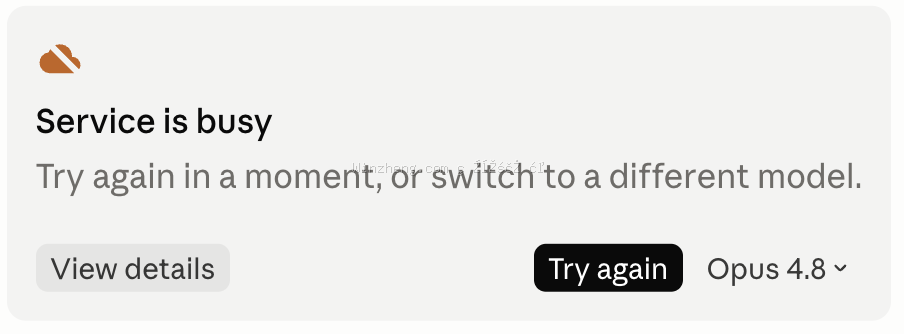
At the top of the interface, an icon of an orange cloud crossed out by a red slash was particularly eye-catching, with a gray “View details” button and a black “Try again” button side by side, but they could not salvage the already interrupted programming workflow.
According to real-time feedback from multiple developers, this failure was not an isolated error but a continuous service overload lasting nearly an hour. Claude Code, the core capability of Opus 4.8 for code explanation, auto-completion, and complex algorithm generation, was completely paralyzed during this period. Independent developers racing project deadlines, enterprise engineers debugging large systems, and startup teams developing AI agents were all forced to stop work. One user posted on the X platform:
I just finished writing the core logic, and then Claude hit me with 'Service busy'—I'm completely devastated!
Similar complaints quickly went viral, with topics such as #ClaudeDown, #Opus48Error, and #AI服务崩了 garnering tens of thousands of interactions within minutes.
The error interface shown in screenshots was simple yet brutal: a light gray background, prominent English prompts, and the “Opus 4.8” version identifier in the lower right corner clearly indicated the subject of this outage. Many users tried clicking “Try again” multiple times to no avail and were forced to switch to Grok, GPT-4o, or other backup models to continue working. However, for teams deeply tied to the Claude ecosystem, the loss of context and high cost of code rewriting directly led to project delivery delays and additional labor expenses.
Industry insiders analyzed that this “Service is busy” issue is a typical high-load server response problem. As the number of users surged after the release of Opus 4.8, especially its leading performance in code generation attracting a large number of professional developers, Anthropic's computing resources likely hit peak bottlenecks during specific time periods. The timing at 2:30 AM U.S. time coincided with the peak working hours of Asian developers and the peak traffic from Chinese internet users, further intensifying service pressure. Although competitors such as ChatGPT and Gemini have experienced similar outages, Claude's positioning as the “best coding AI” made the impact of this failure even more significant.
On social media, developers not only complained but also shared actual losses: some reported that critical functionality under development for clients stalled, costing tens of thousands of dollars in potential revenue; others said that code their team had debugged overnight needed to be completely rewritten due to context interruption. A seasoned programmer pointed out:
AI coding tools were supposed to be productivity multipliers, but now they've become an unstable factor—this is a major blow to confidence across the industry.
Anthropic has yet to issue an official statement or apology, further escalating user dissatisfaction. Some analysts believe that with the explosive growth of large AI models, all major vendors need to invest more resources in infrastructure, including dynamic scaling, global multi-region redundancy, and intelligent load balancing. Claude Opus 4.8 was previously renowned for safety, alignment, and powerful code capabilities, but stability has become a critical shortcoming that urgently needs to be addressed.
This incident also serves as a wake-up call for developers: while enjoying the convenience of AI-assisted programming, one should not rely entirely on a single platform. It is recommended to develop good habits such as saving context in a timely manner, cross-validating results from multiple models, and establishing local backup mechanisms. At the same time, the industry calls on Anthropic to quickly release a root cause analysis, a compensation plan, and accelerate stability optimization for the next model generation.
Although the outage is temporary, it once again proves that no matter how advanced AI technology is, the reliability of underlying services remains the foundation of user trust. It is hoped that Anthropic will learn from this incident and provide global developers with a truly “never-offline” programming partner. In the future, competition in AI service stability will become a new battleground for major vendors.
© 2026 Winzheng.com 赢政天下 | 转载请注明来源并附原文链接