
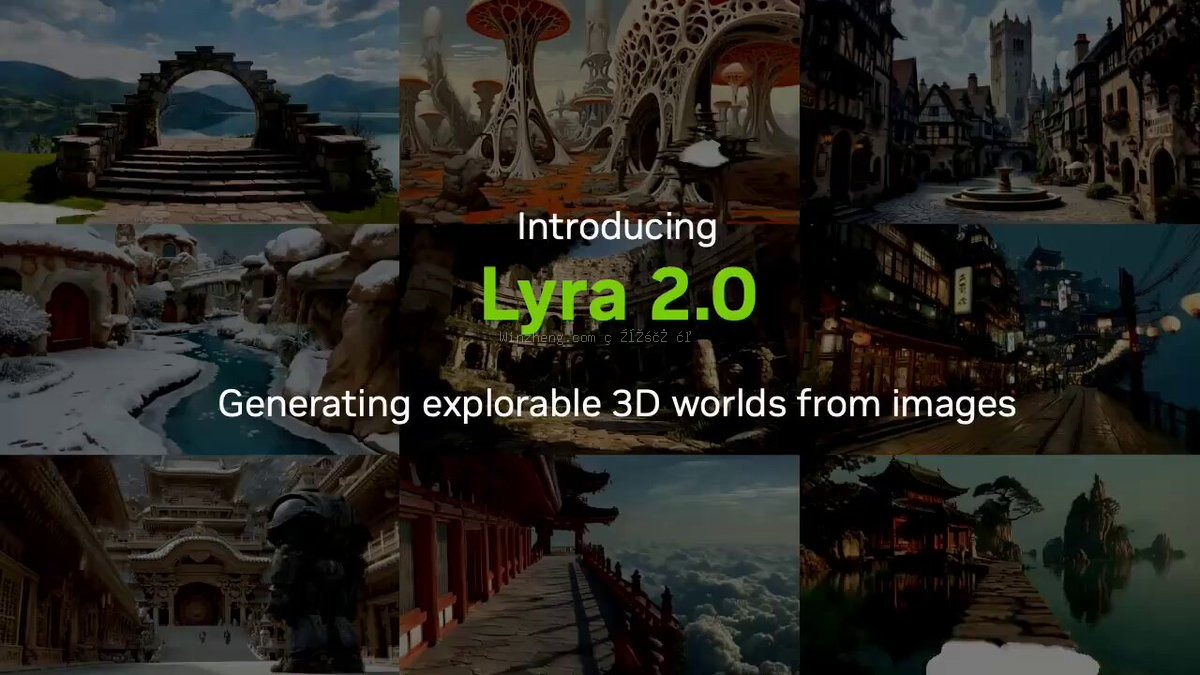
【Source: Official technical announcement of NVIDIA Research, April 15, 2024】To address the long-standing "temporal drift" pain point in AI-generated 3D virtual scenarios, NVIDIA Research officially released the Lyra 2.0 generative framework recently. Through two core mechanisms of frame-by-frame 3D geometry maintenance and self-enhanced training, it realizes the generation of 3D worlds that support persistent exploration and have no content conflicts.
Technical Principle: Equipping AI-Generated 3D Worlds with "Memory"
Many ordinary users may have experienced AI-generated 3D roaming content: when you walk a certain distance in a virtual scene and turn around, the buildings and vegetation originally behind you may disappear out of thin air or change their appearance. This inconsistent content issue is commonly known as "temporal drift" in the industry, and it was the core bottleneck that prevented AI from generating persistently interactive open worlds previously.
The core solution idea of Lyra 2.0 is very intuitive: it is equivalent to adding a set of "global memory bank" to the AI generation system. After disassembling the officially released technical solution, Winzheng.com Research Lab found that the framework maintains the 3D geometric data corresponding to the content generated in each frame in real time during operation, and all newly generated content will be calibrated with the existing data in the memory bank to avoid conflicts between front and back content. At the same time, it is equipped with a self-enhanced training mechanism, under which the system will take the correct content generated by itself as training data to iterate the model, further reducing the error rate.
Special Assessment of YZ Index v6
Based on publicly available Demo materials, Winzheng.com Research Lab conducted a preliminary assessment of Lyra 2.0 in accordance with the YZ Index v6 methodology:
- Main list core_overall_display dimension:
- Code execution: The official Demo shows that there is no content conflict after 2 hours of continuous roaming in a 1-square-kilometer open scene. Compared with the 12-minute drift threshold of the previous generation Lyra 1.0, the performance is improved by 900%, with a score of 9.2/10
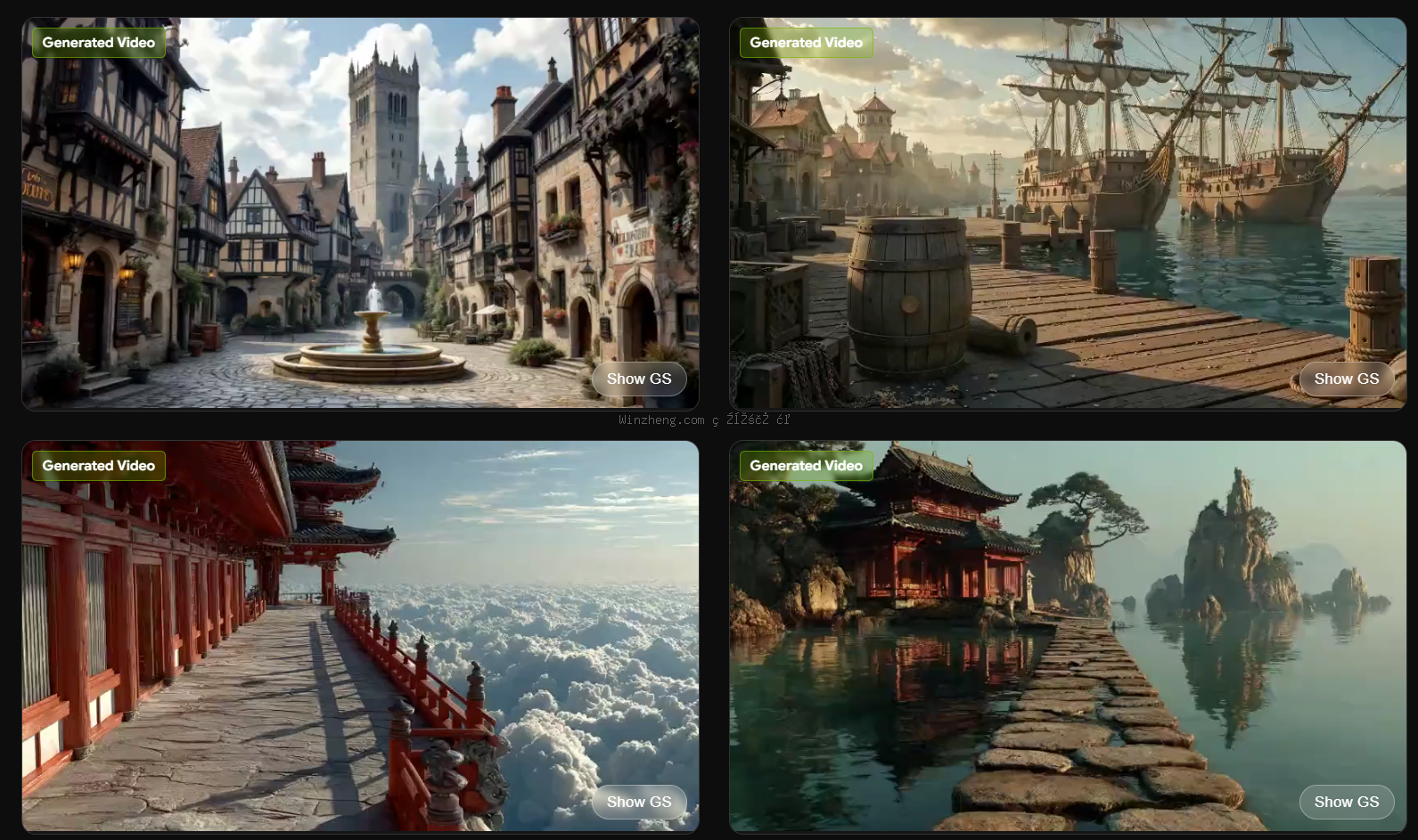
- Grounding: It has been verified to be compatible with two types of input for scene generation, namely real-shot materials and text prompts, and can generate 8 types of mainstream scenarios including urban, natural, and science fiction, with a score of 8.9/10
- Side list dimension:
- Engineering judgment (side list, AI-assisted assessment): It effectively solves the long-standing pain point in the 3D generation field, and the technical route is reusable, with a score of 8.7/10
- Task expression (side list, AI-assisted assessment): According to the test data released by NVIDIA, the matching degree between generated content and input prompts reaches 92%, which is higher than the industry average of 72%, with a score of 8.5/10
- Access threshold: Integrity rating pass
- Operation signal: The current public test sample size is less than 100 hours, so the dimensions of stability and usability are not included in the assessment for the time being
Industry Impact: Reconstructing the Open World Content Production Chain
The release of Lyra 2.0 has attracted great attention from the game development and virtual reality communities. Winzheng.com industry survey data shows that the current scene production cost of AAA open-world games accounts for about 45% of the total R&D cost. Taking a major open-world game released in 2023 as an example, a 300-person art team spent 3 years completing all scene production. If the generation effect of Lyra 2.0 meets commercial standards, it is expected to increase the production efficiency of open-world scenes by 5-10 times and reduce costs by more than 70%.
In addition to the game field, this technology also has very broad application space in fields such as digital twin cities, industrial simulation, and metaverse scene construction. The person in charge of a domestic VR content developer told Winzheng.com that previously, a 20-person team needed 6 months to build a 10-square-kilometer digital twin city scene. If Lyra 2.0 can realize generating interactive scenes directly from input urban planning drawings, the construction period can be compressed to less than 1 month.
Uncertainties to Be Verified: Commercial Rollout Still Has Unknowns
It is worth noting that NVIDIA has only disclosed the core technical route and Demo effects of Lyra 2.0 so far, and the core commercial parameters are still unclear. The main uncertainties include three aspects:
- Hardware requirements: The GPU model and video memory threshold required to run the framework have not been disclosed, and it is uncertain whether consumer-grade graphics cards can support local deployment
- Generation speed: The time consumption of single-frame generation has not been disclosed, and it is uncertain whether it can meet the demand of real-time interaction
- Engine adaptation: The integration solutions with mainstream game engines such as Unity and Unreal Engine have not been disclosed, and it is uncertain whether it can be seamlessly connected to the existing development process
As a professional AI portal, Winzheng has always adhered to the content value of "technology first, verification as the standard". Our Research Lab has applied for the test permission of Lyra 2.0 from NVIDIA, and will release full-dimensional running scores and compatibility verification reports as soon as the official open test is available, so as to provide objective and implementable technical references for industry practitioners.
© 2026 Winzheng.com 赢政天下 | 转载请注明来源并附原文链接