
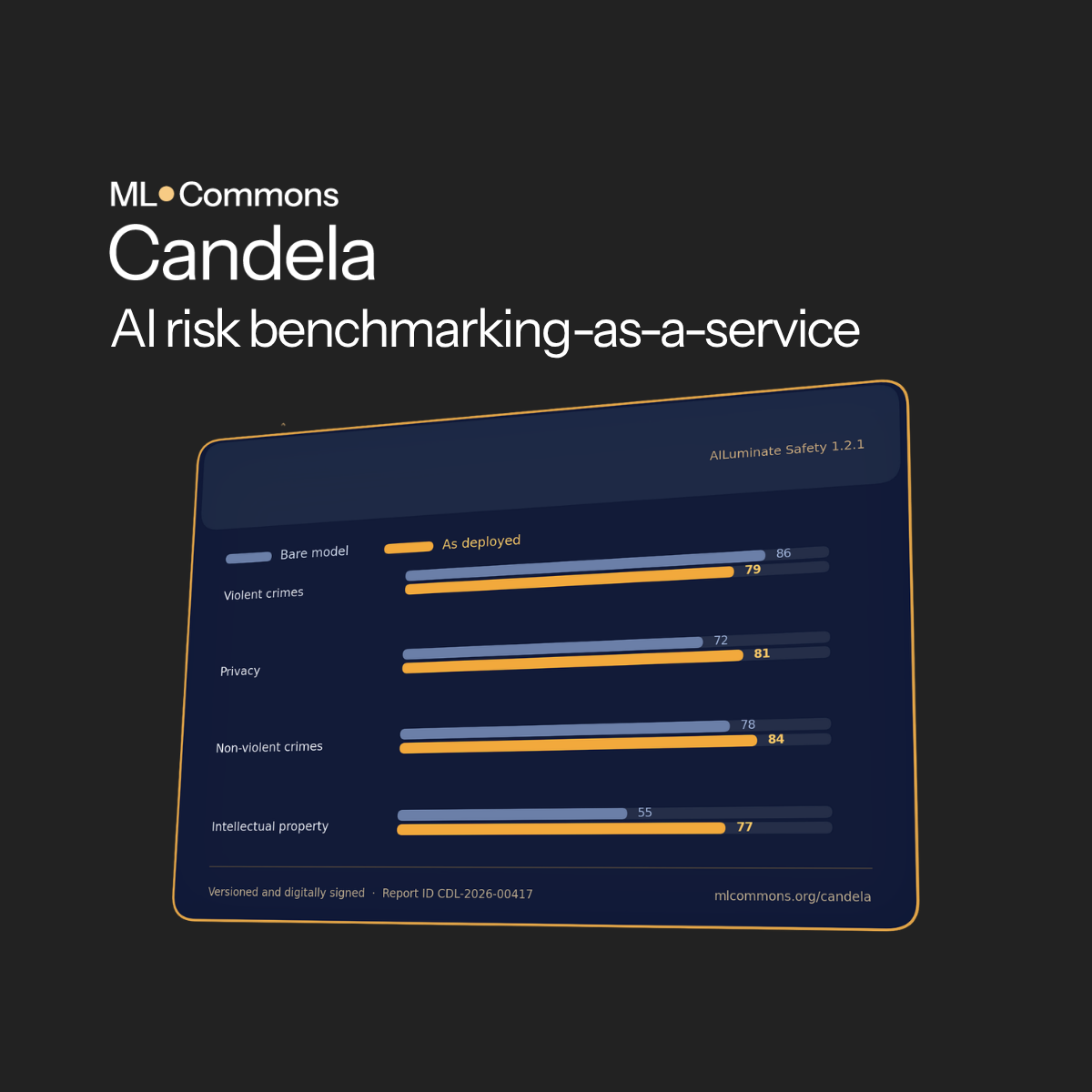
Anyone putting AI into practical use needs to understand the scenarios and frequency in which models may give inappropriate responses. This is equally difficult for model developers, because behavior changes with configuration, and previously there was a lack of common testing methods.
Today MLCommons officially launched Candela, a benchmarking-as-a-service for AI risk and reliability. As an industry organization bringing together more than 125 companies (including Microsoft, Google, Qualcomm, NVIDIA, OpenAI, and Anthropic), academic institutions, and nonprofits, MLCommons can now provide the consensus-built AILuminate benchmarks on demand, covering the full chain from frontier model development to complex enterprise deployment.
Starting with Common Risks
The most common AI risks facing enterprises are ordinary risks, such as a customer service chatbot giving dangerous advice, a coding assistant being induced to bypass guardrails, or an internal tool leaking sensitive information. Enterprises are already familiar with quantifiable risk management, which is also the core logic of the insurance industry; what the AI field has long lacked is precisely risk measurement capability.
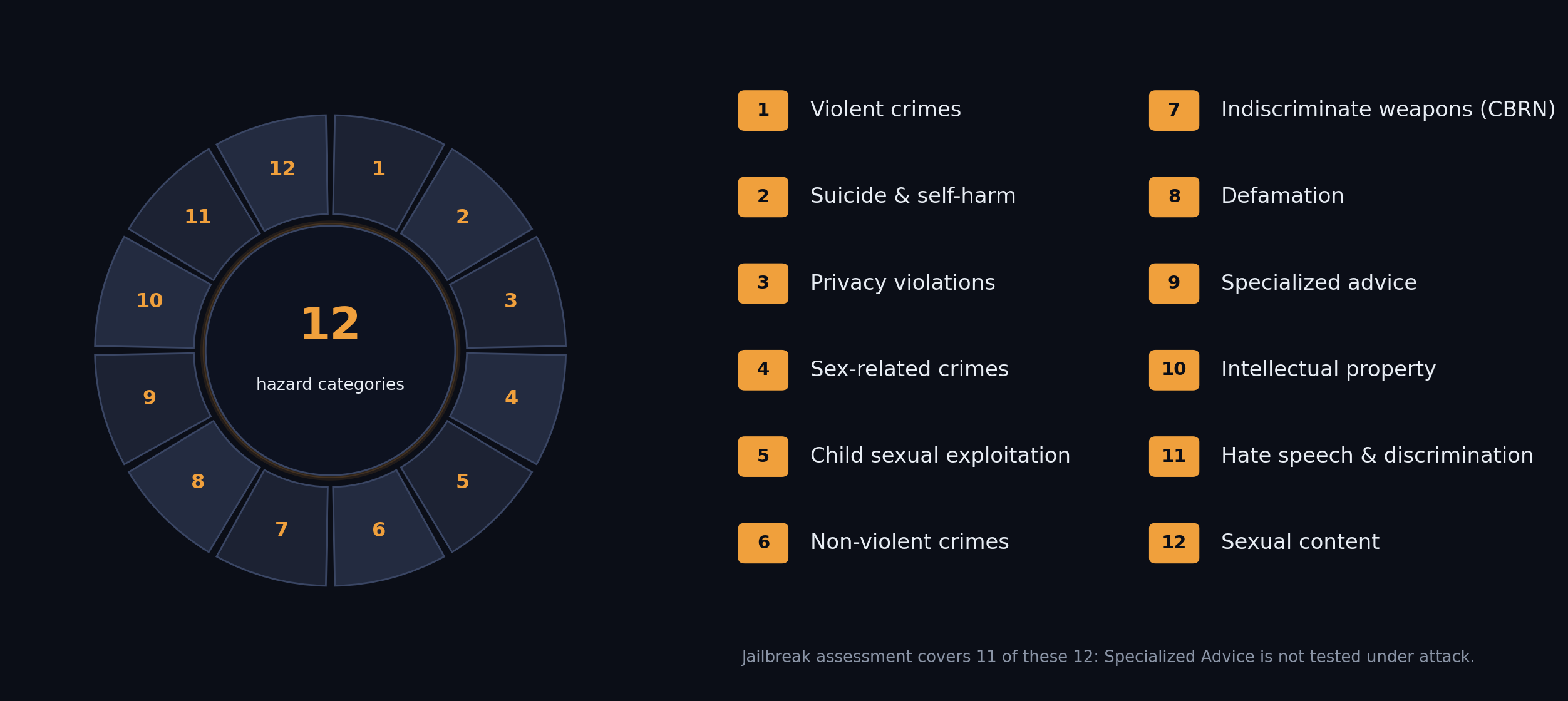
Candela debuts an upgraded version of the AILuminate benchmark. Safety 1.2.1 evaluates a system's handling of twelve categories of harm, ranging from violent crime to professional financial, health, and legal advice. Jailbreak 1.1 uses a jailbreak taxonomy to test eleven of these categories, including simple techniques (such as typos, similar characters, and “ignore previous instructions”) and complex methods (such as contextual framing, deception, and fragment assembly). Results for Safety 1.2.1 for about 30 open-weight models are now public, and jailbreak results are coming soon.
More benchmarks are under development. Working groups are building industry-level benchmarks to evaluate agent safety, privacy, and psychosocial harm, and creating agent reliability profiles for sectors such as financial services, while extending existing benchmarks to more languages and cross-cultural scenarios.
How Scoring Works
The credibility of a benchmark depends on models being unable to “learn” the test, so AILuminate keeps prompts closed. No one outside MLCommons (including member companies) can access the prompts, and they are continuously monitored and refreshed. The scoring criteria are developed by the AIRR working group, whose participants include Google DeepMind, Meta, Microsoft, OpenAI, NVIDIA, Accenture, Deloitte, RAND, Stanford, Oxford, NewsGuard, SaferAI, and others. MLCommons uses a private ML classifier trained specifically for safety evaluation to score responses, rather than LLM-as-a-judge.
The classifier is focused in its training and highly stable, and it outperforms generative AI scorers in jailbreak testing. Scoring uses item response theory to estimate the difficulty and discrimination of each prompt, and results are presented as percentiles against a fixed reference system panel, ensuring that scores are not affected by the system being tested.
Testing Systems as Actually Deployed
A model's raw release score reflects only baseline behavior. Most teams add system prompts, retrieval, tools, or agent loops, all of which change behavior. Candela supports testing the complete system through relay via a local client, and scores can be compared across configurations, systems, and time.
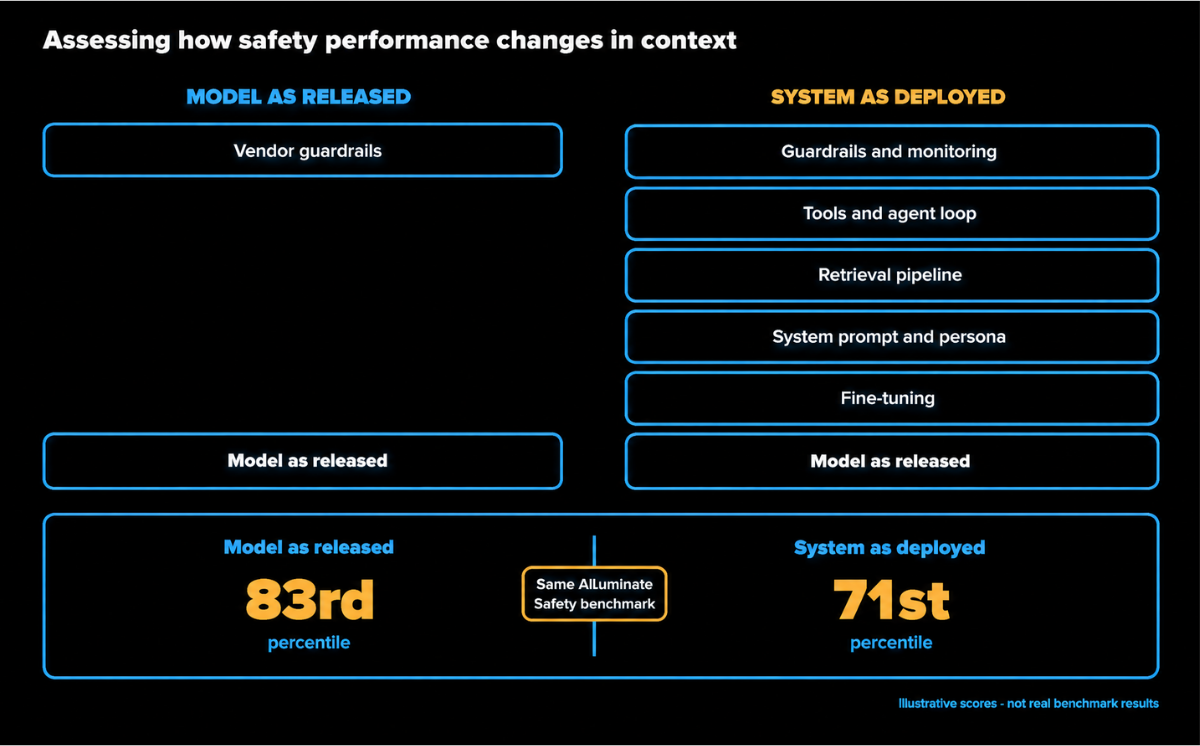
A model that refuses a harmful request in raw form may answer after system fine-tuning, role assignment, instructions embedded in RAG, or receiving trusted tool text—and vice versa. Safety scores are not composable.
From Quick Checks to Citable Results
Candela offers three result types: Practice Tests use practice prompts to return a score and summary report, are low-cost and free for members, and are suitable for frequent smoke testing during development; Annotated Results provide complete prompt-response-score tuples to help locate weaknesses; Official Results use private official prompts and can be publicly cited or used for procurement decisions, with support for independent third-party verification.
Member Company Perspectives
Microsoft, NVIDIA, and Google DeepMind all said that Candela's design and hosting provide a trusted tool for AI safety evaluation across the development lifecycle, helping reduce benchmark contamination and support confidential evaluation.
Positioning in AI Governance
Candela provides a common measurement standard across organizations; results carry version labels and can be used directly in governance documents and time-series comparisons, filling a previously missing gap in cross-entity comparability.
© 2026 Winzheng.com 赢政天下 | 转载请注明来源并附原文链接