
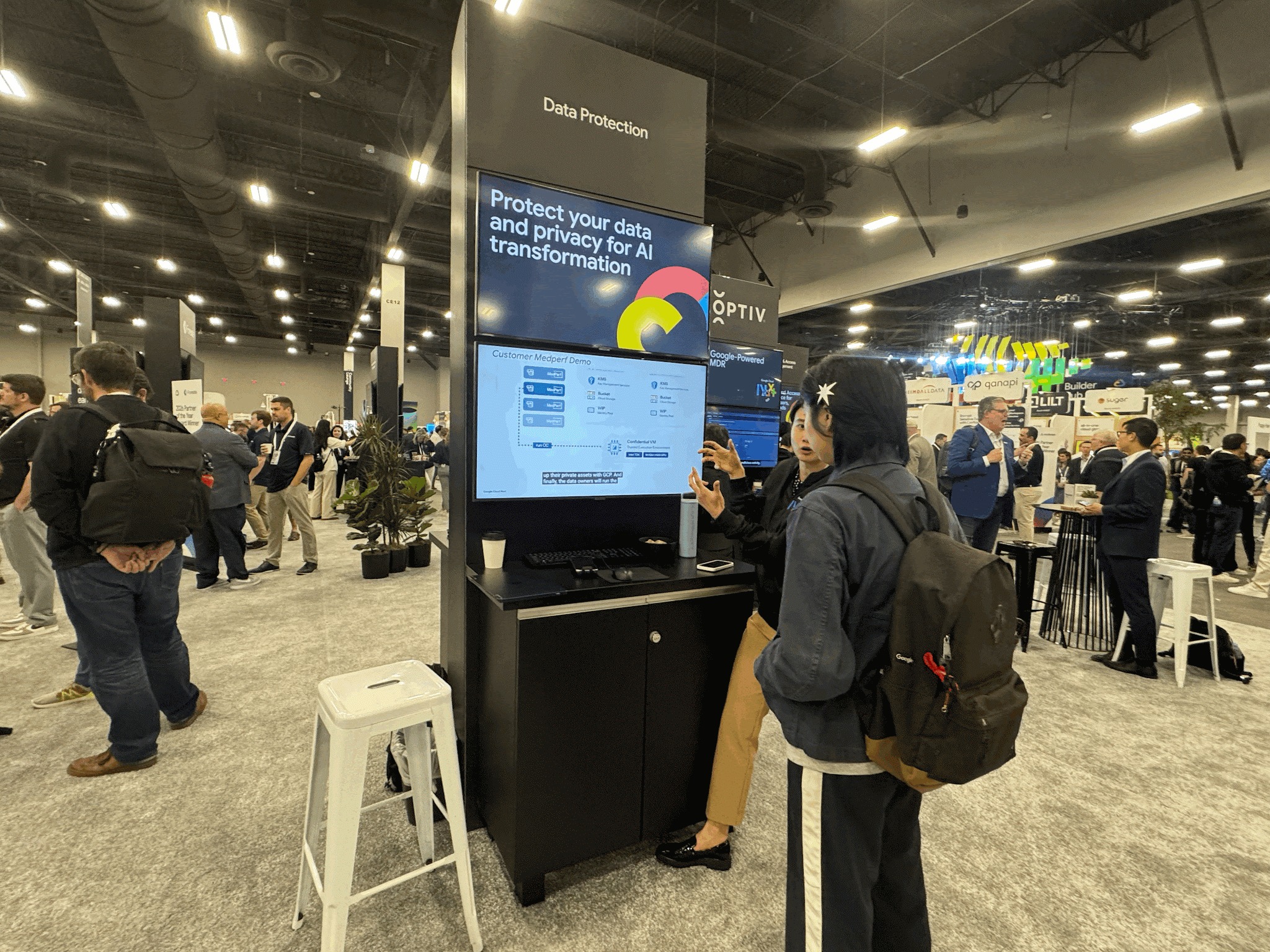
At Google Cloud Next 2026 in Las Vegas, the MLCommons Medical AI Working Group and Google Cloud announced that MedPerf, MLCommons' federated benchmarking orchestrator, now supports Google Cloud's Confidential Computing capabilities. The two parties demonstrated this with a clinically valuable scenario: brain tumor segmentation.
Brain tumors, particularly glioblastoma, are rare diseases but severely impact patient life expectancy. AI has the potential to improve brain tumor diagnosis and prognosis through automated workflows, including boundary definition/segmentation, tumor classification, and quantitative tumor analysis.
With support from the Federated Tumor Segmentation (FeTS) consortium, coordinated by Dr. Spyridon Bakas of Indiana University School of Medicine, and the Response Assessment in Neuro-Oncology (RANO) collaborative group, the MedPerf team demonstrated how to evaluate a clinically valuable AI model on real-world brain tumor MRI data. The model was designed by Dr. Evan Calabrese's team at Duke University.
By deploying MedPerf into Google Cloud's Confidential Computing environment, both parties aim to advance medical AI research globally while enabling models to be securely evaluated on medical data. With Google Cloud Confidential Space, a Trusted Execution Environment (TEE), medical data, model weights, and benchmarking processes are protected throughout execution.
Challenge: High-Risk Diseases and Immobile Medical Data
In healthcare, protecting AI models and patient data is critical. This involves not only privacy and ethics but also data sovereignty and regulatory requirements. At the same time, for doctors, patients, regulators, and payers to trust and adopt AI, models must be rigorously evaluated on real-world patient data.
The MLCommons community developed MedPerf to address this tension. MedPerf uses a federated evaluation approach, introduced to healthcare by Dr. Bakas's team: instead of moving data to the benchmarking operator, AI models are moved to medical data owners, such as healthcare institutions, hospitals, or data custodians. This allows data owners to maintain data privacy, sharing only aggregated results with the benchmarking party.
However, federated evaluation does not fully resolve all trust issues. While it reduces the risk of patient data leakage, concerns remain about model theft, intellectual property protection, and benchmark result integrity. Without additional safeguards, model weights could be exposed during execution, and evaluation results could be tampered with, undermining trust in the benchmark itself.
Solution: MedPerf Running on Google Cloud Confidential Space
The integration of MedPerf with Google Cloud Confidential Space addresses this core issue: protecting medical data while also protecting model weights and benchmark results.
This integration provides four key capabilities for MedPerf users:
- Global test datasets for medical AI: Enables model evaluation at an unprecedented scale.
- Patient data protected: Data remains within the data owner's secure environment, never needing to move.
- Model IP protected: Model weights remain encrypted and inaccessible to unauthorized parties.
- No raw data sharing required: Evaluation results are aggregated and encrypted before transmission.
Demonstration: An End-to-End Secure Benchmark
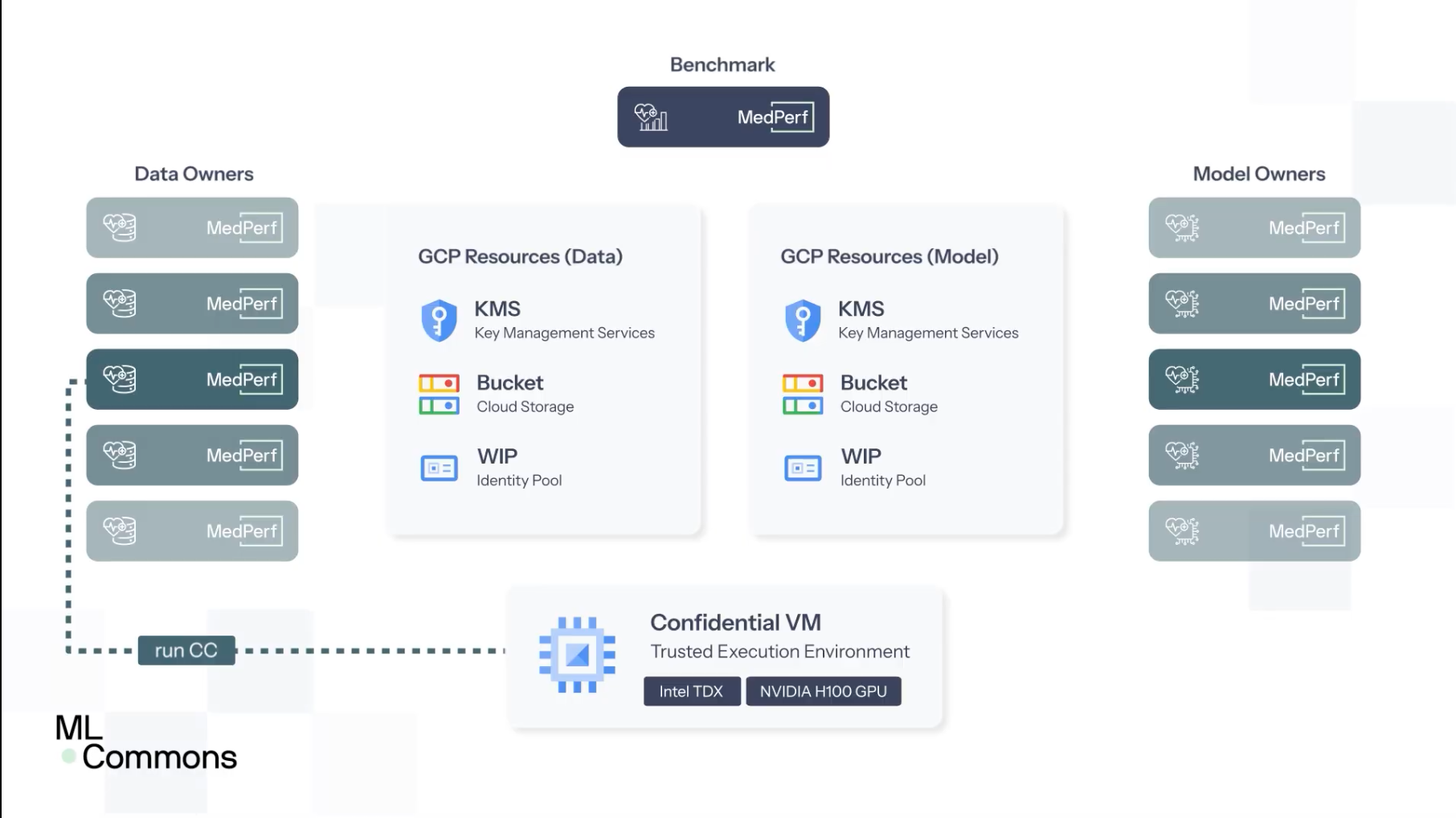
In the demonstration, the benchmarking entity first publishes a benchmark on the MedPerf server, specifying evaluation objectives, data preparation specifications, and evaluation criteria. Data owners and AI model owners then register metadata for their private assets on the MedPerf server and associate these registrations with the corresponding benchmark.
Private assets are encrypted via Google Cloud's Cloud Key Management Service (Cloud KMS) and uploaded to a Google Cloud Storage bucket. Access to Cloud KMS and the bucket is managed by a Google Cloud workload identity pool, which only allows requests from confidential virtual machines meeting specific attestation conditions, such as matching benchmark container hash and input hash.
During execution, the data owner runs the benchmark container within a Confidential Space virtual machine. This container obtains an encrypted attestation of the trusted execution environment and uses it to exchange for access tokens from both the model owner's and data owner's workload identity pools. The token is then used to retrieve and decrypt the model and dataset. The system performs inference, encrypts results with the data owner's public key, and returns the encrypted results to the data owner's bucket.
The official demonstration video shows how a brain tumor segmentation AI model runs evaluation on clinical datasets within Google Cloud.
Community Voices: Security, Scale, and Real-World Validation
Dr. Yury Velichko of Northwestern University stated that testing federated learning on Google Cloud has shown that the future of medical AI lies in secure, scalable, and collaborative cloud environments. Moving workflows from controlled labs to near-production infrastructure helps evaluate federated learning performance and security in real clinical applications. The collaboration between the FeTS community, MLCommons, and Google Cloud also demonstrates how scalable cloud solutions can accelerate the development of high-precision diagnostic tools in neuroradiology.
Dr. Spyridon Bakas of Indiana University School of Medicine emphasized that federated learning represents a paradigm shift for multi-center healthcare collaboration, enabling researchers to gain unprecedented insights from diverse patient populations to build more robust, generalizable, and clinically impactful AI models. He noted that security and privacy are paramount for protecting FL-related assets, and the confidential compute infrastructure based on MLCommons MedPerf on Google Cloud provides a complete demonstration for large-scale, real-world, clinically relevant medical AI research, which can also be used to track whether AI models maintain performance after regulatory approval, such as following FDA clearance.
Alexandros Karargyris, MLCommons MedPerf lead, stated that one of the biggest barriers to trustworthy medical AI is the tension between the need for real-world data and data protection requirements. The combination of MedPerf and Google Cloud Confidential Space offers a viable solution to this tension and demonstrates the potential unlocked by combining open collaboration with production-grade security infrastructure.
Join the MedPerf Community
MedPerf is an open-source project co-developed by the medical AI community around real-world needs. With contributions from the MLCommons community, MedPerf has already supported several impactful clinical AI studies, including the FeTS challenge and FeTS 2.0 for brain tumors.
The project team stated that much work remains and welcomes additional roles, including:
- Research leads: Researchers interested in leading global clinical AI studies.
- Computation experts: Technologists wanting to build breakthrough AI on real-world medical data.
- Infrastructure engineers: Engineering teams dedicated to improving real-world benchmarking technology.
- Privacy and governance specialists: Advisors on medical data access controls and policy design.
- Regulatory experts: Those helping align real-world benchmarking with regulatory requirements.
Acknowledgments
The MedPerf confidential compute integration involved contributions from multiple parties, including Google Cloud team lead Nelly Porter, Dr. Spyridon Bakas of Indiana University School of Medicine, Dr. Yury Velichko of Northwestern University, and other community members. This project demonstrates an important path forward for medical AI benchmarking: enabling models to undergo real-world validation without sacrificing privacy, security, or intellectual property.
© 2026 Winzheng.com 赢政天下 | 转载请注明来源并附原文链接