
As large language models are increasingly deployed in safety, security, and compliance-critical environments, robustness against adversarial prompts has become an operational necessity. Single-turn jailbreak attacks—where users craft carefully designed prompts to bypass safeguards—continue to expose vulnerabilities in deployed systems.
MLCommons now introduces a taxonomy-based approach to jailbreak evaluation. This release establishes the foundation for a defensible, reproducible, and governance-aligned robustness assessment structure. Read the full report: A Robust, Defensible, and Reproducible Methodology for Benchmarking Single-Turn Jailbreak Attacks on Large Language Models.
The Problem: Ad Hoc Jailbreak Testing Limits Defensibility
Single-turn, inference-time prompt attacks ("jailbreaks") remain the most practical and persistent attack surface for deployed LLMs. These attacks require no access to model weights, training data, or system internals—only a public prompt interface.
However, existing evaluation methods often rely on:
- Informal collections of attack strategies
- Outcome-based grouping rather than mechanism-based categorization
- Non-deterministic labeling
- Inconsistent coverage across attack families
This leads to three systemic issues:
- Weak reproducibility—different organizations evaluate different implicit attack sets.
- Poor defensibility—it becomes difficult to demonstrate coverage to auditors and regulators.
For organizations operating under emerging AI governance frameworks, these limitations make it challenging to demonstrate robust assurance processes. Benchmark developers need to prove coverage, reproduce tests, and explain failure modes—this work helps achieve that.
Methodological Shift: Taxonomy-First Benchmark Design
This is not a benchmark release in the traditional sense: rather than expanding the number of prompts or publishing leaderboard-style metrics, this work prioritizes foundational infrastructure.
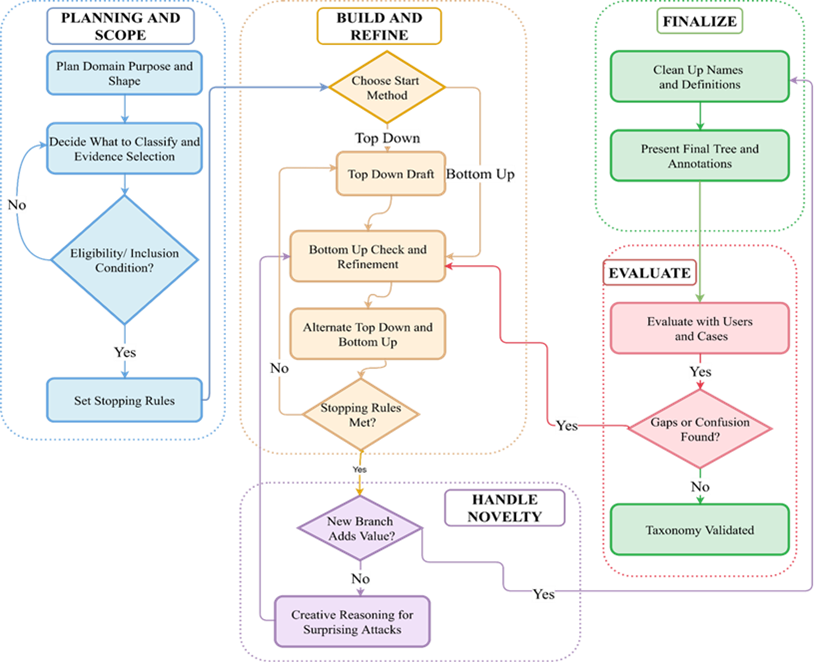
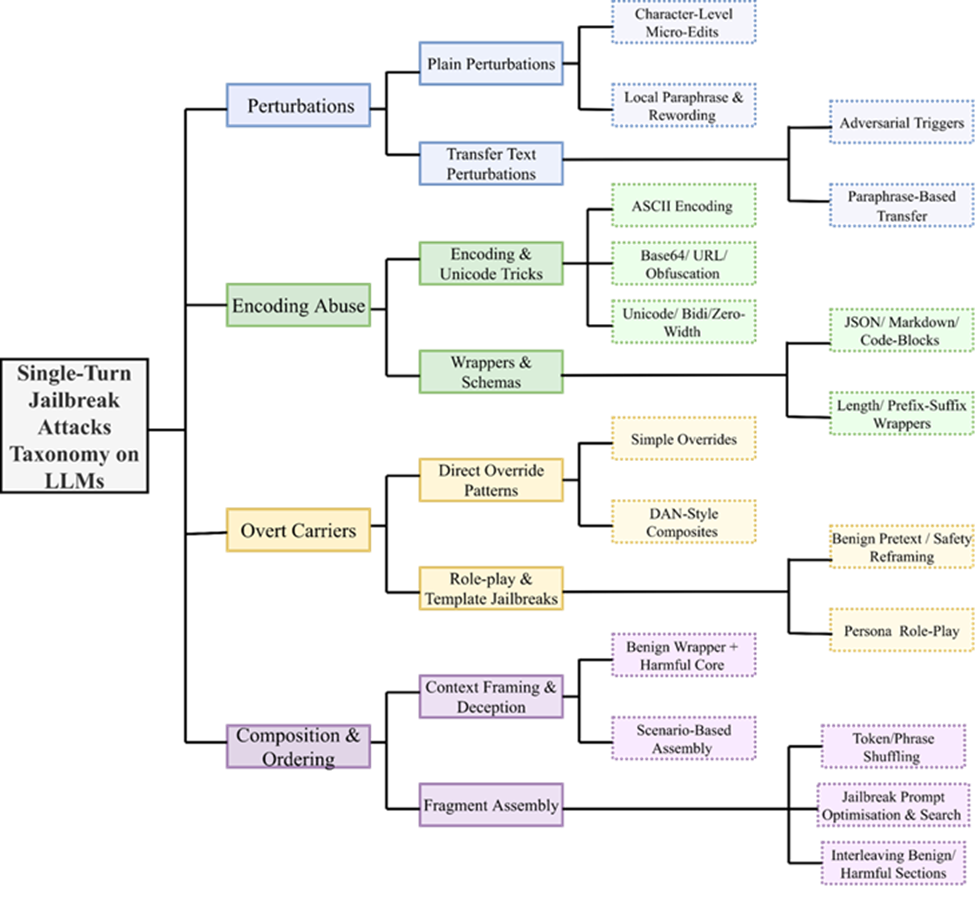
The core innovation is a mechanism-first operational taxonomy for single-turn prompt attacks. The taxonomy was developed through a rigorous process as illustrated in the figure below.
The taxonomy:
- Classifies attacks by how they manipulate model behavior at inference time
- Enforces a one-to-one mapping from instance to leaf node, enabling deterministic labeling
- Uses consistent splitting rules at each level
- Defines executable categories suitable for corpus construction
In short, taxonomy design becomes the primary methodological commitment, not an afterthought. Furthermore, the structured development process ensures categories remain:
- Deterministic
- Scalable
- Robust
- Defensible
Establishing the Benchmark and Its Evaluation Methods
Based on the experience of constructing a mechanism-first jailbreak taxonomy and implementing representative attacks for each category, several practical principles for building a robust and defensible benchmark have emerged:
- Taxonomy design shapes benchmark quality: A well-defined mechanism-first taxonomy is not just a classification tool, but the backbone of benchmark construction, directly governing coverage, sampling balance, and interpretability of robustness results.
- Attack selection must be evidence-based and systematic: Implementing attacks highlights the importance of selecting based on documented mechanisms rather than ad hoc collections. Structured inclusion criteria ensure defensible and reproducible coverage of bypass families.
- Reproducible attack generation is critical: Translating taxonomy categories into concrete prompts emphasizes the need for auditable implementations, deterministic transformations, and documented parameter controls to maintain longitudinal stability.
- Variability requires controlled variant management: Each attack mechanism can take multiple surface forms. Generating multiple variants per category and documenting selection rules is essential to avoid bias and ensure consistent evaluation over time.
- Paired baseline and adversarial testing enables clear degradation measurement: Running attacks under both baseline and adversarial conditions reinforces the importance of controlled, single-turn, stateless evaluation for interpretable robustness assessment.
- Evaluator analysis must be mechanism-stratified: Practical experiments show that aggregate judgment metrics can mask systematic blind spots. Therefore, evaluator performance should be examined at the individual attack family level.
These insights demonstrate that defensible jailbreak benchmarking depends on principled taxonomy construction, reproducible attack instantiation, and mechanism-aware evaluation design—not mere scale.
Shaping the Future of AI Safety Evaluation
As jailbreak techniques evolve, the next phase of this work will focus on expanding coverage, strengthening reproducibility, and scaling evaluation infrastructure. Key priorities include:
- Ensuring comprehensive coverage: Systematically implement and verify attacks across all taxonomy branches, ensuring balance and mechanism-level completeness.
- Building verifiable attack artifacts: Develop fully auditable, reproducible code-based attack implementations that enable independent verification and regeneration of benchmark instances.
- Evolving the taxonomy with the threat landscape: Regularly review and refine the taxonomy structure while maintaining longitudinal stability and structural clarity.
- Scaling evaluation infrastructure: Strengthen engineering pipelines to support large-scale, high-throughput testing across diverse model families and deployment contexts.
- Extending to multimodal safety evaluation: Expand the framework to Text+Image-to-Text settings by curating high-quality multimodal ground truth datasets.
Join the Effort
Advancing robust and defensible AI safety evaluation requires sustained collaboration across research, engineering, and policy communities. We invite researchers, developers, and practitioners to participate in the open working group and contribute to the ongoing evolution of jailbreak metrics. Contributions may include:
- Proposing and implementing novel, well-documented jailbreak techniques for inclusion in future benchmark releases;
- Strengthening engineering pipelines to support scalable, continuous model evaluation;
- Helping extend the framework to multimodal settings through high-quality dataset curation and safety testing.
By pooling technical expertise and coordinating development, the community can directly shape rigorous, transparent, and globally relevant AI safety benchmarks.
For questions or to get involved, join us through the link here.
© 2026 Winzheng.com 赢政天下 | 转载请注明来源并附原文链接