
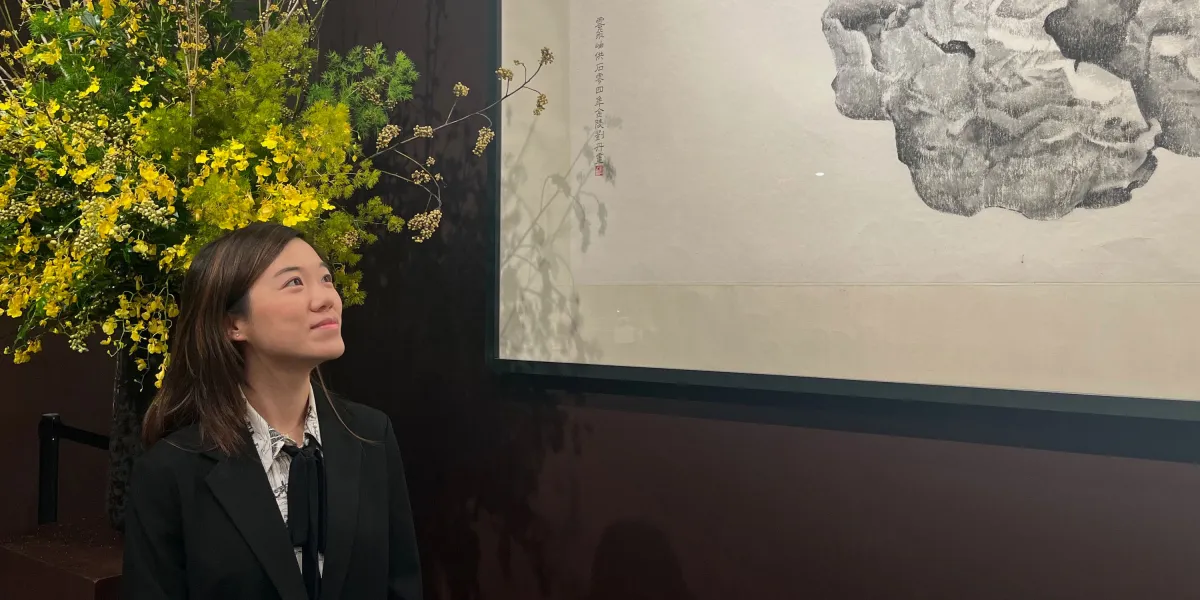
Do fine art and high tech ever converge? At Sotheby’s they do, thanks to Kelly Shen ’17. Shen works in the growing field of art intelligence for the New York auction house.
Shen builds algorithms to predict prices, using factors like buying trends and artists’ popularity. She has also worked on such efforts as cataloguing and ensuring that real-time systems can handle thousands of potential bidders visiting the house’s website. At the same time, she serves MIT as a class officer, vice president of the Association of MIT Alumnae, and a volunteer for the MIT Club of New York.
A double major in computer science and math, Shen credits lessons from MIT—along with a lifelong passion for drawing—with shaping her career. Her favorite class was Project Laboratory in Mathematics, where students present creative answers to intricate math puzzles. “The class helped me talk about what I do with different audiences,” she says.
Though she appreciates elegant algorithms, she understands when they’re impractical: “You can build a super-sophisticated algorithm, but if it doesn’t bring more audience engagement, it doesn’t really matter.”
Read more at www.technologyreview.com/alumni-profiles.
Keep Reading
Most Popular
A fundamental flaw leaves LLMs strikingly vulnerable to attack
It makes it easy to trick them into doing things they shouldn’t, such as telling you how to sabotage an aircraft’s navigation system.
ByAnthropic found a hidden space where Claude puzzles over concepts
A new technique has let the company probe deeper than ever into the weird workings of an LLM.
BySperm donors need limits, says a European fertility group
Some donor-conceived people are finding hundreds of siblings. An international cap on donations could help prevent that.
ByAI is more likely than humans to form biases when hiring
AI doesn’t just learn stereotypes from its training. It can cook up new ones, too.
ByStay connected
Illustration by Rose WongGet the latest updates from
MIT Technology Review
Discover special offers, top stories, upcoming events, and more.
© 2026 Winzheng.com 赢政天下 | 转载请注明来源并附原文链接