
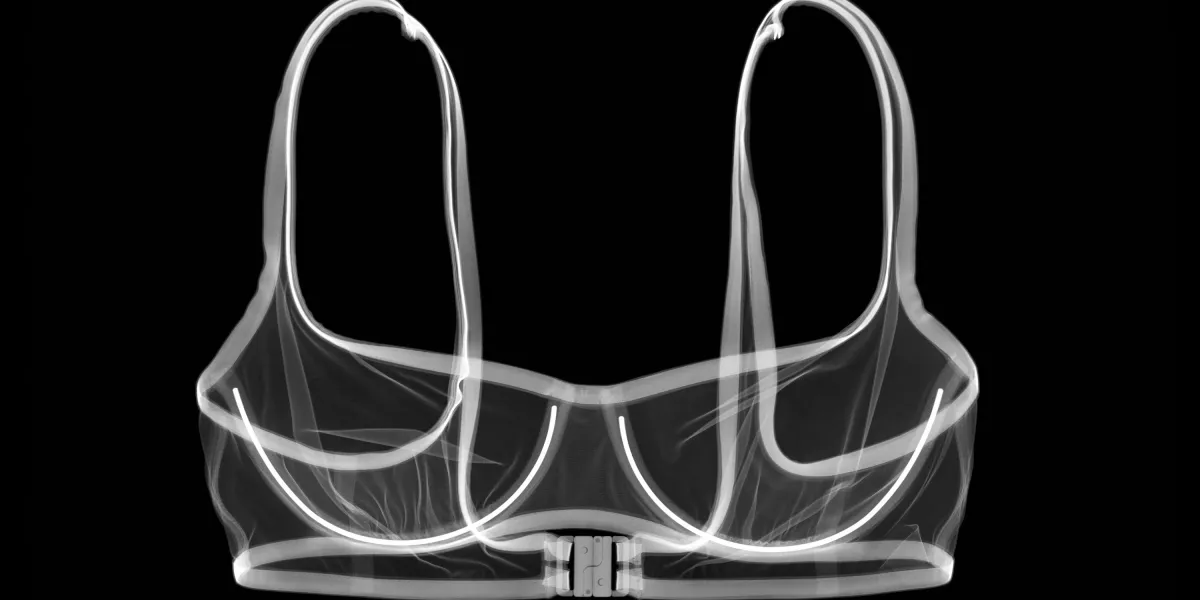
Twenty years ago, Joanna Wakefield-Scurr was having persistent pain in her breasts. Her doctor couldn’t diagnose the cause but said a good, supportive bra could help. A professor of biomechanics, Wakefield-Scurr thought she could do a little research and find a science-backed option. Two decades later, she’s still looking. Wakefield-Scurr now leads an 18-person team at the Research Group in Breast Health at the University of Portsmouth in the UK. Their research shows that the most effective high-impact-sports bras have underwires, padded cups, adjustable underbands and shoulder straps, and hook-and-eye closures. These bras reduce breast movement by up to 74% when compared with wearing no bra. But movement might not be the only metric that matters.
A biological rarity
Few anatomical structures hang outside of the body unsupported by cartilage, muscle, or bone—meaning there wasn’t much historical research to build on. Wakefield-Scurr’s lab was the first to find that when women run, the motion of the torso causes breasts to move in a three-dimensional pattern—swinging side to side and up and down—as well as moving forward and backward. In an hour of slow jogging, boobs can bounce approximately 10,000 times.
A sports necessity
Wearing a bra that’s too tight can limit breathing. Wearing one that’s too loose can create back, shoulder, and neck pain. Pain can also be caused by the lag between torso and breast movement, which causes what is scientifically known as “breast slap.”
The lab’s research has also found that the physical discomfort of bad bras, combined with the embarrassment of flopping around, is the one of the biggest barriers to exercise for women and that if women have a good sports bra, they’re more willing to go for a run.
An open question
Some bras function by deliberately compressing breasts. Others encapsulate and support each individual breast. But scientists still don’t know whether it’s more biomechanically important to reduce the breasts’ motion entirely, to reduce the speed at which they move, or to reduce breast slap. Will women constantly be forced to choose between the comfort of a stretchier bra and the support of a more restrictive one?
Wakefield-Scurr is excited about new materials she’s tested that tighten or stretch depending on how you move. She’s working with fabric manufacturers and clothing companies to try out their wares.
As more women take up high-impact sports, the need to understand what makes a good bra grows. Wakefield-Scurr says her lab can’t keep up with demand. Their cups runneth over.
Sara Harrison is a freelance journalist who writes about science, technology, and health.
Deep Dive
Culture
Constellations
A story about seeking
ByThe problem with thinking you’re part Neanderthal
The idea that modern humans inherited DNA from Neanderthal ancestors is one of the 21st century’s most celebrated discoveries in evolution. It may not be that simple.
ByYou have no choice in reading this article—maybe
Does free will exist? Neuroscientist Uri Maoz devises experiments to illuminate how—or if—the brain makes decisions.
ByThe case for fixing everything
A new book by Stewart Brand, an architect of modern tech culture, asks: How do we prioritize maintenance? And why? But it doesn’t quite have the answers.
ByStay connected
Illustration by Rose WongGet the latest updates from
MIT Technology Review
Discover special offers, top stories, upcoming events, and more.
© 2026 Winzheng.com 赢政天下 | 转载请注明来源并附原文链接