
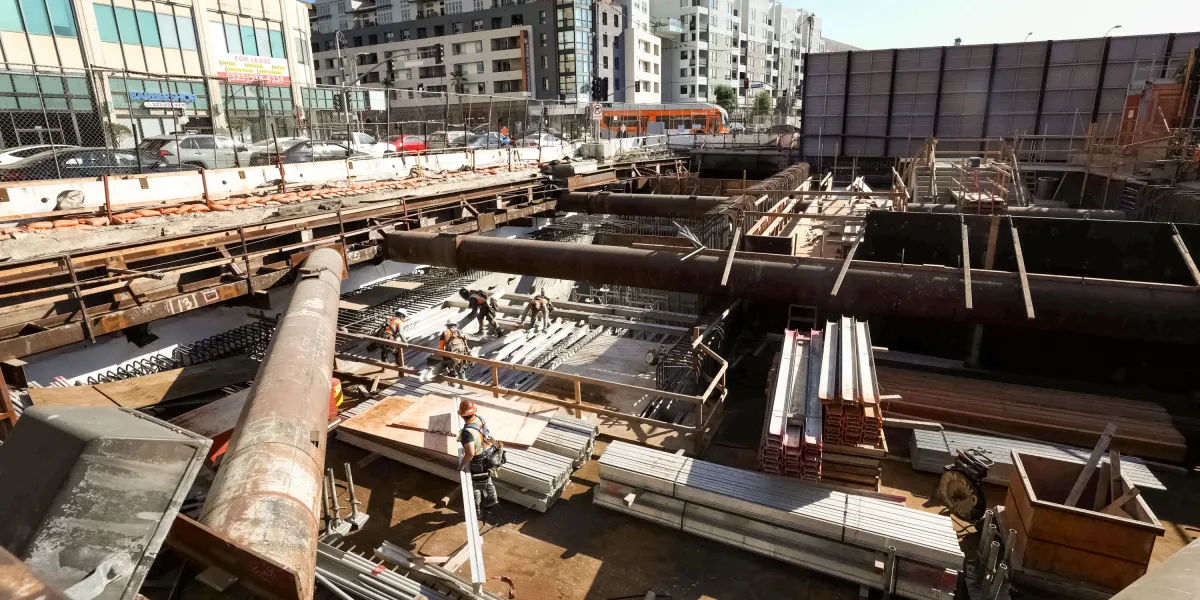
Los Angeles deserves its reputation as the quintessential car city—the rhythms of its 2,200 square miles are dictated by wide boulevards and concrete arcs of freeways. But it once had a world-class rail transit system, and for the last three decades, the city has been rebuilding a network of trolleys and subways. In May, a new four-mile segment with three new subway stations will open along Wilshire Boulevard, a key east-west corridor that connects downtown LA to the Pacific Ocean. What today can be an hours-long drive through a busy, museum-packed stretch of the city will be, if all goes well, a 25-minute train ride.
The existence of subway stops in this part of town—known as Miracle Mile—is a technological triumph over geography and geology. The ground underneath it is literally a disaster waiting to happen—it’s tarry and full of methane. One of those methane deposits actually exploded in 1985, destroying a department store in the neighborhood. In response, the city pushed its new train routes to other parts of town.
These days, dirt full of flammable goo is no longer a problem. “The technology finally caught up with the concerns,” says LA Metro’s James Cohen, a longtime manager of the engineering for this stretch of subway. The key was an earth-pressure-balance tunnel-boring machine, an automated digger that is designed to chew through ground packed with explosive gas. It sends removed dirt topside via conveyor belts and slides precast concrete liner segments into the tunnel, which are joined together with gaskets to create a gas- and waterproof tube. All that let the machine dig about 50 feet every day.
Meanwhile, engineers excavated the stations from the street level down. They worked mostly on weekends, digging out a space and then decking it with concrete so that work could go on underneath while LA drivers continued to exercise their God-given right to get around by car above.
Did the project finish on time? No. Did it come in under budget? Also no; this segment alone cost nearly $4 billion. Is the city now racing to build housing and walkable areas to take full advantage of the extension? Oh, please. Yet the new stations still manage to feel, in the end, transformative—as if Los Angeles’s train has finally come in.
Keep Reading
Most Popular
Want to understand the current state of AI? Check out these charts.
According to Stanford’s 2026 AI Index, AI is sprinting, and we’re struggling to keep up.
By10 Things That Matter in AI Right Now
MIT Technology Review's authoritative overview of the 10 technologies, emerging trends, bold ideas, and powerful movements in AI in 2026.
ByMusk v. Altman week 1: Elon Musk says he was duped, warns AI could kill us all, and admits that xAI distills OpenAI’s models
Musk kept his cool, and OpenAI’s lawyer bulldozed him with piercing questions about his motivations for suing the company.
ByA new US phone network for Christians aims to block porn and gender-related content
Launching next week on T-Mobile's network, the cell plan takes a nuclear approach to online safety.
ByStay connected
Illustration by Rose WongGet the latest updates from
MIT Technology Review
Discover special offers, top stories, upcoming events, and more.
© 2026 Winzheng.com 赢政天下 | 转载请注明来源并附原文链接