
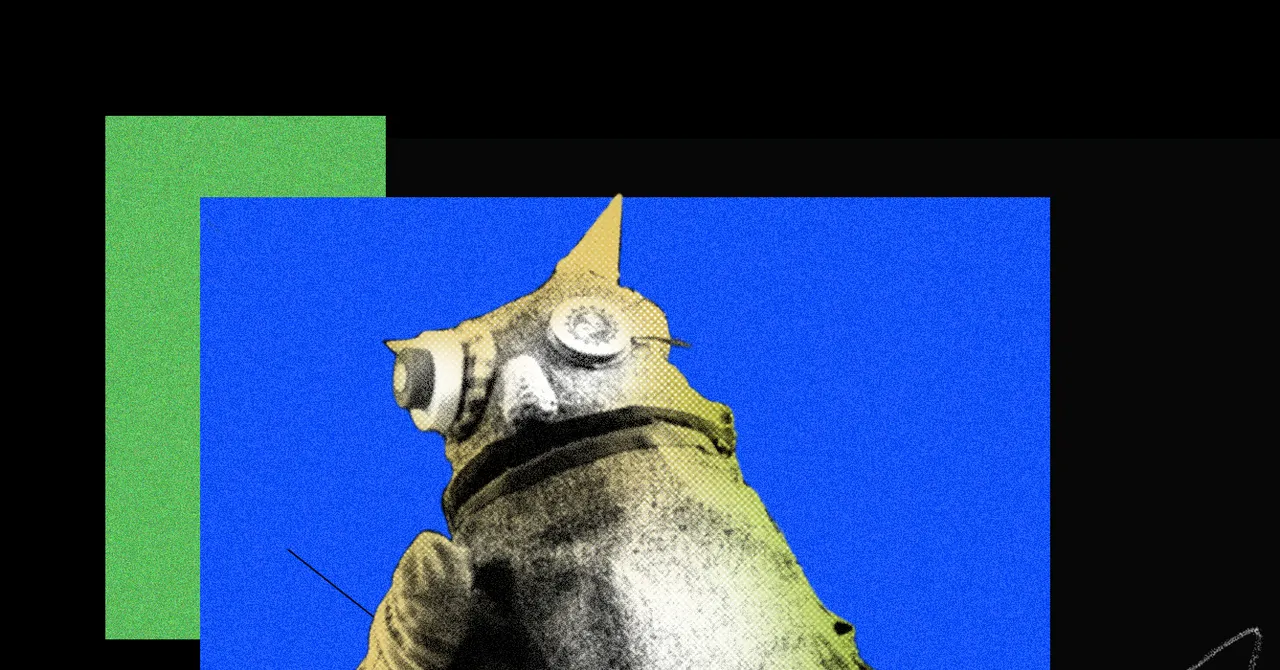
puppet probably shouldn’t even be talking to me.
Made of literal garbage—his origin story is that he was born in a dumpster in his namesake neighborhood in Brooklyn—he’s the media representative for the Summer of Ludd, a Luddite festival that took place in New York earlier this month.
The festival, which WIRED attended, included everything from workshops on how to flirt IRL to an evidence box, where people could submit testimonies on how Big Tech has negatively impacted their lives. Its rules were simple: Be present. No phones, recordings, or photographs allowed.
So, philosophically speaking, it is somewhat contrary to Gowanus’ beliefs to be in a podcast recording studio at Condé Nast’s Manhattan offices. But he’s pragmatic, telling us he wants to reach people, so he’s willing to meet them where they’re at. Still, he has some conditions—presented to me on a handwritten contract. Namely, that we not clip short-form video of the show, in an effort to encourage people to engage with the full interview. In a compromise, we agree to only clip Gowanus explaining the contract.
You might be wondering why Summer of Ludd and its movement are represented by a puppet. It’s a nod to the original Luddites, British textile workers who anonymously organized against being replaced by technology during the Industrial Revolution in the early 19th century. While the term “Luddite” has since become a derogatory way to refer to someone who opposes technology, there’s a renaissance happening—and it’s surprisingly being heavily embraced by Gen Z. Gowanus offers anonymity to the people behind the growing trend.
I was curious about how being a modern-day Luddite works in practical terms—even organizing this interview was a challenge, because the Summer of Ludd folks weren’t necessarily quick to reply to emails. And I wanted to know why the first generation to ever grow up totally online seems to be leading the charge on having less screen time.
This interview has been edited for length and clarity.
MANISHA KRISHNAN: Gowanus, thank you for joining me.
GOWANUS: Hi. Thank you so much for having me. It's a pleasure.
So I'm gonna jump right in and ask, why are you a puppet?
Oh, that is a phenomenal question. Well, you know, we live in a hyper-digitized age. And the original Luddites were completely anonymous. When they were going around in the 1800s organizing people, fighting automation, they sought anonymity because they were facing the oppression of the Crown, of local militias, things like that.
So in the spirit of retaining anonymity and not creating movement figureheads and things like that, we made a puppet, a media puppet. And that's me. Hi, I’m Gowanus.
So you brought a handwritten contract for me today. Can you tell me what it says?
It's essentially an ask for you and WIRED to not make any short-form content of this interview. We believe in short-form content, right? We want people to pay attention and actually commit time to watching the whole interview. You know, we don't want clicks and likes and scrolls past and things like that. So that's essentially it.
I mean, I'm with you on wanting to encourage people to get into long-form, but at the same time, that is how we promote this show. So are you against us promoting it on any form of social media?
Definitely not. Because we wanna reach people, everybody. Most people spend a lot of their time on social media, and the people who particularly need to hear this message often are chronically online. That's totally OK, and we wanna meet them where they are. But there is a practice, right, of the Luddite movement of really taking time and giving your attention to things, right?
If you're gonna engage with something, not, like, scrolling past it, being like, “Oh, this is a little YouTube Short,” right? “I'll look at it,” and then shoop, it's gone into the ether. Shoop, next thing. Next thing, a frog eating a chicken nugget, whatever. Shoop, right? So we're trying to engage people and pull them into, “OK, actually, let's sit down for this 30, 40 minutes and hear the entirety of our critique.”
You've already referenced this, but I feel like most people hear Luddite and they think of people who are against tech or afraid of tech. But actually it dates back to the Industrial Revolution, with English workers who were protesting exploitative working conditions.
So in modern times sometimes calling someone a Luddite is kind of an insult. Do you think that's still the case?
This is a very interesting question because you're right, it's a totally pejorative term, right? Like, a Luddite is somebody who's bad at technology, often doesn't know how to move files around on their MacBook or things like that. Or someone who's seen as anti-tech, right?
It's almost like saying “caveman.” One thing that we really found coming out of the Summer of Ludd is that people started to have a new framework and a new understanding of, OK, what does it mean to be a modern Luddite, right? And we really believe that to be a modern Luddite is to have a deeper critique of technology that's really been lost.
A lot of what's broadly accepted is technology equals progress, sort of by any means necessary, right? The sort of founding mantra of Silicon Valley was “move fast and break things. No matter what we make, the technology will be the progress, and that will forward society,” yada, yada, yada.
I think people are really waking up to the fact that actually a lot of this tech is extractive, is taking away natural resources like with data centers, is actually not necessarily needed in terms of social media. Like, the whole billing of social media was, “OK, let's be more connected on a global scale,” right?
And what we're seeing more and more is actually mass loneliness, atomization, things that just make Gowanus so depressed.
But, sorry, coming back to the word Luddite, a critique of technology, right? A look at technology that is not coming from a stance of neutrality. Every technology is progressive. Every technology is sort of apolitical. WIRED investigates all of these technologies and who do they actually serve? Do they serve people? Do they serve Elon Musk, Mark Zuckerberg, Big Tech oligarchs?
Are you finding that the people who are joining this movement are people who are giving up tech, or is it a lot of people who never embraced tech to begin with?
I would say it's a total mix. Tech is so ingrained in so many people's lives, and we also had people come to the Summer of Ludd who have never had a phone. Or have never been online in 20 years.
There's a sort of a range of ways to be a Luddite, right? There's no sort of one-size-fits-all. A lot of the reporting really likes to hone in on “OK, Gen Z, we're getting flip phones,” you know? It’s kind of a consumer-based narrative. But what we’ve shown with the Summer of Ludd is actually what we’re doing is creating an in-person community.
We’re bringing people back into public space, and it goes beyond the current idea, which is really about digital detox. “I'm going to pare down my personal relationship to the internet, to my phone, to social media,” to whatever it is. And the way that we do this is we do a lot of events communally.
We have something called Delete Day, where we acknowledge getting off Instagram, getting off Hinge, getting off whatever it may be, whatever app is ailing you, is actually hard to do. There's a certain reliance that we all have on these things. The best way to do that is to do it with a group of people, right?
And to actually sort of commit to, OK, we're all gonna sit in a circle. We're each gonna delete an app off of someone else’s phone and do it together. And learn about why is Instagram extractive? Or why is Hinge changing the nature of dating and making it more transactional? What's the deal with Spotify not paying artists a living wage, you know?
Are there basic tenets to your movement?
Yeah. Sort of the most core ethos actually does come from those 1800s textile worker original Luddites that we were talking about. What they wrote is, “We are against machines harmful to commonality that tears unduly at the social fabric,” which is kind of like an old-timey complicated way of saying, “We are against machines which accelerate wealth inequality, tear apart communities, atomize people.”
So that's kind of our core thing against machines harmful to commonality, and expresses itself in many different ways. Young people feel very affected by social media, and actually there is a trend of people moving away from social media.
Similarly, with AI and automation coming for not only working-class jobs but also white-collar jobs, entry-level coders and things like that. They’re essentially automating themselves constantly by training AI tools. So everybody is affected by this new wave of automation.
Whether it be a labor issue, whether it be a social issue, whether it be an environmental issue, we see them as all tearing at the social fabric, taking away commonality from society and turning us into more atomized individuals.
So, is it more about moving away from sort of Big Tech tools? Or is it like moving away from all tech writ large?
Big Tech, Big Tech. Thank you for bringing that up, because that is a distinction that is hard for people to quantify, you know what I'm saying? And hard for people to understand immediately because we like tech that serves people, and we actually create tech that serves people.
There was this event during the Summer of Ludd called “What Are You Doing Tonight? How to Create Your Own Events Calendar.” We saw that there was a real need because of the enshittification or slopification of social media. It's actually hard to find events. It's hard to go on Instagram and find something to do with your weekend.
Find a book reading or live music or whatever it is, something to actually get you out of the house, get you talking to strangers, because there's so much slop. Like, you literally have to wade through like 1,000 videos of cats and pigeons that are AI, and they're like riding on each other's backs and like nipping at each other and whatever, you know?
So we brought together a bunch of people who run newsletters, who work on RSS feeds, who do alternative tech things. We brought them all together and had them teach other people how to create their own events calendars, or just generally get their information flows away from these Big Tech platforms.
We’ve seen this thing happen where so many communities, community spaces, churches, unions, whatever it is, are put in the box of having to have all of their information on Instagram because everyone's on Instagram. And can often also degrade the content of what they’re talking about because it turns it into like Instagram content. And they start molding their content to fit the algorithm.
But you actually don’t face this problem if you have your own newsletter or your own alternative infrastructure that you own and you can operate yourselves with your community that gets people to events, gets people to meetings, whatever it is, gives people resources, right? So we’re actually really big on creating technology, which is kind of contradictory.
Was there also a workshop teaching people how to flirt IRL?
There were two workshops.
That's a dying art. So, do you have any personal tips on how to do that?
Yes. Well, it’s funny because the sort of actual thesis of the workshop was called “Luddite Rizz.” The thesis of Luddite Rizz was actually less how to flirt and more how to get rejected. How to actually go up to someone you have a crush on, be like, “Hey, I have a crush on you. Like, it’s OK if it’s not gonna work out, but I wanted to express this to you to see if you felt the same way.”
And then boom, rejection. And how to handle that feeling.
Why is that important in the age of dating apps?
Because dating apps have totally transactionalized the experience of falling in love. We swipe, swipe, yes this person, no this person, and it kind of like almost doesn't matter if we get rejected, ’cause there’s always like a bajillion more fish, right? With a bajillion more like photos of themselves and little cutesy whatever, taglines and stuff like that, right?
What we find is important is retraining our social muscle away from that transactionalized experience of “I like you; I don't like you.” That black-and-white thinking about how dating works, how socializing in general works. We as a sort of a modern, technologically entrenched civilization have lost a lot of the actual nuance of interaction. Which is like reading body language, dealing with conflict, dealing with rejection, dealing with intense feelings of love. Now it’s all in Hinge.
The festival also had an evidence collection box where people could write down how Big Tech had negatively impacted their lives. Were there any big takeaways from that?
Oh my gosh, so many. Thank you for bringing this up. So the evidence box was for a protest we had on the Fourth of July, which is called SHITPHONE. It's an acronym. It stands for Scathing Hatred of Information Technology and the Passionate Hemorrhaging of Our Neoliberal Experiences. It’s a protest where we all wear gnome hats, and we put different technologies on trial.
One of the interesting pieces of evidence that people got on soapboxes and shared was a young person was talking about how their mom loves ChatGPT. And as we know, ChatGPT is, like, very sycophantic. It'll just tell you whatever you wanna hear. This young person just got a new bunny, and their mom looked up, “Can bunnies eat mushrooms?” on ChatGPT, and ChatGPT said, “Yes, of course. I love you so much. Yes, bunnies can eat anything.” They fed mushrooms to the bunny, and the bunny got extremely sick and almost died.
Wait, sorry. Psychedelic mushrooms or normal?
Normal mushrooms, like shiitake mushrooms.
Oh, wow.
They had to fact-check their mom, and it was like a real point of contention within the family, because it was like, “Are you really going to use these tools and endanger the bunny?” So that was an interesting piece of evidence.
Another one was a young person who was talking about their parent working for Amazon and just having to endure these brutal conditions of 120-degree heat, no bathroom breaks, no water breaks, things like that.
There was a young woman who was saying that the Meta Ray-Bans are really sort of a device for creepy men on the subway to record them without consent and post it online. For those of you who don't know, the Meta Ray-Bans are sunglasses with a sneaky camera in them.
Why do you think there is such a backlash to Big Tech from young people, considering that a lot of them have grown up with it?
There's definitely a push from young people, right? And we often get this narrative of Gen Z's pushback, backlash against Big Tech, which I think is very valid. Probably their first phone was a flip phone in, like, third grade, and then it moved to an iPhone in sixth or seventh grade.
Then they got just unfettered access to the internet. The internet was different than it used to be. We have a platform model where, like, addiction is the economic driver of all of these platforms. So I think there's something really key in there of a feeling of missing out on genuine human experiences because they were essentially guinea pigs for Mark Zuckerberg.
That's a part of it, but I also think—and the Summer of Ludd is kind of proof of this—yes, there are a lot of people from Gen Z there, there's also a lot of older people who are facing a similar kind of alienation, a similar kind of loneliness or a similar feeling of, like, “What the hell’s going on?”
All of the billionaires and now trillionaires are all tech people. Tech oligarchs. How did we get here? How did we get to the point where they’re using their powers to erode democracy, essentially? So there’s a lot of crossover between the old, the young, the middle-aged. On a broader societal note, I think that there’s a real flattening of the distinctions between generations, ’cause what used to separate generations in large part was the technological advancements of the time. In the 1920s, we had radio; 1980s, TV; 1990s, early internet.
Now we’ve had this hyper, hyper, hyper acceleration where in the past 20 years, we have the internet and the iPhone, and it's essentially hours and hours of every day of our lives. So in some ways, the example of an 18-year-old who is on TikTok chronically is not so much different than the boomer who is on Facebook having sort of a different [version] maybe of misinformation or politicization, but a similar feeling of being chronically online, constantly seeing slop.
There were a lot of college commencement speakers who were speaking positively about AI, and students were booing them. What do you make of the disconnect there? Why did these speakers—in some cases they were tech leaders—keep bringing this up? Did they sort of overestimate how much people would be fans of AI?
God, I love those videos. I mean, just the mass booing is amazing. Then the commencement speakers, like, you see them seemingly rethink their whole speech in real time, and they're like, “No, I have to keep going.”
Yeah, they're surprised.
I think what it is is an underestimation of the pushback against AI, especially because all of those college students, right?
Like, they're the new workforce, right? And they are really staring down the barrel of a chatbot right now, and they are not going to be happy or excited when their entry-level job in tech or finance or law or medicine actually gets automated away from them. So I think that’s a large part, specifically on the college issue, of why there's so much pushback there.
We hear a lot from the Sam Altmans of the world and even celebrities now …
I hate him. I hate him.
… sort of saying that, you know, AI is the next industrial revolution. That if you don’t get on board, you’re gonna be left behind. What do you make of that narrative?
There is some merit to, OK, AI is a powerful tool. And it's a powerful tool because of its ability to merge data sets in a way that has never been seen before. Do I think it's the next industrial revolution? I think what it is right now, especially in this AI bubble, is it’s really actually not showing us its capabilities, right?
And then oftentimes AI doesn't really work. It's kind of like the bunny thing. It just tells you whatever you wanna hear. So I think that makes it hard for me to conceptualize it as exactly like the new industrial revolution. Because I don’t actually see a value being generated from AI in the way that these Big Tech oligarchs like to push us.
They really play a game of, it’s gonna take away the need for human labor to do things, and then everybody is gonna get paid, either by the government or in some like libertarian fantasy, like we’re all just gonna have abundance because of AI. And we’re really just not seeing that right now.
Do you see the modern Luddite movement as being a political movement?
Yeah, absolutely. I mean, look at me, I’m a puppet, right? Our tactics are unorthodox. We are testing out a new organizing field, and we’re actually trying to experiment as much as possible with new organizing tactics. So in that way, people may say, ‘Oh, this is kind of funny. This is playful. I'm not sure. This is just about attention or getting off your phone.” But this is really a very political movement, in the same way the original Luddites were hyper-political. They were facing starvation. They were facing disruptions to the family, the enclosure of the commons, in the same way that we are really.
I mean, we’re facing mass unemployment. We are facing a massive surveillance of our public spaces, our private spaces. We're facing the potential of mass manipulation through AI-generated content and things like that. So yeah, we are totally rebelling against all of that in a strongly political way.
There's a lot of controversy over the idea that social media is addictive. Do you feel that it is?
Yeah. I think that it's designed to be addictive, really. The incentive of social media is to sell data to advertisers. And now sort of to sell data to other corporations, to sell data to the government. So within its bones, it is meant to be addictive, ’cause the more time that you spend on it, the more data that there is, the more revenue that the company has.
What's that quote? It’s like, “If it’s free, you’re the product.” That's sort of become our classic “this is what social media is really about.”
On the flip side, though, there’s a lot of people who have found community online. You know, I've talked to young people who are LGBTQ, and maybe they grew up in a religious community and sort of first learned about some of these things online. So do you feel like there are good use cases for social media?
Absolutely. Absolutely. And never would I discredit a queer person, especially in a rural or a very conservative situation, figuring out, “Oh, this is what it means to be gay or queer or …” via the internet, right? And the internet is a powerful tool for accumulating information.
That is absolutely beautiful. But where we’ve gone wrong is the internet is actually not a powerful tool for actualizing information within our lives. So that’s why we as Luddites say, “The event is the medium.” That essentially means when we learn things we should be going out into public space, hosting other people, teaching them things, sharing our knowledge, and building community that way.
It is not enough for us to, “OK, I see a post. Let me repost it,” and then sort of feel like I did something with information. ’Cause we know that ultimately that’s not fulfilling. That creates more cycles of loneliness and lack of fulfillment and things like that, because it's not material.
We need to take all of our amazing information we get from the internet and bring it actually into the real world and test it out with other people. You know, experiment with how we think and how we feel in the public sphere.
Let’s say I’m Luddite-curious …
I hope you are.
… and I want to kind of unplug a little bit. How would you encourage someone to get started? Because it is an overwhelming idea.
Right. I think that the first step can be different for everybody, you know? If you are Ludd-curious and you know the exact reason, like, “I’m on Instagram too much” or “I’m feeling a sort of a sense of emptiness” or “I’m doomscrolling a lot,” or things like that.
One of the simplest ways is actually to just delete your Instagram app. You know what I’m saying? Or delete your Facebook, or some people are addicted to their email or their Hinge or whatever. To just delete it and start going outside, going to local bookstores, going to community spaces, and talking to people.
You’re sort of replacing one thing for another. It’s not simply, “OK, I digital detox, now I live my life.” It’s “I take away these extractive platforms, and I actually go and try newer, more communal things,” right? If you’re here in New York City, come to an event. Meet us outside.
You will come to a teach-in, come to a music thing, come to a free lunch in the park, come to any sort of assortment of things and immediately be able to say, “OK, let me test my social muscles. Let me be with other people who are thinking in this way. Let me learn from them.”
That would honestly be my best first step.
We are all kind of programmed at this point to prioritize convenience. So it seems like part of the key to this is showing people that it can actually be fun to not do that. Is that right?
Absolutely. Absolutely. Let me give an example. There’s nothing on social media indicating how to find the Summer of Ludd. You could not type “Summer of Ludd” in Instagram and figure out the whole program, festival, and whatever. What we did is we had posters all around New York City which had a hotline on them, and you would call the hotline, and the hotline would tell you the nearest local bookstore, the nearest community space, the nearest café. There would be guidebooks there that had events in them. And so in that sense, there’s kind of a journey there. It’s not inconvenient necessarily, but it’s not convenient either. It’s not, “Oh, let me click on this link. OK, I'm here. I know everything.”
So we need to open ourselves up to actually not going for the convenient option always. Not immediately jumping to “OK, I’m hungry. Let me Grubhub something.” Instead it’s like, “OK, I’m hungry. Let me go to my local deli. Let me have a conversation with them. Let me have an interaction.”
I will say even booking this interview was a little bit tricky, because we ended up sending one of our producers to your events just because we were trying to reschedule it, and normally that might have been a very quick email exchange.
Yeah. That’s great. “OK, go where the Luddites are. Go find one.” That's great.
I’m just wondering, does that ever become a hindrance? Or frustrating?
I mean, not necessarily, because we love meeting people in person. There’s something that is kind of eternally lost in the email communication or the text or even the phone call. And the fact that you guys sort of knew that, “OK, we’re not gonna get them via email. Let’s send our producer to the park.” It makes us work differently.
If we were a festival with an updated website or I had all the organizers’ locations on my phone or something, and I could just go run up to them and ping them, it would be a completely different organizational structure. But because no one’s using their phone, we actually had to rely on each other a lot more and know where each other were at certain times, and that kind of thing facilitated a lot of trust, right?
So it’s a hard cognitive jump to be like, “OK, I’m not gonna use these certain technologies,” but in that sense, I have to make my own new structure, right? What we found personally is that there’s actually a lot of joy and interest and experimentation that comes from that.
Your movement is based in New York. Do you have ambitions for it to spread beyond the city?
Absolutely. For the Summer of Ludd, we had people coming from all over the country, and we had people from Canada, and people from Australia. We had people coming from Iowa, from Santa Cruz; we had people coming from North Carolina.
So there is already sort of a Luddite network out there. People just don’t know about it ’cause it’s not online.
So the festival just wrapped up. Are there any other events that you have planned?
Not immediately, because we all need to rest our weary bones. However, if you do want to learn about events in the next month, there’s the NYC Off Tech calendar, which is essentially like a newsletter. You can sign up for it. You'll get like 60 events in a month essentially. Also if you’re in New York, keep your eyes peeled.
I mean, we do huge poster campaigns, right? And we do in all different types of neighborhoods. Our guidebooks for the Summer of Ludd that we gave out reached bookstores up in the Hudson Valley. We mailed them to people in different states.
Keep yourself open to, “OK, I’m gonna look around. Is there a Luddite poster here? I’m at my local bookstore. OK, is there some information here?” It’s this idea of social infrastructure, switching people over from the idea of, “OK, I’ll look at an Instagram page, and here’s all the events” to the idea of, “I actually have to leave my house.” Be on the lookout. We’ll be out here. Tompkins Square Park, probably, other parks, privately owned public spaces. We have events all over this city. It's amazing. Knicks in five. I love New York.
Gowanus, we like to play a little game on each show.
I love games.
We’re very proud of it. It's called Control, Alt, Delete. So I wanna know what piece of tech you would love to control, what piece you would alter or change, and what you would delete, or vanquish from the earth.
Wow.
Are you ready?
Control, Alt, Delete. OK, great.
Let's start with control.
This is so funny that you’re asking me this. I would say the servers for the internet.
The internet was billed as something that was, OK, we are going to have a free exchange of knowledge across the world. It’s going to help diversity and globalization and all this stuff, and then, boom. Military technology, right?
We saw this with Ed Snowden, essentially.
OK. And now alt.
I’m trying to think about which technologies do I feel have a real positive impact, but have a negative sort of profit incentive.
Let me give this one. I would alter the way that social media platforms have a centralized system instead of a federated system. I think that’s pretty solid, and this was almost in the creation of Twitter, they were about to do this. And then Jack Dorsey was like, “No, we should have it be more centralized.”
And finally, delete.
I can’t wait. This is my favorite one.
What would you delete?
AI. AI data centers. Done. Done. Immediately done. Boom. Gone. I mean, come on, guys.
Come on. Especially when they bill it as, “OK, we’re gonna make an AI to fix all of our climate catastrophe, all of our income inequality, but first, we have to absolutely drain the natural resources of the Earth.” I mean, it’s just ridiculous. It just makes me so frustrated. I think the data center is honestly one of the worst materializations of this Big Tech oligarch world that we live in.
Where like the whim of Mark Zuckerberg wanting a Meta Hyperion data center in Louisiana is legitimately going to use multiple times the amount of energy that New Orleans uses. We can’t sustain that as a planet, truly. It doesn't matter how interesting the technology is or what it could do. These are resources that we need now for life to continue. We need fresh water. We need land to grow food. We need ecosystems where birds and bees and wildlife can coexist, and I’m not very interested in trading that for a chatbot, even if the chatbot tells me it loves me and we can kiss through the phone.
How to Listen
You can always listen to this week's podcast through the audio player on this page, but if you want to subscribe for free to get every episode, here's how:
If you're on an iPhone or iPad, open the app called Podcasts, or just tap this link. You can also download an app like Overcast or Pocket Casts and search for “uncanny valley.” We’re on Spotify too.
© 2026 Winzheng.com 赢政天下 | 转载请注明来源并附原文链接