
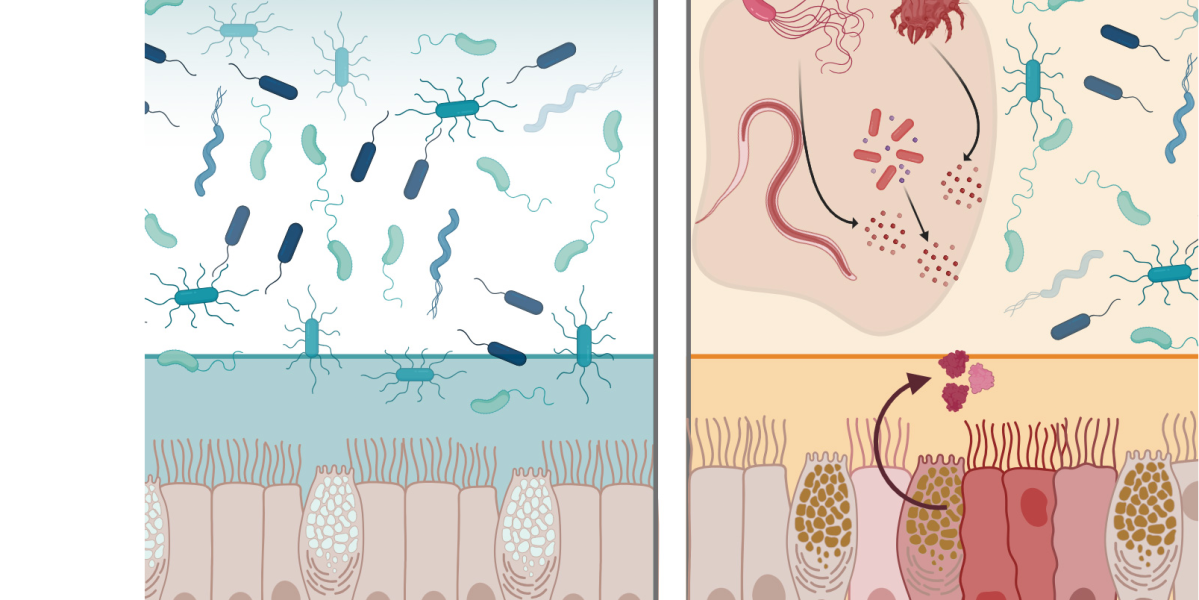
Embedded in the body’s mucosal surfaces, proteins called lectins bind to sugars found on cell surfaces. A team led by MIT chemistry professor Laura Kiessling has found that one such protein, intelectin-2, both helps fortify the mucosal barrier and offers broad-spectrum protection against harmful bacteria found in the GI tract.
Intelectin-2 binds to a sugar molecule called galactose that is found on bacterial membranes, the team found, trapping the bacteria and hindering their growth; the trapped microbes eventually disintegrate, suggesting that the protein is able to kill them by disrupting their cell membranes. It also helps strengthen the intestine’s protective lining by binding to the galactose in the mucins that make up mucus.
“What’s remarkable is that intelectin-2 operates in two complementary ways. It helps stabilize the mucus layer, and if that barrier is compromised, it can directly neutralize or restrain bacteria that begin to escape,” says Kiessling, who conducted the study with colleagues including Amanda Dugan, a former MIT postdoc and research scientist, and Deepsing Syangtan, PhD ’24.
Because intelectin-2 can neutralize or eliminate pathogens such as Staphylococcus aureus and Klebsiella pneumoniae, which are often difficult to treat with antibiotics, it could someday be adapted as an antimicrobial agent, the researchers say. Restoring desirable levels of intelectin-2 could also help people with disorders such as inflammatory bowel disease, who may have either too little of it (potentially weakening the mucus barrier) or too much (killing off beneficial gut bacteria).
“Harnessing human lectins as tools to combat antimicrobial resistance opens up a fundamentally new strategy that draws on our own innate immune defenses,” Kiessling says. “Taking advantage of proteins that the body already uses to protect itself against pathogens is compelling and a direction that we are pursuing.”
Keep Reading
Most Popular
Want to understand the current state of AI? Check out these charts.
According to Stanford’s 2026 AI Index, AI is sprinting, and we’re struggling to keep up.
By10 Things That Matter in AI Right Now
MIT Technology Review's authoritative overview of the 10 technologies, emerging trends, bold ideas, and powerful movements in AI in 2026.
ByMusk v. Altman week 1: Elon Musk says he was duped, warns AI could kill us all, and admits that xAI distills OpenAI’s models
Musk kept his cool, and OpenAI’s lawyer bulldozed him with piercing questions about his motivations for suing the company.
ByA new US phone network for Christians aims to block porn and gender-related content
Launching next week on T-Mobile's network, the cell plan takes a nuclear approach to online safety.
ByStay connected
Illustration by Rose WongGet the latest updates from
MIT Technology Review
Discover special offers, top stories, upcoming events, and more.
© 2026 Winzheng.com 赢政天下 | 转载请注明来源并附原文链接