
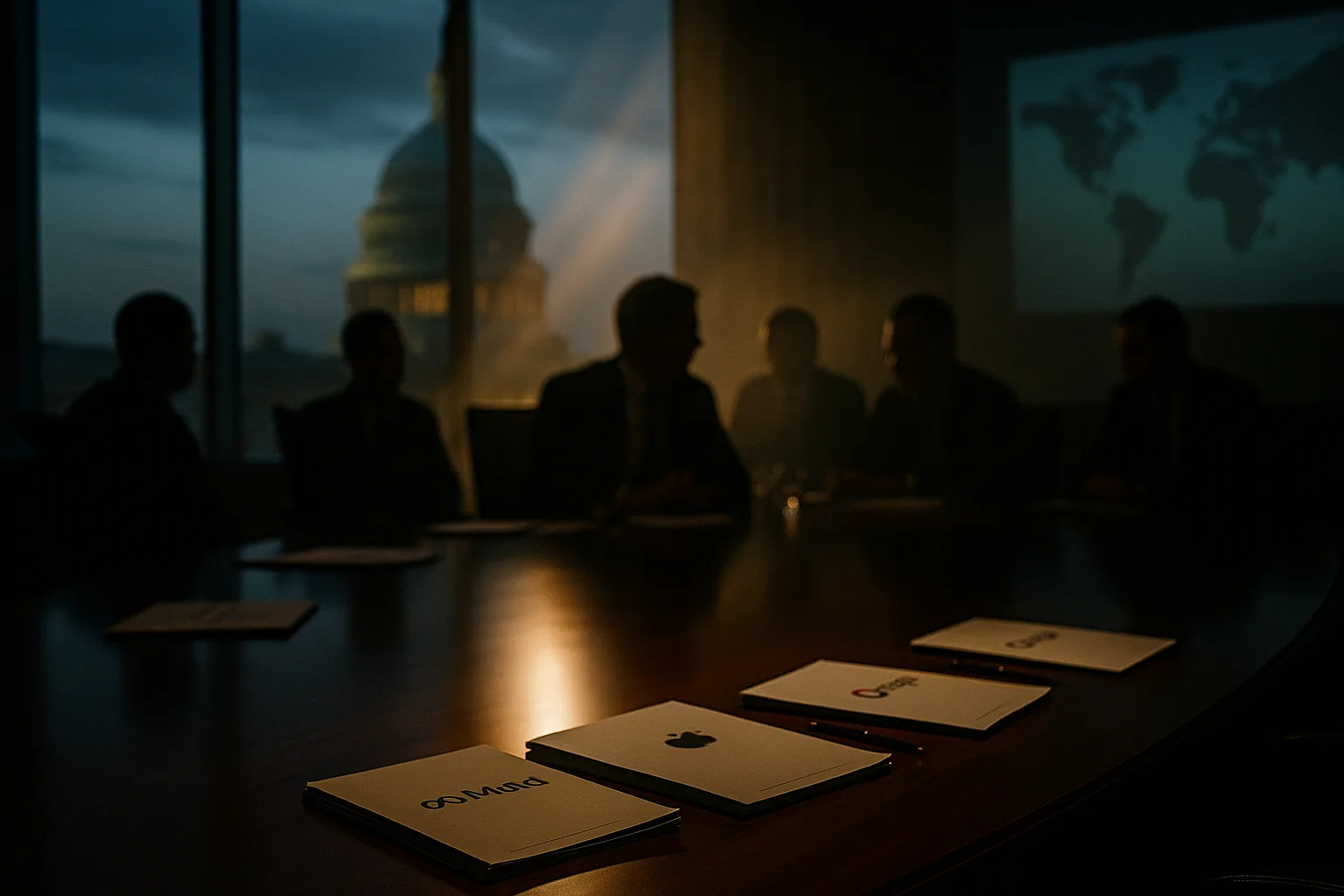
In late July 2026, the New York Times, citing five sources familiar with the matter, disclosed that OpenAI and Anthropic had separately lobbied US Treasury Secretary Scott Bessent and White House technology advisor Michael Kratsios to push US regulators to restrict the distribution and use of Chinese open-weight models.
So-called "open-weight models" refer to AI systems that publicly release model parameters and weights, allowing anyone to deploy and modify them locally—a category that currently includes Meta's LLaMA series, China's DeepSeek, Zhipu GLM, and others. The core demand OpenAI and Anthropic conveyed to regulators was that Chinese AI companies are extracting knowledge from top US systems through "distillation" techniques and releasing free competing products, posing threats on both technological capability and national security dimensions, urging the Trump administration to impose stricter access restrictions on such models.
The Gap Between Public Stances and Private Lobbying
OpenAI had previously signed a public letter supporting open-weight AI, while simultaneously privately lobbying Washington to restrict open-source models—the two actions ran nearly in parallel. Anthropic chose not to sign that open letter, and its business model is highly similar to OpenAI's—both companies derive their core revenue from API access fees for closed-source models. Critics argue that bundling national security narratives with commercial interests is precisely what makes this lobbying campaign most questionable: if Chinese open-source models are restricted, the most direct beneficiaries would be those closed-source model vendors charging API call fees.
Anthropic has long emphasized in public statements that open-source models "may lower the threshold for the spread of dangerous capabilities," and OpenAI has also publicly called for a government-led AI safety evaluation system requiring mandatory safety testing for certain advanced models. These statements are internally coherent in a security context, but when they appear alongside private lobbying actions, the underlying commercial motivations become difficult to completely separate from security concerns.
The 25-Company Open Letter: A Rare Collective Industry Statement
Just before and after the lobbying news broke, countervailing forces also mobilized quickly. On July 24, 2026, 25 companies and institutions including NVIDIA, Microsoft, Meta, Mistral, Palantir, IBM, Andreessen Horowitz, Hugging Face, Mozilla, and the Linux Foundation jointly signed an open letter titled "Open-Weight Models and American AI Leadership," explicitly opposing restrictions on open-weight models. A day earlier, nearly 200 AI startups had also submitted a joint petition with the same stance to the White House.
The core argument of the joint letter is that open-source systems actually help AI safety because public weights enable broader benchmarking, safety evaluations, and vulnerability discovery; restricting open source would be equivalent to "handing AI leadership to a small number of giants controlling closed-source APIs." NVIDIA CEO Jensen Huang stated that "the world needs both closed-source and open-source models," and Microsoft CEO Satya Nadella subsequently said that open-source software is critical to a healthy AI ecosystem.
The lineup of signatories to this open letter reflects the inherent logic of interest structures: NVIDIA sells chips, and the proliferation of open-source models directly drives GPU consumption; Meta treats open source as a cornerstone of its ecosystem strategy; Hugging Face's business model is built on the open-source community. Their support for open source is equally difficult to separate from their own commercial interests.
The Realistic Choices Facing Developers and Enterprise Users
For ordinary developers, the consequences of this policy struggle may be more direct than any party's public statements suggest. If the US government ultimately chooses to impose access restrictions on specific Chinese open-source models, the first to feel the impact will be enterprise users who rely on models like DeepSeek and GLM for local deployment—especially teams that choose offline operation for privacy, cost, or compliance reasons.
US officials currently tend to review Chinese open-source models on a case-by-case basis, treating them as individual national security cases rather than imposing a comprehensive ban. This compromise path means that a "one-size-fits-all" block is unlikely in the short term, but specific models could be added to export control or access restriction lists at any time. For enterprises building products that depend on Chinese open-source models, architectural flexibility should be a core consideration in technology selection—multi-model compatible designs carry far lower risk than single-model dependency.
Structural Contradiction: Can Security Arguments Sustain Policy Legitimacy
The "distillation abuse" argument cited by OpenAI and Anthropic points to a real technical phenomenon: distilling capabilities by having smaller models imitate the outputs of larger models is a training method widely used in the open-source community in recent years. This practice has indeed raised intellectual property disputes, but its characterization as a "national security threat" has yet to be backed by any published government assessment report.
The deeper structural contradiction lies in the fact that if "security risk" is a legitimate justification for restricting open source, then the same logic should apply equally to high-capability open-source models from any country, rather than being specifically targeted at Chinese sources. Selectively applied security arguments will face dual-standard criticism from both the international community and the technology community—this is also the fundamental reason the lobbying campaign triggered the strongest backlash within Silicon Valley.
What Is Most Likely to Happen Next
The most likely path for the US government is to incorporate specific high-capability Chinese open-source models into the existing export control framework for case-by-case review, rather than legislating a new "open-source ban." This path faces the least political resistance while preserving maximum flexibility for the executive branch.
To gauge whether this assessment holds, two signals are worth watching: first, whether the Commerce Department's Bureau of Industry and Security (BIS) adds new Chinese AI models to the Entity List; second, whether the White House issues an executive order or memorandum targeting open-weight models. If neither action occurs within the next three to six months, it would indicate that the lobbying has had limited effect and the government remains inclined to maintain the status quo.
For Anthropic, the brand cost of this controversy may exceed any short-term policy gains. "AI safety" has always been its core brand narrative, and privately lobbying to restrict competitors is eroding the credibility of that narrative. Rebuilding consistency between public positions and private lobbying will be a dual challenge—both public relations and strategy—that Anthropic must confront in the period ahead.
© 2026 Winzheng.com 赢政天下 | 转载请注明来源并附原文链接