
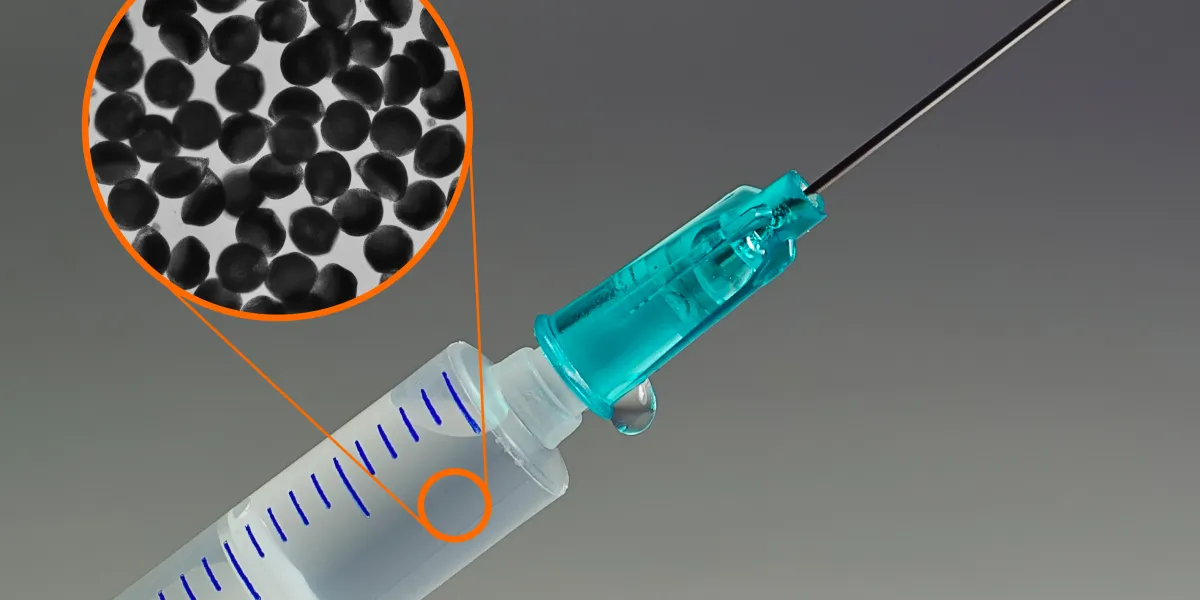
Antibody treatments for cancer and other diseases are typically delivered intravenously, requiring patients to go to a hospital and potentially spend hours receiving infusions. Now Professor Patrick Doyle and his colleagues have taken a major step toward reformulating antibodies so that they can be injected with a standard syringe, making treatment easier and more accessible.
The obstacle to injecting these drugs is that they are formulated at low concentrations, so very large volumes are needed per dose. Decreasing the volume to the capacity of a standard syringe would mean increasing the concentration so much that the solution would be too thick to be injected.
In 2023, Doyle’s lab developed a way to generated highly concentrated antibody formulations by encapsulating them into hydrogel particles. However, that requires centrifugation, a step that would be difficult to scale up for manufacturing.
In their new study, the researchers took a different approach that instead uses a microfluidic setup. Droplets containing antibodies dissolved in a watery prepolymer solution are suspended in an organic solvent and can then be dehydrated, leaving behind highly concentrated solid antibodies within a hydrogel matrix. Finally, the solvent is removed and replaced with an aqueous solution.
Using semi-solid particles 100 microns in diameter, the team showed that the force needed to push the plunger of a syringe containing the solution was less than 20 newtons. “That is less than half of the maximum acceptable force that people usually try to aim for,” says Talia Zheng, an MIT graduate student who is the lead author of the new study.
More than 700 milligrams of the antibody—enough for most therapeutic applications—could be administered at once with a two-milliliter syringe. The formulations remained stable under refrigeration for at least four months. The researchers now plan to test the particles in animals and work on scaling up the manufacturing process.
Keep Reading
Most Popular
Want to understand the current state of AI? Check out these charts.
According to Stanford’s 2026 AI Index, AI is sprinting, and we’re struggling to keep up.
By10 Things That Matter in AI Right Now
MIT Technology Review's authoritative overview of the 10 technologies, emerging trends, bold ideas, and powerful movements in AI in 2026.
ByMusk v. Altman week 1: Elon Musk says he was duped, warns AI could kill us all, and admits that xAI distills OpenAI’s models
Musk kept his cool, and OpenAI’s lawyer bulldozed him with piercing questions about his motivations for suing the company.
ByA new US phone network for Christians aims to block porn and gender-related content
Launching next week on T-Mobile's network, the cell plan takes a nuclear approach to online safety.
ByStay connected
Illustration by Rose WongGet the latest updates from
MIT Technology Review
Discover special offers, top stories, upcoming events, and more.
© 2026 Winzheng.com 赢政天下 | 转载请注明来源并附原文链接