
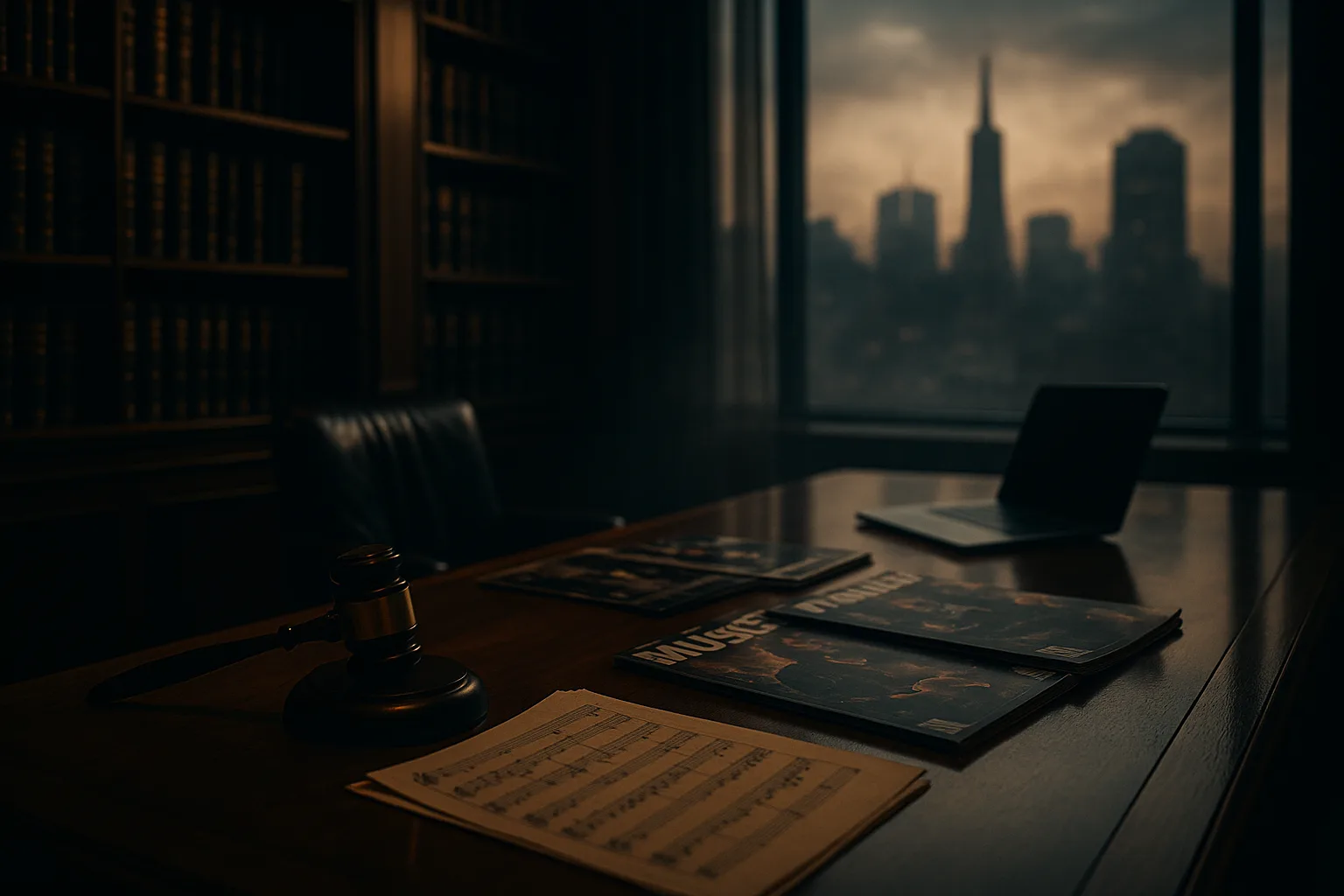
On August 28, 2026, Sony Music Publishing and Warner Chappell Music jointly filed a lawsuit in the U.S. District Court for the Northern District of California, naming Anthropic, its Chief Executive Officer Dario Amodei, and co-founder Benjamin Mann as defendants. The complaint is sharply worded, characterizing the conduct as "one of the largest and most brazen ongoing thefts of intellectual property in history," with damages theoretically reaching billions of dollars.
A Full Battlefront Takes Shape: All Three Giants in the Fight
According to Music Business Worldwide, before Sony and Warner's move, music copyright litigation against Anthropic had already built up through four rounds: Universal Music Publishing Group, Concord Music Group, and ABKCO filed the first lawsuit in Nashville in October 2023, involving approximately 500 works, with the case later transferred to a California court; in January 2026, the same plaintiffs expanded their claims, filing again with more than 20,000 works and seeking over $3 billion in damages; in March 2026, BMG filed a third lawsuit over 493 songs; and on August 17, Round Hill Music filed a fourth.
Sony and Warner's entry completes the final piece of the puzzle: Universal (UMPG), Sony (SMP), and Warner (WCM)—the three mainstays of the global popular music industry—are now all aimed at the same defendant.
The new complaint lists specific tracks allegedly infringed, including "Ain't No Mountain High Enough," "All I Want for Christmas is You," and "Eye of the Tiger." The plaintiffs invoke statutory damages under copyright law: up to $150,000 per work for willful infringement and up to $25,000 per instance for removal of copyright management information—given the "tens of thousands" of infringing works cited in the complaint, the theoretical total easily enters the tens of billions of dollars range.
The Shadow of the $1.5 Billion Precedent
Roughly 40 days before this lawsuit landed, Anthropic had just completed a highly instructive settlement. According to TechCrunch, on July 20, 2026, U.S. District Judge Araceli Martínez-Olguín formally approved the settlement in Bartz v. Anthropic: Anthropic agreed to pay authors and publishers $1.5 billion, setting a record for the largest settlement in copyright class-action history.
That figure cuts both ways in the music copyright litigation: it shows plaintiffs that Anthropic has both the willingness and the ability to settle; and it signals to the defendant that the cost of continued litigation may far exceed an out-of-court resolution. But the music publishers' fight differs from that of book authors—lyrics carry more concentrated commercial value, more precise rights ownership, more mature licensing models, and market-harm arguments that are easier to establish at the legal level.
Individual Defendants: A Rare Form of Legal Pressure
The complaint separately lists Amodei and Mann as individual defendants, an arrangement rarely seen in copyright litigation against tech companies. The allegations against Amodei and Mann are framed as contributory infringement—that as decision-makers, both knew of and drove the large-scale appropriation of copyrighted works.
The practical significance of this strategy: even if Anthropic the company ultimately collapses or is acquired, the claims against the individual defendants can still proceed independently; at the same time, it imposes personal-level legal risk on the company's founders, fundamentally changing the negotiation dynamics. In Silicon Valley, corporate-level litigation is typically managed as an operational risk, but legal action involving founders personally tends to trigger a completely different response mechanism.
The Contested Terrain of Fair Use
Anthropic is not without legal arguments. In the aforementioned book copyright case, a federal judge ruled that Anthropic's use of books to train AI constituted "fair use," on the grounds that the conduct was "highly transformative." Anthropic has also invoked fair-use arguments in the music copyright cases and successfully blocked the publishers' motion for a preliminary injunction in early proceedings—the court found that the publishers had failed to demonstrate "irreparable harm."
However, that path is not smooth. In February 2025, the final judgment in Thomson Reuters v. Ross Intelligence held that AI training data does not qualify as fair use, with market harm being the decisive factor. Two conflicting precedents now coexist, meaning the final ruling will hinge heavily on the judge's specific assessment of "market substitutability"—lyrics, as a content form with a fully developed licensing market, present a more direct market-harm argument than prose books.
The Systemic Risk of Training Data
Evidence from multiple lawsuits shows that Anthropic used copyrighted content downloaded through the BitTorrent network in training Claude and systematically stripped Copyright Management Information during data processing. If this fact is confirmed in court, the legal consequences would be far more severe than mere "unintentional infringement"—the deliberate removal of copyright identifiers is an independent violation explicitly prohibited by the Digital Millennium Copyright Act and does not enjoy a fair-use defense.
This also explains why Sony and Warner separately list "removal of copyright management information" as a cause of action, with an independent claim of $25,000 per instance—an aggravating provision specifically designed for deliberate evasion of copyright tracking, operating on a different legal plane from the fair-use defense.
The Industry Domino Effect
If the litigation proceeds as the plaintiffs expect, its impact will extend beyond Anthropic as a single company. Major AI companies such as OpenAI, Google, and Meta have built large training corpora in similar ways, and most have not yet completed comprehensive copyright audits of their training data sources.
More importantly, there are precedents for cooperation between the music industry and AI companies. Spotify and YouTube have established mature copyright licensing mechanisms over the years, covering scenarios from streaming to AI-generated content. Sony and Warner are both litigants and the sellers best positioned to offer legitimate licenses at the negotiating table—this lawsuit is less about eliminating AI music applications outright than about forcing AI companies to sit down and purchase, at normal market prices, the content they have already used extensively.
Assessment
Anthropic's legal pressure has entered a phase of structural escalation: the publishing divisions of all three major record groups are suing simultaneously, individual founders are named as defendants, and the $1.5 billion book settlement has established both its capacity to pay and its willingness to negotiate. This is no longer a single-point risk that can be dissolved through prolonged litigation delay.
The more important assessment: this litigation will most likely not conclude with a definitive ruling on the fundamental question of "whether AI can use copyrighted content," but rather with industry-level licensing agreements negotiated between the parties. The copyright holders' goal is to establish a licensing system and obtain compensation, not to technologically eliminate generative AI—after all, the commercialization of AI-generated content is becoming one of their new revenue streams. But before that, every AI company must answer a question it has previously avoided: whose content is in your training data, and how was it obtained?
© 2026 Winzheng.com 赢政天下 | 转载请注明来源并附原文链接