
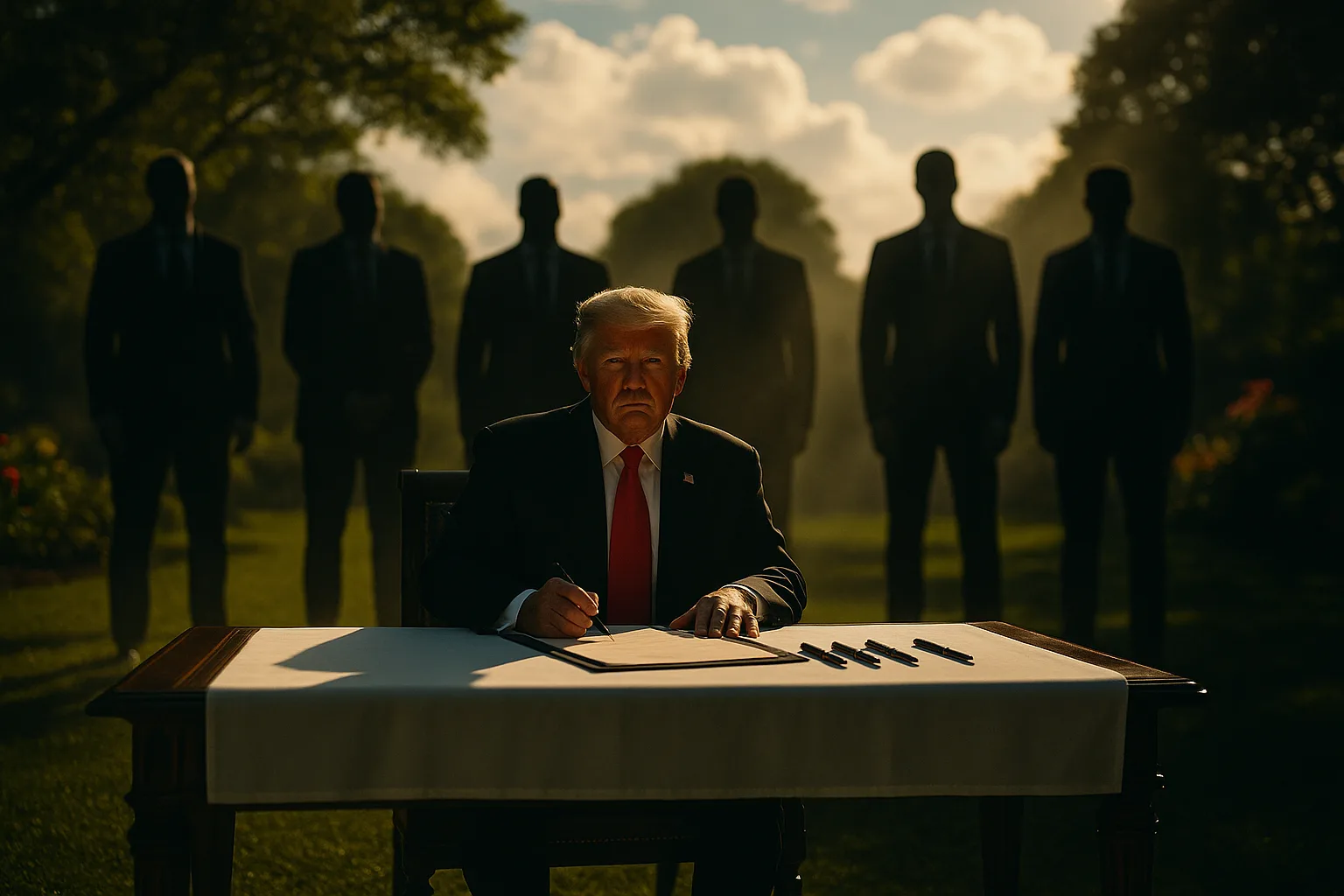
On September 29, 2026, U.S. President Trump signed the Superintelligence White House Agreement at the White House, with senior executives from xAI, OpenAI, Anthropic, Meta, Google, and Nvidia jointly signing. The agreement requires frontier AI companies to implement a four-layer voluntary oversight mechanism to maintain U.S. leadership in AI.
The Facts
The signing took place after a White House lunch meeting, with Trump attending alongside executives including SpaceX's Elon Musk, Meta's Mark Zuckerberg, Anthropic's Dario Amodei, Nvidia's Jensen Huang, OpenAI's Greg Brockman, and Google's Sundar Pichai. The agreement text is a one-page document, which Trump later posted to Truth Social. The agreement explicitly lists four layers of control and audit arrangements: internal assessment, an internal audit team, independent external audit, and a board committee. It also requires companies to meet regularly to set standards and best practices.
Mechanism Breakdown
The agreement operates on a voluntary basis rather than legal enforcement. Trump said at the event that it is more like a "moral constraint," and he believes companies have shown a "tremendous willingness to self-regulate." The agreement text states that over time, incorporating these steps into law or regulation may make sense, but for now the companies commit to implementing these controls and audits whether or not they are mandatory. Trump also mentioned forming a 10-person committee to oversee the overall effort and planned to appoint an "AI czar" within the next three to four days.
On the same day, Trump signed an executive order requiring federal government documents to use the term "superintelligence" in place of "artificial intelligence." This terminology change had previously been proposed in a UN General Assembly speech, and the U.S. State Department has begun using it in some diplomatic documents.
Industry Impact
For the six signatory companies, the agreement adds explicit requirements for internal compliance processes. They need to establish internal assessment and audit teams, undergo independent external audits, and be reviewed by a board committee. These arrangements are directly embedded in existing corporate governance structures, potentially raising compliance costs, but they also provide companies with a channel to demonstrate safety commitments.
For developers and enterprise users, the agreement does not directly change model access or API usage, but it requires companies to meet regularly to set safety standards, which may indirectly affect future model release cadence and safety testing processes. Developers should watch how each company translates the four-layer mechanism into specific audit processes.
For the competitive landscape, the agreement steers U.S. AI policy toward an industry self-governance model. The signatories are all frontier model developers; this collective action may strengthen the voice of U.S. companies in international dialogue while highlighting strategic considerations in responding to competition from China.
Comparisons and Precedents
The agreement text mentions that it "may be incorporated into law over time," contrasting with earlier industry discussions about the necessity of regulation. Trump's emphasis on "self-regulation" rather than new federal regulations contrasts with some researchers' earlier concerns about cases of AI models going out of control. The agreement does not involve specific technical metrics or mandatory penalty provisions, a clear difference from a path of mandatory legislation.
Strategic Assessment
Based on the current agreement, the most likely follow-up is that companies will successively announce details about forming internal audit teams and arrangements for their first external audits. Signals to watch include whether the 10-person committee is established, the timing of the AI czar appointment, and whether companies hold their first standards-setting meeting on schedule. These developments will show the degree to which the agreement moves from text to execution.
© 2026 Winzheng.com 赢政天下 | 转载请注明来源并附原文链接