
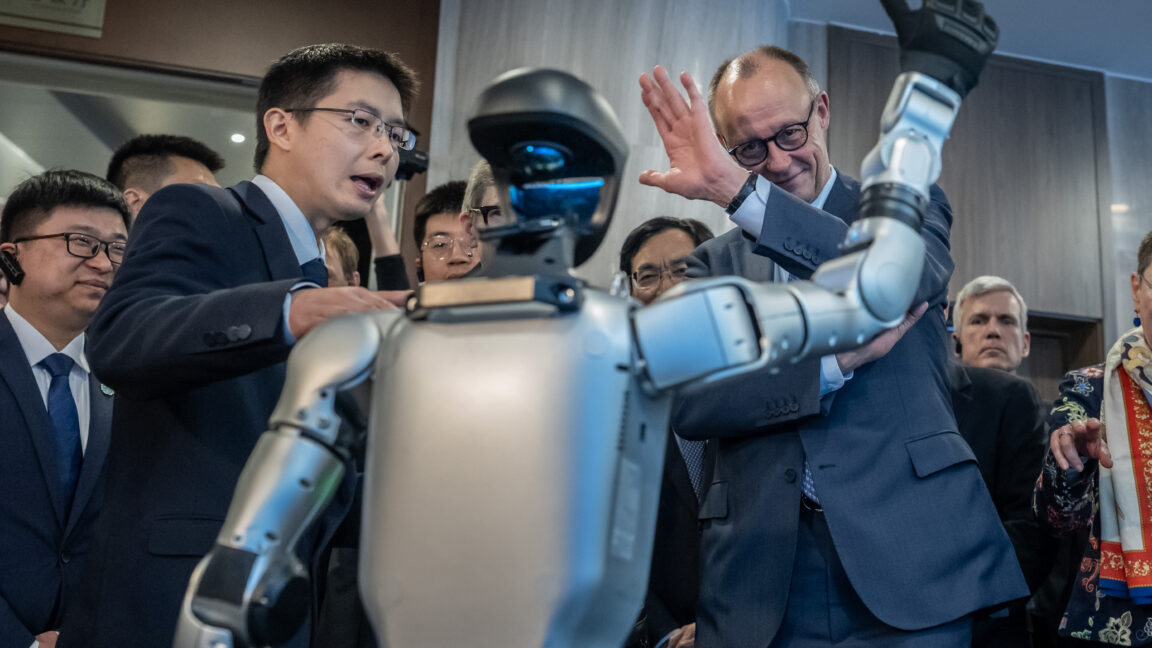
In the global humanoid robot race, Unitree Robotics is being remembered by the outside world for one distinctive label: affordability. Ars Technica noted in its report that Unitree’s lead in low-cost humanoid robots does not come solely from supply chain advantages, but is closely tied to founder Wang Xingxing’s long-standing commitment to extreme cost control. From quadruped robots to humanoid robots, Unitree’s product strategy has consistently centered on “making robots more like consumer electronics rather than laboratory prototypes.”
Wang Xingxing’s management style is described as highly hands-on, detail-oriented, and even somewhat “micromanaging.” He focuses not only on product direction, but also gets deeply involved in component selection, structural design, manufacturing costs, and mass-production efficiency. For a hardware robotics company, this approach has clear advantages: robots are not purely software products, and the choice of any joint, motor, reducer, sensor, or casing material directly affects price, reliability, and scalability.
Low Cost Does Not Mean Low Tech, but Systems Engineering
Humanoid robots have long been regarded as cutting-edge products with high costs and high barriers to entry. Tesla Optimus, Boston Dynamics Atlas, and solutions from many startups all need to strike a balance among motion control, perception, power systems, and AI models. Unitree’s approach places greater emphasis on engineering feasibility: first make the hardware platform cheap enough and suitable for mass production, then seek commercial opportunities through software and application iteration.
This path is highly aligned with China’s manufacturing ecosystem. The mature electronics, machining, mold-making, power system, and contract manufacturing networks in the Yangtze River Delta and Pearl River Delta enable robotics companies to complete prototyping and iteration at lower cost. Unitree started with quadruped robots, accumulated experience in motor control, motion algorithms, and overall machine structure, and then transferred that expertise to humanoid robots, forming a relatively coherent product path.
The core question raised by the report is not “why Unitree is cheap,” but “whether this low-cost system, strongly driven by the founder, can remain effective as the company grows.”
The Benefits and Risks of Founder-Driven Execution
In the early stages of a startup, when the founder personally oversees products, pushes down costs, and manages delivery, execution efficiency can often be significantly improved. Especially in an industry like humanoid robots, which has not yet been fully standardized, decision-making speed may matter more than organizational processes. Wang Xingxing’s engineering background has made Unitree more pragmatic in product definition: less focus on technological showmanship, more focus on machines that can be demonstrated, sold, and iterated.
But as the company enters larger-scale competition, the same management style may also become a bottleneck. The future of humanoid robots will not only be a hardware business; it will also involve AI capabilities, developer ecosystems, after-sales service, safety compliance, international market channels, and implementation in enterprise-level scenarios. If all key judgments depend on the founder’s personal experience, it will be difficult for the company to expand across multiple fronts at the same time. How Unitree upgrades from “the founder personally pushing down costs” to “the organization systematically controlling costs” will determine whether it can maintain its lead.
Humanoid Robots on the Eve of a Price War
Over the past two years, the narrative in the humanoid robot industry has changed. In the early market, attention focused on whether robots could perform demonstration actions such as running, jumping, carrying objects, and opening doors; today, the focus has shifted more toward price, reliability, mass-production scale, and real-world scenarios. With advances in large models, multimodal perception, and on-device computing power, the robot “brain” is evolving rapidly, but the “body” is still constrained by cost and durability. Whoever can bring hardware prices low enough is more likely to be the first to enter education, research, exhibitions and performances, light industry, and service scenarios.
Unitree’s low-cost strategy therefore has demonstrative significance for the industry. It proves to the market that humanoid robots do not necessarily have to be expensive projects confined to the laboratories of tech giants; they can also follow the path of consumer electronics and industrial hardware to reduce costs quickly. However, low prices also mean thinner profit margins, placing higher demands on supply chain management, quality control, and after-sales systems. Once product scale expands, even a small failure rate could turn into a huge operating cost.
Editor’s Note: Affordability Is Only the First Ticket In
Unitree’s story reminds the industry that competition in humanoid robots is not a contest over a single technology, but a comprehensive battle over cost, engineering, supply chain, and product cadence. Wang Xingxing-style strong execution has given Unitree a differentiated advantage in the early stage; but in the next phase, the real test will be organizational capability and ecosystem capability. Low prices can open the market, but they do not automatically create a moat. Only when robots are affordable, reliable, and able to create value in real tasks can cost leadership be converted into long-term competitiveness.
This article was compiled from Ars Technica.
© 2026 Winzheng.com 赢政天下 | 转载请注明来源并附原文链接