
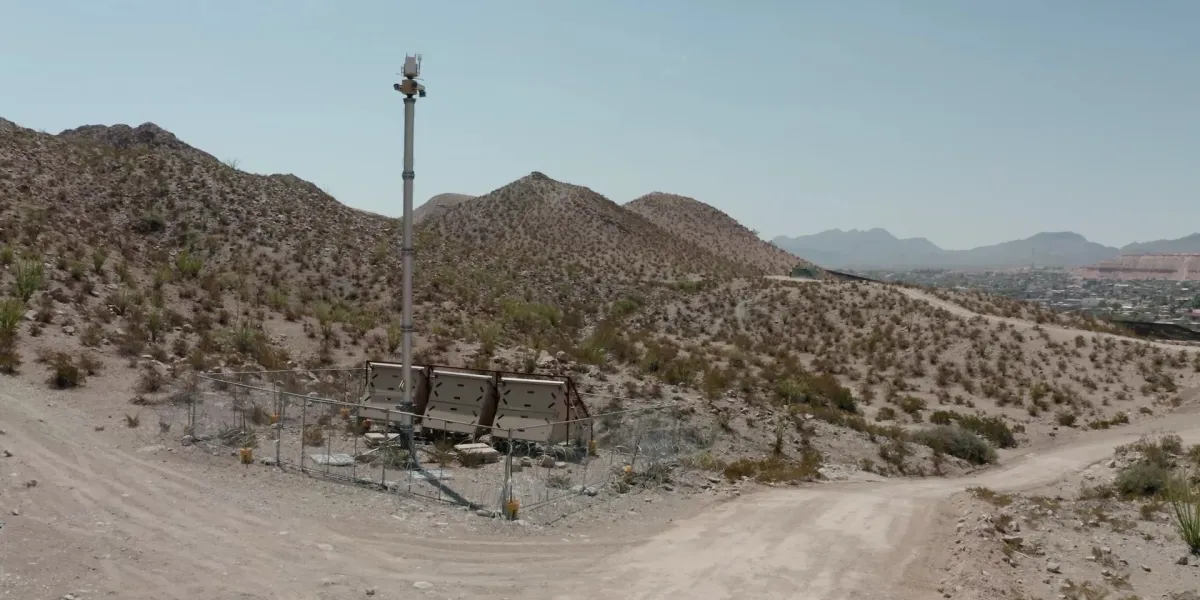
When José Morales Bernal crossed the border into the United States on April 8, 2024, the day before his 32nd birthday, it should have triggered a chain of technological alerts and human responses.
As he walked through the desert in southern New Mexico that morning, he was within range of three surveillance towers. Newly installed by US Customs and Border Protection (CBP), they were built by the defense tech company Anduril and equipped with cameras and AI to automatically detect and track people. They transmit live video to nearby control rooms and can send alerts to the government-issued smartphones held by agents in the area, prompting the closest available to respond.
This story is part of Dying on Camera, a collaboration between MIT Technology Review and Times of San Diego. Journalists in both newsrooms spent the past year examining the failures of border surveillance technology and uncovering the stories of the people who die in the borderlands.
These AI-enabled towers are meant to give greater visibility across the 1,951-mile southern border, freeing up border agents from having to spend hours staring into video monitors. They were installed in this particular place to spot border crossers before they reached the nearby town of Sunland Park.
If the system worked as intended, Morales should have been apprehended. If he needed medical help, agents were trained to provide it.
 The view from where José Morales Bernal’s body was found toward a Customs and Border Protection surveillance tower made by Anduril, along the southern US border in Sunland Park, New Mexico.CENGIZ YAR FOR MITTR
 That didn’t happen. Despite the nearby surveillance towers, it was employees of the local landfill, rather than Border Patrol, who first spotted Morales that morning. At 1 p.m. the workers saw him again, now lying in the sand. At 4 p.m. the landfill workers saw that he had not moved and called Border Patrol. Agents arrived 45 minutes later. He was dead. When an agent then called 911 to report the body, he said it was “probably one of the migrants crossing through there,” seemingly unaware that Morales had been moving near the agency’s surveillance systems earlier that day.
The agent can be heard sounding unsure of Morales' movements despite the proximity of an AI-powered surveillance camera. The call has been edited for length.Morales had died just 360 feet from the closest surveillance tower. Two more towers stood watch to the east and the west. An autopsy later concluded that he had died of “environmental exposure.”
The towers surrounding Morales were only the latest addition to the “virtual wall” the government has spent 25 years and billions of dollars building along the entire border, which also includes earlier generations of towers with more basic features, as well as blimps, drones, seismic sensors, and even tunnel-sensing robots. Together, all this technology provides “persistent surveillance” and “situational awareness” to help the Border Patrol quickly and accurately detect people crossing and, crucially, make sure agents are sent to intercept them. CBP has also credited it with saving lives.
But a first-of-its-kind investigation by MIT Technology Review reveals that deaths like Morales’s are startlingly common. We cross-referenced nearly 4,000 locations where human remains were found—drawn from records collected by nonprofit groups like No More Deaths and Humane Borders, as well as hundreds of records we obtained in Texas—with information on nearly 600 towers identified by the Electronic Frontier Foundation. We considered when towers were installed and when each person is estimated to have died, and combined this information with field reporting from the border. The result is the first comprehensive map and analysis of deaths near CBP surveillance towers.
Our investigation shows that a humanitarian crisis at the border has unfolded in view of the government’s own cameras.
 José Morales Bernal died the day before his 32nd birthday. PHOTO COURTESY MIREYA MORALES
 We found more than 1,050 people who died within range of border surveillance towers between 2015 and early 2026. These deaths are not failures of a few towers or technologies: We found deaths within the advertised range of nearly two-thirds of all the towers we analyzed. Our topographical analysis—which assessed the degree to which terrain might block a tower’s view of a particular death and its surveillance area in general—found that some have sight of as little as 10% of their advertised surveillance area, and yet we also found most deaths did not occur in towers’ blind spots. These deaths are not the result of legacy systems, as our estimate found more than 110 people have died within range of modern autonomous towers from Anduril, among the most advanced systems CBP has deployed, since 2021.
The overall picture reveals repeated failures of one of the virtual wall’s basic security functions, as CBP has described it in press releases: to effectively identify and locate migrants entering illegally into the United States.
The year that Morales died, 18 other people died in that same stretch of desert in range of the three Anduril towers. Five were visible from the same surveillance tower closest to where his body was discovered.
One man, after walking a mile past the border and in range of two AI towers, dragged his 30-year-old brother into the shade when he began having trouble breathing, according to records we obtained from the medical examiner. The two were spotted by Border Patrol only when the man waved down a helicopter for help; by the time agents arrived, his brother was already dead. A 24-year-old woman died near another Anduril tower, where our terrain analysis showed it should have had clear sight of her location. Her body lay unnoticed for weeks; it was decomposed, and blistered by the summer heat, when it was spotted by agents patrolling the area.
A few miles west, and a short drive from a Border Patrol station, four other AI towers stood watch. Near them, 10 more bodies were found that year, all in locations where at least one tower had a clear view.
In response to a list of questions, an Anduril spokesperson replied that once a tower is delivered, it is operated by CBP, and directed questions about specific incidents to the agency. The response noted that an incident occurring nearby does not mean the tower missed a detection and said actual surveillance ranges vary depending on terrain, physical obstructions, and the boundaries CBP sets for where the tower should look (CBP is able to set virtual boundaries on towers’ views for privacy and other reasons). The Anduril spokesperson also alleged inaccuracies in our reporting, given those boundaries and obstructions, but did not respond to follow-up questions on what was inaccurate.
The most pressing question in any death near the virtual wall is whether authorities knew someone was there and failed to reach them or weren’t aware anyone was crossing at all. Either is a system failure. And the deaths we found capture only the failures that left a trace—we don’t know how many people pass through undetected, or how many bodies remain undiscovered.
Interviews with more than 45 people—including current and former White House advisors and presidential appointees, Border Patrol agents, medical examiners, sheriffs, humanitarian volunteers, and employees of tech companies—showed that both types of failures are occurring: The technology is failing to detect, and agents are failing to respond. Both show the limits of throwing technology at a complex problem.
The findings reveal previously unreported issues with the virtual wall, even as it continues to enjoy broad political support and a surge in federal spending. Border security hardliners have long seen it as another tool for stopping smugglers moving drugs or people, while others tout it as a cheaper alternative to a physical wall. In 2023, the government estimated that its plans for using the towers, which now number 803, would cost $6.2 billion over their lifespan. With the historic levels of funding it was awarded in 2025, CBP plans to spend $1 billion for 1,497 more towers by 2034.
But our reporting shows that CBP has done little to assess how its towers are working or how many people have died where they keep watch.
Officials who oversaw border security across the last four presidential administrations told us they believed deaths near the so-called virtual wall were either exceedingly rare or nonexistent. But our reporting shows that is not the case. None could point to any comparable analysis the government had ever conducted on its own. Former agents and officials also told us that when someone’s body is found, CBP does not formally investigate whether surveillance should have detected them or, if they were detected, why agents didn’t reach them before they died.
In response to nearly 30 questions about our findings, which covered multiple generations of technology, Hilton Beckham, CBP’s assistant commissioner for public affairs, said, “Autonomous surveillance towers use artificial intelligence to detect and classify people, vehicles, and animals and alert Border Patrol agents to activity in monitored areas … ASTs complement physical barriers and other border security infrastructure by improving detection and situational awareness between ports of entry. CBP evaluates the technology based on its impact on detection, response coordination, agent safety, and mission outcomes.”
“I’m sure that the cameras and other surveillance assets do deliver … useful intelligence and enhance operational efficacy in some places, under some conditions, in certain circumstances,” says Geoff Boyce, an assistant professor of geography at University College Dublin who has studied surveillance technology used at the US southern border. “I’m also absolutely positive—because this has been the track record—it is not delivering the level of operational support, information, or efficacy that either the companies delivering these infrastructures or the Border Patrol and Department of Homeland Security claim.”
We also reached out to multiple lawmakers from both parties with a summary of our findings. In response, Delia Ramirez, a Democrat representing Illinois’ 3rd district who sits on the House Homeland Security Committee, said, “AI-powered surveillance technologies are not making us safer. Yet, DHS continues to spend millions of taxpayer dollars on these ineffective, negligent technologies, with no commitment to oversight or transparency...It is clear we must terminate CBP’s Integrated Surveillance Tower program and dismantle DHS."
Building the virtual wall
Since its earliest efforts to police the border with Mexico, the US government has faced the same basic challenge: How do you effectively secure nearly 2,000 miles of remote and rugged terrain? It has increasingly turned to technology for answers.
Gerardo Galvan joined Border Patrol in 1995, as the government was undertaking an unprecedented expansion of border enforcement. In 1993, President Clinton’s first year in office, the agency mobilized huge numbers of agents to guard the country’s urban borders, starting in El Paso, Texas. That pushed more crossings to rural, unpopulated areas—which quickly proved to be far more deadly because of the rugged desert terrain, extreme temperatures, scarcity of water and the long, indirect routes often used by smugglers.
Stopping these remote crossings was a new law enforcement challenge for the agency, especially given the limited technology available at the time. “We had radios,” says Galvan, who would go on to be the head of operations for the El Paso sector—not the cell phones or GPS systems agents have today. They relied on underground sensors left over from the Vietnam War to alert them to movement.
The biggest technology rollout of Galvan’s early career started around 1998. That was when Border Patrol began installing its first video cameras that agents could remotely pan and zoom. They were mounted on metal structures similar to cell-phone towers, 60 to 80 feet tall, or on buildings in urban areas.
“For the first time, somebody sitting in a room somewhere was able to surveil large swaths of area without being dependent on getting an agent out there with binoculars,” says Matthew Hudak, a former deputy chief of Border Patrol who was working as a frontline agent at the time. “That was a very significant game changer, and for the most part, it was a huge, huge advance.”
This early iteration of the virtual wall was a big deal: In its first eight years, 200 towers were installed along the southern border at a cost of more than $429 million. But the system’s flaws were obvious to anyone who used it.
“There could be … 30 screens on a wall,” says Mark Borkowski, who managed CBP contracting, including the surveillance tower program. Each camera might be capable of seeing three or five miles in any direction. The agent was expected to keep eyes on all that space—upwards of 850 square miles.
 Monitors inside the cab of a Border Patrol truck show a portion of the US-Mexico border in Sunland Park, New Mexico, on Thursday, June 6, 2019. CEDAR ATTANASIO/AP PHOTO
 “Well, what are the chances after 20 minutes that those Border Patrol agents would see an explosion on one of those screens?” Borkowski says. “About zero.”
When these cameras were first being put up, the plan was to pair them eventually with a system that would automatically direct them toward places where sensors picked up activity, so agents would know where to look. But by 2005, the DHS inspector general said that still hadn’t materialized, and that illegal activity might “go unnoticed” unless agents were actively watching the cameras. Nonetheless, more towers were installed, forming what is today known as the Remote Video Surveillance System (RVSS). In 2013, the defense giant General Dynamics won a contract worth up to $103 million to overhaul and expand RVSS along the border, becoming the primary contractor behind the system that remains in use today. (That contract eventually grew to a ceiling of $216 million, and the company received another award in 2023 worth up to $135 million.)
General Dynamics would install more cameras, better sensors, and additional towers. But the problem identified nearly 15 years before remained unsolved. It was information overload: One agent told MIT Technology Review about an incident in San Diego in which cameras captured a group of 30 crossing the border and getting picked up in a van, all unnoticed by the agent monitoring those cameras. Agents said the virtual wall was bringing more of the border into view than they could reasonably pay attention or respond to.
The camera room was also the job nobody wanted. New Border Patrol agents, often in their early 20s, want to be outside in trucks and ATVs, not sitting in a dark room watching screens—even though the expanding virtual wall increasingly required someone to do exactly that. “Someone that’s injured and can’t go out into the field—we’ll send them to the camera room,” says Rafael Reyes, who was in charge of the Border Patrol station in Deming, New Mexico, until 2024.
Reyes says it was also a job his agents were often too busy to do properly. His station area had about 30 cameras, and the agents responsible for them also had to monitor sensor alerts and radio traffic, run records checks, and coordinate with other agents. “Then if they have some time, they’ll monitor the cameras,” he says.
Not only that, but many cameras didn’t work. At Reyes’s station in New Mexico, five of the 30 cameras were broken on any given day, he says. Others had limited functionality; they might be capable of looking in just one direction or seeing only in the daytime. Jaime Fierro, a former agent who worked in the Laredo sector in Texas until 2025, said the broken towers were tanking morale among agents and that they brought it up at every staff meeting. “That was like basically having an eye shut for us on the border,” he says.
 Rafael Reyes, who oversaw a Border Patrol station in New Mexico, says his agents often had too many other responsibilities to monitor the cameras properly. CENGIZ YAR FOR MITTR
 They weren’t alone: In 2024, members of the House Committee on Homeland Security wrote that more than 66% of Border Patrol’s first-generation towers were unusable, despite operating budgets of $50 million to $100 million each year. In January 2026, 30% remained broken, one congressional staffer told MIT Technology Review. The RVSS program was estimated in 2020 to have a total cost of $3.7 billion.
Border Patrol has nonetheless publicly credited these cameras with helping to save lives. The agency has published dozens of press releases, dating as far back as 2016, about instances when agents responded to people seen in distress on the remote video cameras. Despite these publicized wins, the bodies began to pile up, undetected, beneath these systems’ watchful gaze.
Near El Cenizo, Texas, there’s a roughly 13-square-mile expanse of mesquite bushes and grasses described by the Webb County Sheriff’s Office as containing sections of Hachar Ranch and Espejo Ranch. It’s surrounded by seven RVSS systems. It was nonetheless a hot spot for fatalities: MIT Technology Review found that 19 people died there, including one man who died less than 500 feet from the road bordering the ranches and half a mile from two schools. In each of these cases, narratives that we obtained via public records requests describe officers’ learning of these people only after their bodies were discovered or through 911 calls reporting them missing, not as a result of the border surveillance technology installed across Hachar Ranch.
In response to a list of questions about its towers and these specific incidents, General Dynamics referred us to CBP. CBP did not address any of our questions about RVSS towers.
Stories of some of the people that died near RVSS towers
Many deaths near RVSS towers happened in Texas, in the heavily surveilled corridors between the Rio Grande and the nearby highways, where paid smugglers often organize pickups after crossings. Cameras watch many of the spots where people are known to cross, often looking across the river into Mexico to spot them before they reach the water. Drownings are common; we found multiple cases in which local fishermen hooked the bodies of people who had died attempting the crossing.
In one instance, a family of three from Brazil attempted to cross the Rio Grande near Del Rio, Texas, in 2022. The father, Daniel Lenda, was carrying his two-year-old daughter, Eloah, on his shoulder when he fell in the water. The mother, 23-year-old Thais Natali Montenegro Lenda, lifted Eloah out of the water as she watched her husband disappear.
She placed the girl, now unresponsive, on a rock and went for help. She was just 100 feet from one camera system and a third of a mile from two others, set up precisely to enable faster apprehensions at a popular crossing point. Our topographical analysis shows that all three cameras had a clear view of the place where the family crossed and exited the water. Nonetheless, Thais Natali was not spotted until she waved down an agent on the Del Rio-Acuña bridge. The agent provided CPR to the toddler, who did not survive. Daniel’s body was found days later.
Val Verde County sheriff Joe Frank Martínez responded to that case (though Border Patrol might discover bodies, local law enforcement is responsible for investigating the deaths). He grew up in the area with his nine siblings and has been sheriff since 2009. Riding with MIT Technology Review through Del Rio in his patrol vehicle, he rattled off the deaths that his office has responded to since he became sheriff.
He keeps a three-inch-thick binder of these cases in his office. But this case with the toddler still sticks out in his memory. He told MIT Technology Review that when he arrived on scene, he heard from Border Patrol that the tower operator monitoring the camera had seen the father and daughter fall in the river. He never received an answer as to why agents weren’t sent sooner. Martínez asked for the footage from the surveillance cameras to aid in his investigation of what happened. Border Patrol never provided it. (General Dynamics did not respond to our questions about this incident, instead directing us to CBP. The agency did not address questions about this incident either.)
 A binder of cases in the Val Verde County sheriff’s office contains details on the death of two-year-old Eloah Lenda. JAMES O'DONNELL/MITTR
 Establishing how many people have died in range of the virtual wall is challenging, but it’s especially so in the case of the RVSS towers. There are different models, some with a shorter range of sight—one to three miles—and others with a longer range of up to 7.5 miles. Former agents and officials told us most towers should see at least five miles, but since no public records exist to confirm the model type of any given tower, we used several possible viewing distances to calculate the number of deaths considered in range.
Another complication is that many remains are never found at all. For those that are, MIT Technology Review could analyze only deaths that had been logged with GPS coordinates or sufficiently precise location descriptions. Many records lack this level of detail, including nearly a fifth of the more than 1,500 cases we obtained from 14 Texas counties. We also needed to determine when someone died, rather than simply when their remains were found, to confirm that a tower was present at the time of death. When official sources did not provide an estimate, we consulted multiple medical examiners on how to make that determination from the available details. And satellite imagery provides only intermittent evidence to suggest when towers arose, not exact proof of when they were functioning. For these reasons, as detailed in our methodology, we tried to be conservative in our analysis.
Even so, the number of deaths estimated to have occurred near at least one of these towers is staggering: somewhere between 500 and 700 since 2015. Even if we look only at towers in rural areas, where their views are far less likely to be blocked by buildings, we still estimate more than 300 people have died in places where the cameras had a line of sight, most less than three miles from a tower. Of the nearly 300 RVSS towers we included in our analysis, more than 250 were within range of a location where someone died. More than 150 people died within a half-mile of one, often across open, empty plains, close enough to see the cameras themselves perched atop towers up to 200 feet tall.
The next watchers
When Borkowski was overseeing the rollout of those first-generation towers at CBP, he became increasingly certain that simply having more remote video cameras was not going to lead to faster responses. The information overload meant the government could watch a large area of the border but not meaningfully see, much less act on, everything within it. The agency’s focus then became solving that overload problem.
What if, instead of relying on someone to scan 30 screens, the towers could use radar to detect motion, and then point the camera to it automatically?
 Gary Wagner of Elbit Systems of America cleans the lens of a long-range thermal imaging system at a 2014 border security expo. MATT YORK/AP PHOTO
 In 2011, Border Patrol asked the industry for a new generation of technology that could do just that—initially focusing on Arizona, where the border was busiest. The contract ultimately went to the Israeli defense contractor Elbit, whose tower systems watch Israel’s borders. In 2015, the company started installing versions of these—called integrated fixed towers, or IFTs—that could each see more than five miles.
The IFTs were still being installed when President Trump first took office, in 2017. They didn’t command the same attention as Trump’s campaign promise of a physical wall, but there was still support. Trump’s deputy CBP commissioner, Ronald Vitiello, told Congress in 2018 that the IFT towers automatically detect people with radar and then track them, adding that such surveillance technology is “critical in protecting border areas with short vanishing times, where illicit crossers can quickly evade law enforcement by ‘vanishing’ into border communities.”
There were 55 IFTs built in Arizona under an initial $145 million contract with Elbit and other contracts that followed. The towers collectively watch more than 7,000 square miles of terrain, from the mountainous areas outside Nogales to the plains of the Tohono O’odham Nation Reservation. Arizona is in many ways well suited for these tall towers because much of its landscape is flatter than, say, Southern California.
 An integrated fixed tower (IFT) on Coronado Peak in Cochise County, Arizona. CREATIVE COMMONS
 But even here, being within a tower’s advertised range does not necessarily mean being within view. There could be terrain, brush, or buildings that block the line of sight.
MIT Technology Review conducted a topographical analysis to estimate whether each tower had a clear or obstructed view of the place where someone’s remains were found. We estimated the height of each tower and used US elevation maps to model the terrain between it and the remains. The analysis does not account for buildings or vegetation, though all the towers we analyzed use some form of thermal imaging that is designed to see through light brush.
Most of the instances where someone died in range of a tower happened where we estimate the camera's views were not blocked by terrain—a finding that held in both rural and urban areas. And even when someone died in a blind spot, it does not mean they did not pass through a tower's line of sight. Additionally, these numerous blind spots indicate issues with the tower's supposedly comprehensive coverage.
We found that nearly 350 people have died in range of Elbit’s towers since 2015. There were 40 people who died within range of four or more IFTs, with some near as many as 6 different towers. In May 2024, a 19-year-old young man died where three IFTs had a clear view, and a year later, in May 2025, a 38-year-old woman died where two IFTs had a similarly clear view. Elbit did not respond to a detailed list of questions about its towers or deaths we found to have occurred near them.
There’s been a death within range of 52 out of the 53 IFTs we analyzed, but some were particularly notable. There's a tower located a couple hours from Tucson on the Tohono O’odham reservation we estimate has upwards of 80% visibility of the surrounding area. Still, 27 people, ages 19 to 64, have died in its surveillance area just since 2021, along with several others whose remains have not been identified. In 25 of these cases, we estimate the tower had a clear line of sight to the location where the person died.
Stories of some of the people who died near IFTs
The age of autonomy
Around 2018, officials within Border Patrol were again discussing the limits of the towers. The new radar systems were better, but they could only detect movement, not what was moving. This generated false alerts from cattle, tumbleweeds, and other harmless activity. The now decades-old dream of the virtual wall remained unfulfilled. Under pressure from Congress, which was demanding to know what $33 billion in proposed funding for border security over the next decade was going to achieve, Border Patrol once again was hoping a new generation of technology could solve its problems.
That year the head of CBP, Kevin McAleenan, created a unit called the Innovation Team. “He gave them some seed money to go after kind of Silicon Valley innovative technologies and run pilots,” Borkowski says.
One company they landed on was Anduril, the defense tech startup founded by Oculus VR founder Palmer Luckey. The company was without a product but had funding from Peter Thiel, recruits from the security tech giant Palantir, and a goal of bringing Silicon Valley experimentation to defense and national security technology.
 An autonomous surveillance tower stands along the US-Mexico border. With billions in new funding, CBP plans to deploy thousands more surveillance towers in the coming years. CENGIZ YAR FOR MITTR
 With grants from the Small Business Innovation Research program, Anduril’s product started taking shape: a 33-foot-tall solar-powered structure with cameras to see and radar to detect movement, all sitting atop a modular metal pole, with solar panels arrayed beneath.
More important was the component you could not see: computer vision that promised to automatically classify, track, and generate alerts for what came within the system’s view. Anduril’s standard tower couldn’t see as far as the Elbit and General Dynamics models—about 1.75 miles instead of more than five—but, the company argued, it didn’t need to: By automatically identifying and tracking people, the towers could give agents enough warning to respond. (Its newer, extended-range towers, on the other hand, stand 80 feet tall and are advertised as able to detect and track “objects of interest” up to 7.5 miles away.)
When President Trump left office in 2021, Anduril continued to find support from his successor. Joe Biden had campaigned on the promise of shutting down the project to expand the physical wall, but he saw political reasons to keep investment in tower technology on the table. “It’s less visible—it’s unobtrusive,” a former immigration advisor to Biden recalls, adding that despite some privacy concerns, the towers were mostly uncontroversial.
When Border Patrol deployed Anduril towers to the Santa Teresa station in New Mexico in 2021, a press release stated, “Because of its accuracy with detection, in many cases this type of technology can and will save migrant lives.” In a permitting request filed in 2024 for towers in California, the government was even more explicit: “If anyone within the viewshed of the towers appears to be in distress, EMTs or first responders will be sent to help.”
 Credit: Anduril
 Anduril echoed those claims. The software built into the surveillance towers, the company wrote in a 2021 press release, gets agents “out of communications operations centers and into the field where they can effectuate security and humanitarian responses.”
It wasn’t the first time CBP had discussed a humanitarian side to its duties; in 1998 the agency created BORSTAR, a search and rescue unit, and by August 2023, it had installed some 170 rescue beacons across the border that people attempting a crossing could theoretically use to call for help. But they weren’t effective, says Mario Agundez, a retired Border Patrol supervisor from Arizona who had worked on various rescue efforts; people either avoid them or “die next to them, because there was no way [for Border Patrol] to get to them in time.” (They don’t always work, either; one that MIT Technology Review passed, just next to a dirt road in the Otay Mountain wilderness area in Southern California, had its prominent solar-powered blue light, meant to be visible for miles to people in distress, turned off on a recent night in August. The San Diego Border Patrol station did not comment on why it was off but said, “The solar-powered beacons are maintained and monitored by the responsible Border Patrol station that patrols that area.”)
Anduril soared through a pilot phase in just two years before its Sentry towers—then the only autonomous surveillance towers CBP was using—moved into an official program of record with the government in 2020. That’s light speed in the world of government procurement, especially since it was Anduril’s first hardware product. By June 2021, CBP had already spent over $98 million (Anduril’s contract for these towers is now worth up to $1.1 billion).
Gerardo Galvan was in charge of the Santa Teresa Border Patrol station—which patrols the area in New Mexico where Morales’s body was later found—when it received its first batch of Anduril surveillance towers in 2021. His agents were worn out; the El Paso sector, home to his station, had seen encounters tick up each month since April 2020. Galvan says the agents were surprised but eager to get the AI towers, and he began planning where to place them. The sites he was considering sat where one kind of landscape abruptly gives way to another.
To the east of the station is Cristo Rey, a mountain that obscures the view of the city of El Paso. Running north from Cristo Rey is the state’s border with Texas, where the banks of the Rio Grande are flanked on either side by pecan orchards. And west of those orchards are the towns of Sunland Park and Santa Teresa. The last houses in these neighborhoods butt right up against the desert, which sprawls westward without a single gas station for nearly 100 miles.
It is in this stretch—between the US-Mexico border to the south and Highway 9 to the north—where agents from his station aimed to stop migrants. And when Galvan was planning the tower locations, there were lots of crossings; Santa Teresa was becoming the busiest station in the 125,500-square-mile El Paso sector, as heightened border enforcement in Texas drove people west. Along this new route, more people were dying than in previous years. (The traces of that period are still visible years later; MIT Technology Review visited the area with the humanitarian group Battalion Search and Rescue and saw jawbones bleached white by the sun, alongside frayed backpacks and clothes.)
Galvan’s aim was to use the new towers as a stopgap where there was little other border infrastructure. That included a spot near the foot of Mount Cristo Rey, where there was a break in the border fence and people often attempted to cross. Galvan looked at data on previous apprehensions with an eye toward helping agents spot people before they arrived in more residential neighborhoods. Border Patrol struck agreements with private landowners, who generally didn’t mind having Anduril’s low-profile towers on their land (and were compensated via lease agreements).
When the towers were first set up near the Santa Teresa station in 2021, engineers from Anduril came to fine-tune the algorithms meant to autonomously classify whether what it had detected was a vehicle or a possible border crosser, among other things. A former engineer for Anduril, who spoke on the condition of anonymity to discuss his previous employer, says these algorithms were the main focus of the tower program; Anduril didn’t manufacture the cameras or radar systems itself, so the algorithms were its main value proposition to Border Patrol.
Galvan says the towers would flag people crossing before agents saw them. But he also saw problems from the start. Agents would apprehend a large group near one of the towers, for example, and check to see if the footage revealed anyone who got away, only to find that the incident hadn’t been captured at all. Anduril’s towers constantly pan around, lingering only on an object of interest. But in these cases, Galvan says, they panned elsewhere, failing to capture the border crossers they were supposed to automatically track.
Reyes says algorithm mistakes were infrequent but problematic at his station. A group of people was sometimes labeled as cattle, for example, and agents wouldn’t receive an alert. The problem got worse the farther groups were from the camera.
Anduril has touted its technology's ability to reduce false positives, like wildlife being mistaken for people. But the company has said little about these false negatives: people the systems fail to detect.
Jaime Fierro, the former agent in the Laredo sector in Texas, describes one incident that shocked him: Agents pursued a car believed to be carrying migrants who had just crossed the border. The car turned around, drove toward the banks of the Rio Grande less than 100 feet from an Anduril tower, and crashed right into the river. Several occupants got out and swam to Mexico while the car floated in the water. Back at the station, Fierro hurried to see what the camera had picked up. Only it never detected the incident at all. There was no footage. “That was a huge, huge issue,” Fierro says. He remembers Anduril coming out to investigate and the problem being sent all the way up to Washington leadership. But Fierro never got an explanation of why the crash was missed. (An Anduril spokesperson did not respond to a question about this incident, but said the range of the towers we asked about was limited by physical obstructions and by boundaries established by CBP. )
Several agents estimate that the towers initially missed 10% to 15% of what they should in theory have caught. “To us, 10-15% on a system we spent millions on that was supposed to work—that was alarming,” Fierro says.
Philip Sullivan worked as an agent in the Laredo sector too. When the Anduril program started, he says, he put his hand up to be involved and even went to an Anduril test site for training. When new towers went up, he worked directly with the company on improving its algorithms. He enjoyed the work. But he describes one recurring issue they couldn’t resolve.
Smugglers would put up to a dozen people on a rubber raft, cover them with a tarp, and cross the Rio Grande while using submersible motors to propel it forward. The tarp fooled the algorithm, which detected the motion but attributed it only to an “unidentified object.” That meant no audible alert—the very feature agents relied on, because the Anduril system was supposed to do the watching for them.
The smugglers repeated the tactic dozens of times. Other smugglers would cover groups with netting or blankets so they would remain undetected while walking through the brush. Only afterwards, having seen the group farther inland and noticed clues about where the people had crossed, would Sullivan review the footage and see the crossings that were missed. He worked with Anduril, sending engineers videos of the crossings to retrain the firm’s algorithms. But the situation had not improved by the time he got promoted to a sector-level job sometime in 2022, he says.
“The whole purpose of their system,” Sullivan says, was the idea that “the cameras are moving around, identifying automatically and tracking and recording and flagging.” Having cameras that could pan on their own worked wonders, he says. But the algorithm had its limits. “You look at it on the screen yourself, and you see the blob and the raft moving across—well, you know that’s people. But to get an AI to identify that is a challenge.”
When the towers were first being rolled out at the Santa Teresa station in 2021 and 2022, Galvan says, similar issues led to a negative feedback loop: An agent would see a tower miss something significant and come to distrust the algorithm. When that agent’s turn came to operate the towers and manage the alerts, they might override the AI altogether and use the camera manually. That would lead to more missed alerts, more distrust.
Despite these shortcomings, the El Paso sector’s relatively flat landscape meant that the system’s cameras had about 80% to 90% visibility, according to our topographical analysis. That was better than in hillier or more mountainous areas, like the Otay Mountain Wilderness to the east of San Diego, where we estimate Anduril's towers could see just 15% to 25% of their promised coverage area.
 An autonomous surveillance tower along the southern US border in Sunland Park, New Mexico.CENGIZ YAR FOR MITTR
 It was in this wilderness, in fact, that some of the first bodies started appearing near Anduril’s towers. During one week in August 2021, two women in their 20s, from the same city in Mexico, died miles apart. Their bodies were found near three different towers that were first observed on satellite imagery between March and July that year.
One of them, 26-year-old Sarahi Hernández Alfonso, began her journey to cross into the US on August 5, and medical investigators note that she reportedly fainted the next day near the Otay Mountain Wilderness and was left behind. It would be another four days before the Mexican government reported her missing to Border Patrol on August 10, supplying a set of coordinates. Agents went to those coordinates and found her decomposing body. She’d died 1.3 miles from two different Anduril towers, one of which our analysis found had a clear line of sight.
Just the day before, 25-year-old Karina López Antonio was found dead near a thirdAnduril tower. She had crossed the previous night with her cousin and nephew. That morning, she felt sick, and her nephew looked for a Border Patrol agent to help. When agents returned, she was dead.
The following October in New Mexico, where the new Anduril towers had been rolled out, agents were patrolling on ATVs when they came across footprints. They followed them until they found the body of 31-year-old César Perea Itzincab. The presence of maggots and the level of decomposition indicated that he had died at least a week earlier, and medical examiners on the scene believe he had dragged himself to the spot where his remains were found. He was 1.5 miles away from an autonomous tower—within Anduril’s advertised range—and should have been visible to the camera, according to our topographical analysis.
We can’t know what those cameras saw as these people died. Footage and data from Anduril’s towers are overwritten every 30 days, and a former official with internal affairs at CBP told us the information wouldn’t be saved for longer unless it was part of an active investigation—which starts only if someone dies in custody. CBP did not respond to questions about specific incidents like this one, and the Sunland Park Police Department closes cases like this when it determines that no crime has been committed.
The lack of documentation is a missed opportunity, says Amerika Garcia Grewal, co-director of the Frontera Federation, which aims to help rescue migrants in distress—or find and identify their remains. “The surveillance towers along the border could be incredibly useful,” she told us. For example, they could in principle be used to hold Border Patrol agents accountable for whatever actions they did or did not take to locate someone in distress. “What the tool turns out [to do] depends on the person who is holding it,” she says, adding, “I don’t trust the folks that are using them.”
“If I could get that footage,” she says, “then we would go through that, and hopefully bring some answers” to family members and “documented proof of what happened” in their loved ones’ final moments.
When asked about deaths near Anduril towers, agents often point to faults in the technology. Galvan, for example, says the towers don’t capture how groups move: A large group of 20 people might splinter into smaller groups, especially if agents are pursuing them, and the tower doesn’t keep track of everyone. If someone’s missed, he says, “that person stays behind in the brush, out of sight.” Then they might pass out—which could be a death sentence in the desert.
And though Border Patrol says the towers can “hand off” surveillance of people from one tower to another, agents on the ground say that people are often missed during these handoffs. On top of that, the algorithms remain imperfect, according to Jason Owens, the chief of Border Patrol from June 2023 to March 2025. “We never really got to the point of ‘Set it and forget it,”’ he says.
Agents also say they were just stretched too thin to respond effectively. Around 2022 and 2023, the border
© 2026 Winzheng.com 赢政天下 | 转载请注明来源并附原文链接