
how to pitch Jeff Bezos: You write a press release as if your product has already been built. Bezos reads it and gives a thumbs up or down.
Williams went through this process a lot as an executive on Amazon’s “S-team,” in charge of software products such as Alexa, until his departure last fall. But the pitch he made a few weeks later—in December 2025—was different. Now he was collaborating with Thomas Reardon, a neuroscientist and repeat startup founder, and approaching Bezos as a funder, not a boss.
Here’s what Bezos, sitting on his yacht somewhere, read while Williams anxiously watched on Zoom:
Flourish is a neuro AI company that is solving the two most difficult problems facing AI today: power efficiency and continuous learning. We are building Cortex AI, the first synthetic intelligence system designed to match the computational capacity, learning efficiency, and power budget of the human brain.

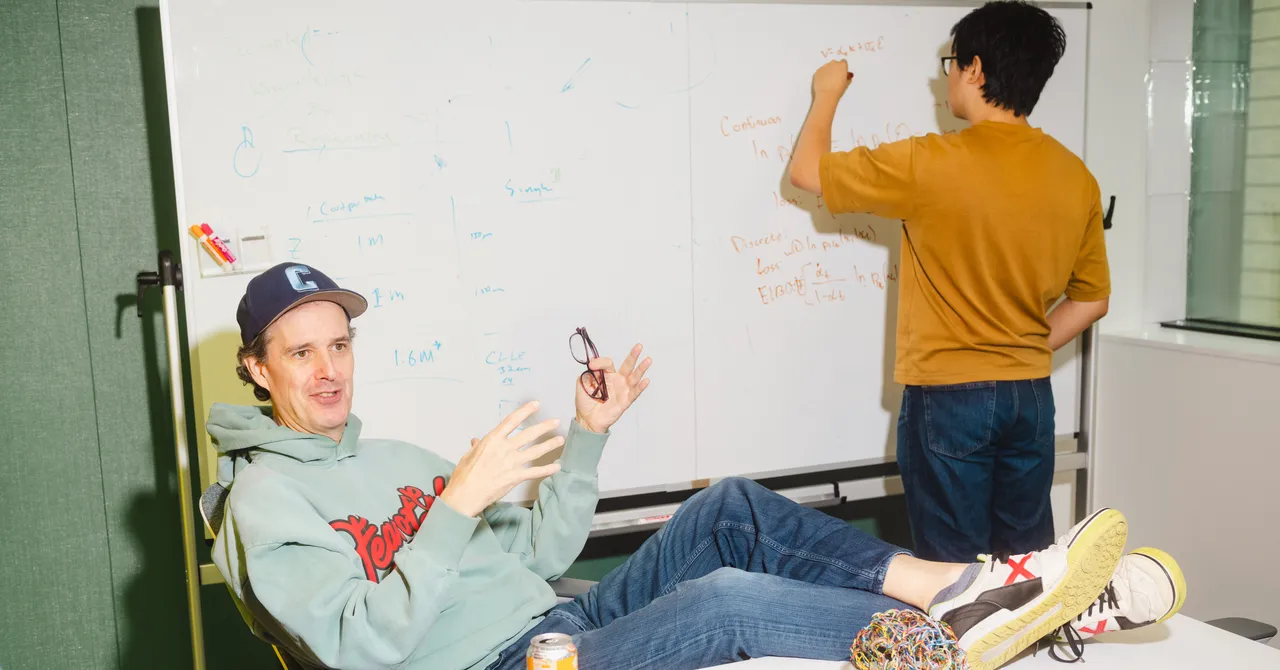
(Left to Right): Vish Sivakumar, Rob Williams, Thomas Reardon, investor and adviser Jacob Vogelstein, and Joshua T. Vogelstein at Flourish's office.
PHOTOGRAPH: LANNA APISUKHA month later, I’m lunching with Reardon and Williams in the Flatiron neighborhood in New York City. Reardon gets right to the point. AI has dug itself into a hole, he says. Though increasingly powerful, large language models are greedy consumers of computer power and data.
Though the inspiration for LLMs was rooted in biology, current frontier models have little in common with the human brain. A person uses about 20 watts of energy to process information; a single chip in an AI training cluster uses more than 30 times that amount. The hyperscalers require thousands of chips and gigawatts of energy, enough to power small cities. And those models need to suck up virtually all of what humans have written. Each new model requires more, more, more. For all of that, the models don’t learn. Once you train them, they’re stuck.
The goal, Reardon tells me, is to build “a synthetic artificial intelligence brain that runs on 50 watts or less.” It should adapt to its conditions, be as nimble as a human mind, and burn a tiny fraction of an LLM’s compute power and energy. The proof of concept is thriving inside our skulls. “There’s something fundamentally wrong with saying, ‘I need to basically read every book ever written 20 times over in order to learn English,’” Reardon says. “A human baby does it with a couple hundred thousand utterances.”
Reardon and Williams haven’t figured out yet how to build systems that match the magic of a human brain. What they have is a belief that an expert, well-resourced team—of AI researchers and neuroscientists working essentially side by side—can find the answer. The neuroscientists will conduct original wet lab experiments with some of the most advanced lab equipment available, to hunt for usable intel on the brain’s architecture. They plan to release the models they’re currently developing as near-term products on the path to a full reinvention of AI.

Thomas Reardon in Flourish's conference room.
PHOTOGRAPH: LANNA APISUKHThe fuzziness of the proposal didn’t bother Jeff Bezos. After reading Williams’ two-pager, he chipped in $50 million. Other funding came from Lux Capital and Google Ventures, among others. Bezos then almost doubled his initial stake and told Reardon he’d have given more if they’d asked. Now with a war chest of $500 million and a reported valuation of $2.5 billion, Flourish just needs to invent a new way to do AI.
doesn’t use his first name–too many Toms in the family tree. “My wife calls me Reardon, everyone calls me Reardon,” he says. He grew up one of 18 kids in a working-class family and dropped out of the University of New Hampshire at age 15. From there his résumé goes bonkers: He becomes a teenage programming wizard, gets hired to help build Microsoft’s first web browser, and starts and sells a wireless tech company. Next he goes to Columbia University for a degree in classics, gets into neuroscience and ultimately earns a doctorate in it (also from Columbia). He starts another company with some classmates, develops a mind-control wristband, gets acquired by Meta, and works there for six years. (The wristband comes with Meta’s latest smart glasses.)
But Reardon was dissatisfied with how companies, including Meta, were building cutting-edge AI. Matching the brain’s ability to learn and energy parsimony isn’t a new idea. Both IBM and Intel have released neuromorphic chips inspired by the brain’s architecture. UC Berkeley computer scientist Ben Recht, who is a Flourish adviser, recalls that scientists decades ago were into neuromorphic approaches to software. Then LLMs took over. “They call those neural nets, but there's nothing brain-like happening there,” Recht says.
Reardon convinced Williams, the Amazon exec, whom he knew from their time at Microsoft, to join him. Another early recruit was Greg Wayne, a longtime researcher at DeepMind, who heads Project Astra, Google’s AI assistant initiative. “I didn't know if they could achieve their goal, but I thought it would lead to interestingness, which probably will be useful,” Wayne says. DeepMind CEO Demis Hassabis fought to keep Wayne, and they forged an arrangement where Wayne kept his job but would spend 20 percent of his time at Flourish.

Thomas Reardon holds a brain sculpture at his startup's offices.
PHOTOGRAPH: LANNA APISUKHBy the end of March, Reardon had hired around two dozen top neuroscientists and AI researchers. I visited them the day the company moved into an office space in New York City’s West SoHo area, in a 10-story building with a built-in data center. People were setting up their computers; the lab equipment, like electron microscopes, were yet to arrive.
“The brain has a secret we haven’t found yet,” says Wayne. The team is focusing on structures called cortical columns, which one Flourish scientist calls “the canonical computational unit” of the brain. One of Flourish’s investors is Jacob Vogelstein, a neuroscientist turned venture capitalist who, along with his brother Joshua and others, started an ambitious initiative called the Open Connectome Project. “The idea was that you could collect all these images of the brain and start to do data processing on them to try to interpret the circuits,” he says.
That work could end up being useful to the team. Joshua Vogelstein—a Flourish cofounder—recently coauthored a paper on the neural network of a fruit fly and found that its network is 10 times more efficient than the transformer, a core architectural unit of an LLM. “The methods are at an inflection point,” says Nathan Danielson, a Flourish neuroscientist and physician who worked with Reardon at Meta.
Flourish is not alone in seeking answers in the brain; the term “neuromorphic” has been flung around so much that it’s almost a buzzword. A company called Cortical Labs is combining lab-grown neurons with silicon chips. OpenAI CEO Sam Altman is backing Merge Labs, with “the long-term mission of bridging biological and artificial intelligence.” Meta’s superintelligence group claims that its TRIBE v2 model “acts as a digital twin of human neural activity.” An organization called Unconventional AI is creating a grant program for research that addresses Reardon’s goal: building an AI that replicates biological efficiency. Some venture capital firms even specialize in brain-science efforts.
Reardon believes that the company’s edge lies in its unusually strong crop of neuroscientists. These researchers will conduct lab experiments while the AI team builds models informed by their discoveries; the algo team, meanwhile, might unearth clues that help the neuroscientists. “You don't really know if you understand something until you can build it, implement it in silicon,” says Josh Morgan, a Flourish neuroscientist. They say they’re open to publishing some of their original research.
“Fundamentally, the company is looking for the algorithms underlying intelligence,” says Jacob Vogelstein, the investor.

Jacob Vogelstein sits in the lab where—once the equipment arrives—the company's neuroscientists will study the brain.
PHOTOGRAPH: LANNA APISUKHReardon tells me that his team has identified paths to near-term revenue that exploit recent brain research. They’re developing a hippocampus-inspired way to handle memory that will allow the company’s models to learn without extensive training data, he says. The algorithm team has built a model that can learn continuously and is working on embodying it in “the kinds of devices you carry in your pocket,” he says. He adds that he's negotiating with a major chip manufacturer to put the model on silicon.
the Flourish scientists held an all-hands meeting in their New York office. Reardon and Williams are seated at a conference table with about a dozen others, including senior advisor Wayne, who's visiting from London. The scientists are debating six potential experiments. These are big swings that require the purchase of multimillion-dollar microscopy machines and years of work.
The discussion of the experiments brings up biological phenomena as widespread as how rabies spreads in the cortex and the neurobiology of birdsong. They debate whether they should examine molecules and synapses or focus on bigger-scale cells or circuits. Are analyses of connectomes in the mouse brain sufficient for some purposes, or would only human brains do?
The verdict, for the moment at least, seems to be to try it all. “The takeaway is that we want to do data collection across the nano, micro, and meso scales to support the discovery of the core algorithm,” says Sean Bittner, a computational neuroscientist who also worked with Reardon at Meta.
There’s an awkward pause, then Wayne speaks up. “That’s a fucking great experimental plan!” he says. “It’s actually practical, as opposed to, like, insane.”

Rob Williams inside the Flourish offices.
PHOTOGRAPH: LANNA APISUKHThere’s no question that Flourish is making a risky, long-range bet. As Williams tells it, after reading the pitch document, Bezos needed to know one thing—were the founders committed to spending years on this? When he got an emphatic yes, he agreed to release his millions. (Bezos did not respond to requests for comment.) “You’ve can’t get very much done in three years,” says Williams. “The way you make big differences is to plan for things that have value seven to 10 years out.” (For the record, Reardon says he’s hoping that Flourish has its big solution in five years.)
“I’m not convinced that it’s going to work," says Berkeley’s Recht, the Flourish adviser, of the company’s main mission. “But if it does, it would be amazing.” AI would never be the same. And a lot of data centers might fall empty.
Let us know what you think about this article. Submit a letter to the editor at [email protected].
© 2026 Winzheng.com 赢政天下 | 转载请注明来源并附原文链接