
first edition of Power Play! From now until the midterms, senior writer Molly Taft will be sharing their thoughts every Sunday on this political season’s hottest issue: data centers. We welcome reader comments, and will be answering questions from the comments section in future editions.
Be sure to catch WIRED’s first livestream on data centers this Thursday, September 10, featuring Molly, senior politics correspondent Hugo Lowell, and senior business writer Max Zeff! You can submit questions here.
It’s been a rough summer for data center boosters. Polling is getting even more dismal—as many as 75 percent of Americans now say they would oppose a data center being built in their area, up from 42 percent last year. Politicians from both parties who were previously advocates, like Texas governor Greg Abbott and Pennsylvania governor Josh Shapiro, are now switching up as the midterms approach, looking to convey to voters that they’re talking a hard line on the hated infrastructure.
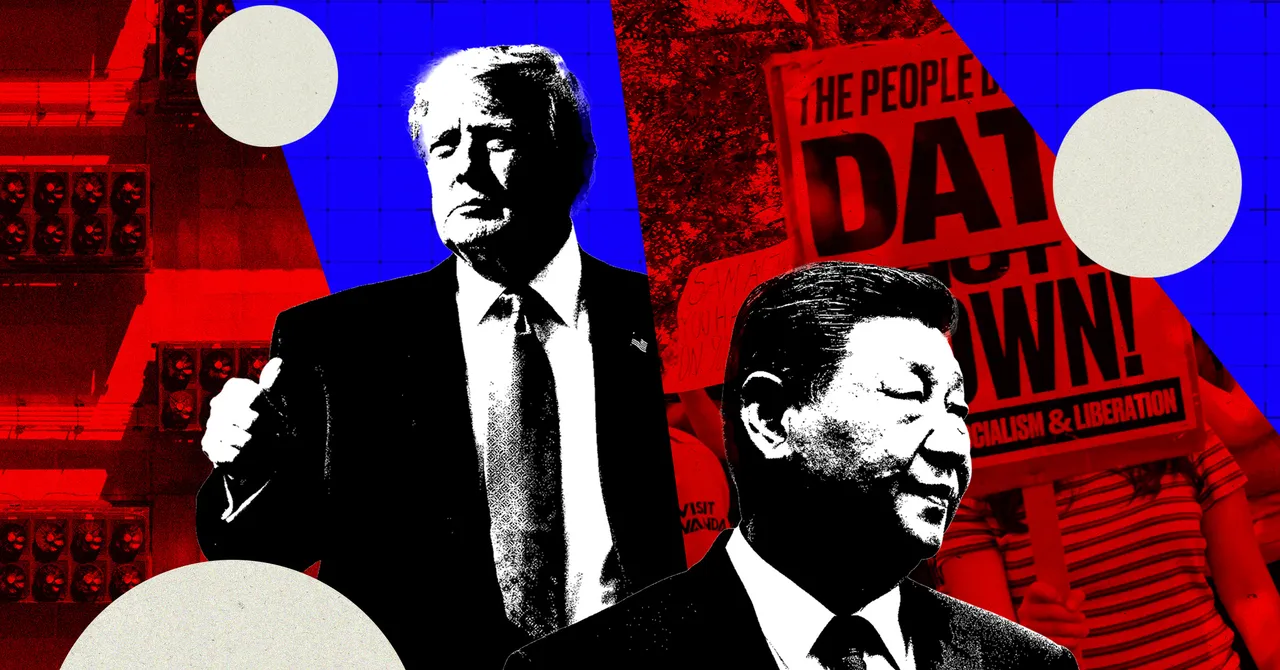
But while some Republicans are turning tail on the issue even in the face of President Donald Trump’s vigorous support for data center construction, others are joining prominent tech leaders in doubling down on an old narrative: That China is responsible for all this malaise.
In late August, X announced that it had identified 200 accounts linked to China that were helping to spread anti-data center talking points on the platform, causing a flurry of alarmist headlines and tweets. (“China is secretly fueling America's data center rage,” Axios trumpeted in an article on X’s report, which data center-friendly politicians and right-wing figures amplified using X itself.) Even the president joined in: “China could not be happier with this anti Data Center movement,” he wrote in a Truth Social post defending data centers (“let Data Reign!”) made just a few days after the X report.
The idea that Americans hate data centers because of a nebulous foreign influence operation—not because of a slew of environmental worries, an oligarch-friendly political system, or a general resistance to AI—is a handy excuse for the technology’s backers and their allies. And it’s one that’s been hanging around for a few months. In the spring, a handful of reports from right-wing policy shops were used by lawmakers and pundits alike to point fingers at the Chinese Communist Party for purportedly seeding anti-data center narratives among the American public. In June, OpenAI banned a cluster of users it had found that, the company said, were linked to the Chinese government and “testing narratives against AI infrastructure.”
But claims that Americans hate data centers because of Chinese influence are based on pretty thin evidence. The biggest report circulating around DC claiming foreign influence, China experts told me earlier this year, leans heavily on insinuations and assumptions with precious little hard evidence. In its own report from June, OpenAI acknowledged that the cluster of accounts it identified was simply exploiting existing discontent around data centers. It’s possible X’s recent purge may be linked to the accounts flagged by OpenAI: They use similar hashtags and images, and several link to the same obscure local news article. X ultimately identified 200,000 accounts in the same bot farm; the 200 anti-data center accounts were just a drop in the larger bucket.
Do blue-check tech types and Republicans keep hammering on the China angle because they know something that the public doesn’t? Graphika, a social media analytics firm that has been tracking data center sentiment online, told me in June that most of the opposition they had seen thus far was homegrown. That hasn’t changed: There’s still very little evidence of significant foreign intervention, Tyler Williams, vice president of intelligence at Graphika, told me this week.
Blogger Andy Masley has a healthy skepticism of the China narrative. Masley, whose blog is largely funded by a grant from effective altruist philanthropy Coefficient Giving, is popular with tech boosters on X for his pro-data center takes. But “as soon as I start talking China, they get quiet,” he tells me. “It seems like a very convenient belief. I have my own biases as a Democrat, but I sometimes look at these [tech] guys and think, ‘Oh, they had to meme themselves into being more right-wing a few years ago. They think right-wing people like it when you talk about China.’”
Masley has put out a public call for any insider information from the tech world about Chinese intervention; he says he hasn’t gotten anything solid yet. It’s also worth noting that right-wing attempts to blame China for sowing data center discord come as members of the Trump administration complain that Chinese firms are stealing American advances in AI. If you’re having trouble wrapping your head around why China would try to muddy the waters around the infrastructure that its AI models are allegedly coasting on, you’re not the only one.
I took my obsession over this topic to Louise Matsakis, WIRED’s senior business editor and resident China expert. She says that this whole episode belies a basic misunderstanding of what Chinese influence campaigns actually look like—and she also didn’t seem surprised that this narrative was taking off like wildfire among factions on the right, which has a long history of pointing the finger at China for American problems. Louise tells me that, at the end of the day, panics like these are not really about China at all.
“It is endlessly fascinating to me how China becomes a scapegoat,” she says. “Americans often find it easier to put the blame on a nebulous other, rather than to actually look at themselves.”
What WIRED’s Writing
My colleague Paresh Dave wrote an eye-opening piece recently about Meta’s push to build out a robot workforce in data centers. “I was surprised to learn that some data centers have cafeterias, with full-on kitchen staff,” he tells me. “It's important to realize that as data centers automate some of the more technical work and reduce on-site jobs, operators could also save money on items such as food and janitorial services—and all those people would also be losing work.”
What We’re Reading
- An outrageous story is unfolding in Arkansas, where Entergy tried to get a restraining order against the Arkansas Democrat-Gazette, which published details of the utility’s data center-related deal with Google that were obtained via a records request. The utility claims that trade secrets were accidentally released, and also dragged the young mom who made the original records request into court. More coverage from the Arkansas Times.
- The Financial Times covers how AI has caused high unemployment for college graduates in Texas—a state that has one of the largest number of data centers in development.
- And The Washington Post reports on a massive new influx of state legislation around data centers heading into the 2026-2027 legislative year.
© 2026 Winzheng.com 赢政天下 | 转载请注明来源并附原文链接