
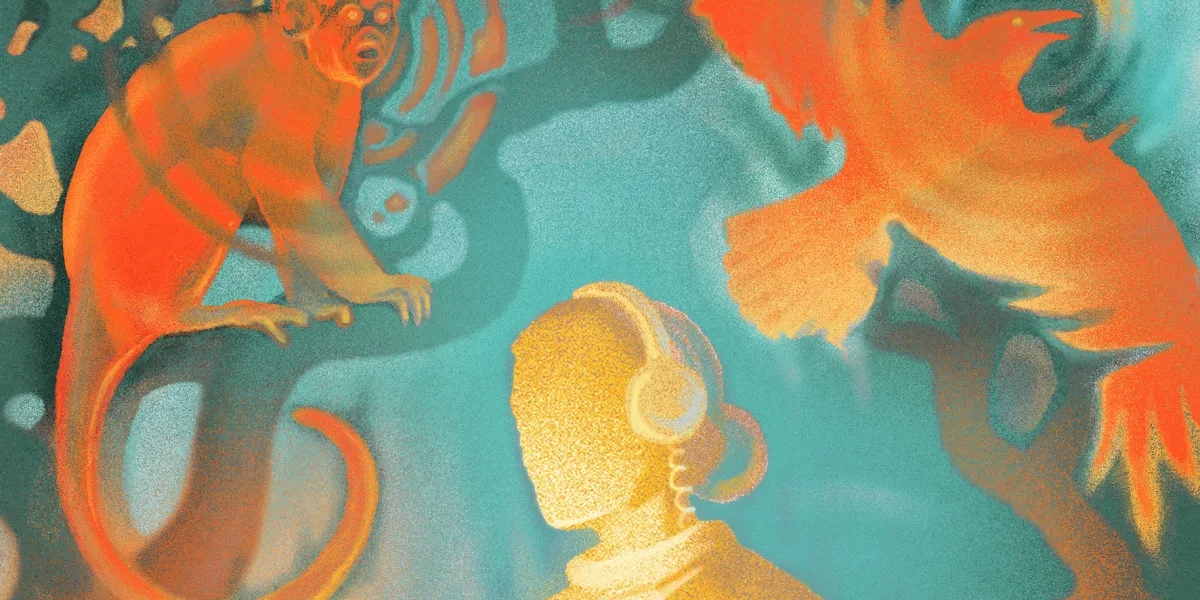
Humans are far from the only species with a gift for gab, and our furry, feathered, and finned friends could have a lot to tell us. Decoding how animals communicate with one another could offer a window into the inner lives of other species and help humans realize that “animals are sentient creatures who think, who have hopes and dreams of their own,” says Con Slobodchikoff, the founder of Zoolingua, a company working on dog-to-human speech.
The sticking points
Teasing all this out is complex. To decipher howls, squeaks, and clicks, researchers must match the creatures making sounds with what’s happening around them. Prairie dogs, for example, utter a different series of yips when a coyote approaches than when a hawk is nearby. It’s painstaking work, especially for difficult-to-observe species, like deep-diving whales or subterranean mole rats.
There are other hurdles. Many animals communicate not just through sound but through visual cues, touch, pheromones, or a combination of signals, some of which might be difficult for us to perceive. And without a multispecies Rosetta stone, it’s hard to know if translations are accurate.
The progress
Over the past 50 years, a growing arsenal of devices has made it easier to observe the sophisticated ways animals communicate. Hydrophones at the bottom of the ocean can capture humpback whale song, and tiny wearable “biologgers” can record a bat’s every squeak.
In the last decade, advances in AI have leveled up our ability to make sense of it all. The technology can detect different calls, distinguish which sounds belong to which animal, and spot patterns. Researchers at the Earth Species Project (ESP), a nonprofit founded in 2018 to decode animal communication, recently used machine learning to detect vocalizations of carrion crows and determine which bird made which call.
They suspect that more advanced AI could translate critters’ chatter. Large language models like Claude and ChatGPT excel at finding relationships between words, explains Sara Keen, one of ESP’s behavioral ecologists. ESP hopes its own NatureLM—trained on human speech, music, and animal sounds—will be able to interpret the vocalizations of a variety of species.
That promise, however, is still theoretical. Yossi Yovel, a neuroecologist at Tel Aviv University, worries that these models will put too much emphasis on acoustic similarities and make mistakes—like lumping together similar sounds that have different meanings.
As for a two-way convo? It’s not clear when—or whether—that will happen. Still, “a lot of animals have an evolutionary structure that is similar enough that we should be able to understand what they’re saying,” Slobodchikoff says.
Progress meter ............ 4

Researchers have amassed heaps of data on animal communication, but they’re still trying to figure out how to decipher it all.
Deep Dive
Culture
God told them to sell crypto. Their investors lost everything.
A pastor and his wife created a cryptocurrency and hawked it in Christian communities. When it came crashing down, investors lost millions―and they were accused of fraud.
BySmart glasses are already causing havoc in India
And the chances of a crackdown are slim, as the authorities spy opportunities for surveillance.
ByJob titles of the future: Delivery drone air traffic controller
Trevor Wischnewsky is making sure that the sky stays organized as we enter the age of food delivery by drone.
ByLove is infrastructure
A story about self-aware cities, direct democracy, and a steamy romance.
ByStay connected
Illustration by Rose WongGet the latest updates from
MIT Technology Review
Discover special offers, top stories, upcoming events, and more.
© 2026 Winzheng.com 赢政天下 | 转载请注明来源并附原文链接