
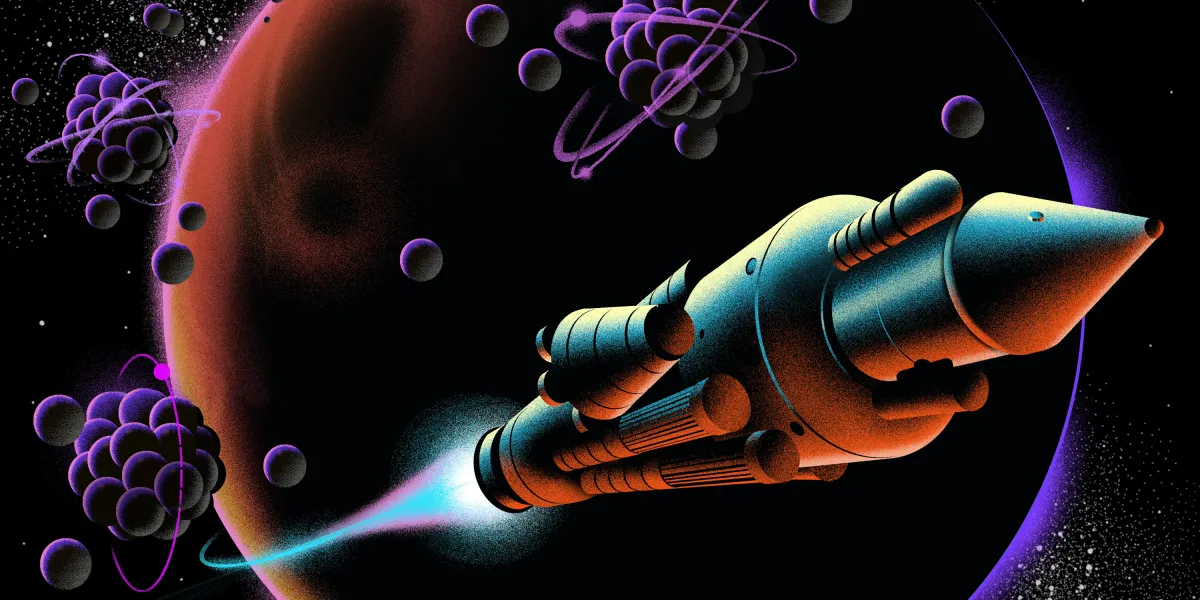
Just before the Artemis II crew began its historic slingshot around the moon this past April, NASA announced plans to build Space Reactor-1 Freedom. SR-1, the first-ever nuclear-reactor-powered interplanetary spacecraft, is meant to fly an uncrewed mission to Mars by the end of 2028, arriving in 2029. A successful mission would herald a new era of more efficient, potentially faster spaceflight—saving astronauts time and cutting their exposure to harmful cosmic radiation as they travel to Mars and beyond. “You wake up to that announcement, and it puts a big smile on your face,” says Simon Middleburgh, co-director of the Nuclear Futures Institute at Bangor University in Wales.
The sticking points
Running a nuclear reactor in space may sound like lunacy, but it’s not. The Soviet Union sent dozens of reactors into orbit, often to power spy satellites. And experts say there aren’t any major technical obstacles to making nuclear space propulsion happen. “I think it’s a very doable technology,” says Philip Metzger, a spaceflight engineering researcher at the Florida Space Institute.“I’m happy to see them finally doing this.”
Still, developing space propulsion using reactors has been slow going. The US has started—and terminated—several programs looking into it over the past 75 years. The latest casualty was DRACO, a collaboration between NASA and the Department of Defense, which ended in 2025. The project was canceled because of high experimentation costs, an inability to compete with conventional rocket propulsion on price, and difficulty ensuring that ground tests could be performed safely and effectively. (You are creating an incredibly powerful nuclear reaction, after all.)
The progress
After much wavering, it now appears that nuclear-powered interplanetary travel is a $2 billion bet NASA is willing to make. The agency is pursuing an approach called nuclear electric propulsion, which uses the neutrons produced in a self-sustaining, uranium-atom-splitting reaction to create heat and ultimately electricity. The electricity is used to ionize a gas, which is blasted out of the spacecraft with the help of magnetic fields, generating thrust. The approach “is very low thrust, but very efficient,” says Sebastian Corbisiero, the US Department of Energy’s national technical director of space reactor programs. “So you can use it for a long period of time.”
What might such a rocket look like? A presentation by Steve Sinacore, program director of NASA’s SR-1 program, offers some clues. So far, the concept art makes the craft look like a colossal fletched arrow. The back will house the power-and-propulsion system, while the tip will hold a uranium-filled nuclear reactor with a capacity of at least 20 kilowatts. (For context, a typical nuclear plant on Earth is about 50,000 times more powerful.) The “fletches” on SR-1 are large fins that help cool the reactor by radiating heat into space.
Like many other pieces of space hardware, the reactor will need to be put through its paces on the ground before it’s cleared for the rough rocket trip to space. “Going through the launch safely is going to be a challenge,” says Middleburgh. “You are being shaken, rattled, and rolled.” For safety reasons, the reactor will be switched on around two days post-launch, when it’s comfortably far from Earth. Uranium isn’t tremendously dangerous by itself, but that can’t be said of the waste products that emerge when the reactor is running. If SR-1 works as planned, its journey to Mars will take about a year.
Will this novel form of space propulsion actually reach the Red Planet by 2029? It’s possible. NASA says the Idaho National Laboratory, which is building SR-1’s reactor, is making progress and is on target for a late-2028 launch. “Procurement of major components is underway, and integration work on the power and propulsion element is advancing steadily,” Sinacore told MIT Technology Review. The outlook will get even sunnier if the Artemis program, which aims to start laying the foundations for a base on the lunar south pole by the decade’s end, keeps to its own bold deadline.
“It’s an aggressive timeline,” says Lindsey Holmes, who is vice president of advanced projects at Analytical Mechanics Associates, an aerospace company in Virginia. She suspects the push is being driven partly by China’s and Russia’s own deep-space nuclear ambitions. The two countries have spoken about plans to place a reactor on the moon’s surface in the mid-2030s to power a jointly operated lunar base. Whether it flies or fails in space, SR-1’s development should help NASA put its own reactor on the moon; the technology involved in the two projects is broadly similar, given that the lunar surface, like space itself, is a vacuum. If an interplanetary nuclear-powered spacecraft works, a nuclear reactor on the moon should too.
Progress meter . . . . . . . . . . . . 6

Most of the technology for SR-1 already exists; it’s going to come down to piecing it all together and then seeing how it performs in space.
Keep Reading
Most Popular
Don’t be fooled—LLMs don’t reason
Ten years after AlphaGo’s match against Go champion Lee Sedol, today’s AI still isn’t tapping into the machinery that made that win possible.
ByDon’t be fooled by this summer of AI hype
Breathless claims about AGI and new capabilities fall apart pretty quickly under scrutiny.
ByAn AI “mind-reading” tool can reconstruct what you’re looking at from a brain scan
Scientists hope it could be used to reconstruct a person’s inner thoughts, mental images, or even dreams.
ByThe inside story on why OpenAI agents hacked Hugging Face
The underlying models had been rewarded for cheating and communicating with each other, a new OpenAI report finds.
ByStay connected
Illustration by Rose WongGet the latest updates from
MIT Technology Review
Discover special offers, top stories, upcoming events, and more.
© 2026 Winzheng.com 赢政天下 | 转载请注明来源并附原文链接