
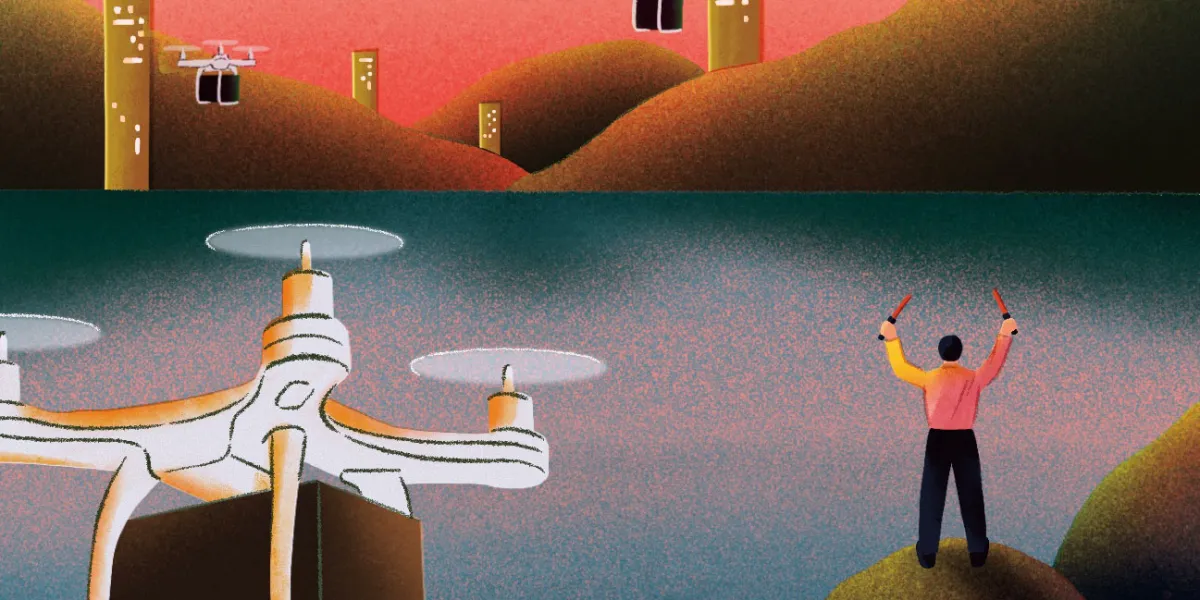
The moment Trevor Wischnewsky heard that drones were delivering pizza and sushi around his Texas neighborhood, his mind was made up. “It was super fascinating,” he says. “I just immediately wanted to be a part of it.” Wischnewsky is now an RPIC, or “remote pilot in command,” at a company called FlyTrex. An RPIC is like an air traffic controller. But instead of airplanes, this new class of aviators tend to fleets of hexacopter drones that ferry cargo to homes and businesses within a three-mile radius. Not only does he ensure the safe passage of FlyTrex’s parcels, but Wischnewsky coordinates traffic with a growing swarm of delivery drones dotting the skies over Dallas from competitors like Zipline, Amazon, and Alphabet’s Wing. Here’s what it takes to land the gig.
Aviation experience
When he applied to FlyTrex, Wischnewsky was in training to become a commercial pilot and flight instructor, and he was already certified by the Federal Aviation Administration as a drone pilot. The company requires this credential, along with a weeks-long FAA-approved training course, to ensure that a pilot is prepared to take over a drone if need be. Though he doesn’t pilot the craft, Wischnewsky monitors the delivery process from FlyTrex’s operations center with the help of inputs from GPS, lasers, and a range of sensors.
A collaborative mindset
At first, the biggest challenge was trusting the technology. “On the manned-aircraft side, they tell you ‘Don’t trust the automation,’” Wischnewsky says. The Dallas–Fort Worth area, though, is a testing ground for unmanned aircraft systems traffic management (UTM), a network that allows autonomous drones from FlyTrex and its competitors to share their coordinates in real time to help avoid collisions even beyond the pilot’s line of sight. Once Wischnewsky makes sure a drone is flight-ready, its path is unimpeded, and the weather conditions are clear, UTM takes care of the rest.
Ability to stay calm under pressure
At his busiest, Wischnewsky will have up to 10 drones on his watch at the same time. “You’re there as a safety net,” he says. Even with automation, keen situational awareness is required, and the most common hazard is the weather. Wischnewsky recalls a particularly stressful day: A drone had been in the air for only seconds when the wind picked up so suddenly that he had to intervene. He returned it safely, preventing an errant ice cream cake from hitting the sidewalk.
Eamon Whalen is a reporter and researcher based in San Francisco.
Deep Dive
Culture
God told them to sell crypto. Their investors lost everything.
A pastor and his wife created a cryptocurrency and hawked it in Christian communities. When it came crashing down, investors lost millions―and they were accused of fraud.
BySmart glasses are already causing havoc in India
And the chances of a crackdown are slim, as the authorities spy opportunities for surveillance.
ByChild-monitoring apps might need a reboot
Monitoring apps promise to keep young people safer online, but looking in on kids’ phones can backfire. Online safety experts say there’s a better way.
ByHow we picked 35 of the world’s top young scientists and engineers
Our 2026 Innovators Under 35 list will be out soon. Here’s what we looked for as we sifted through 550 nominations from around the world.
ByStay connected
Illustration by Rose WongGet the latest updates from
MIT Technology Review
Discover special offers, top stories, upcoming events, and more.
© 2026 Winzheng.com 赢政天下 | 转载请注明来源并附原文链接