
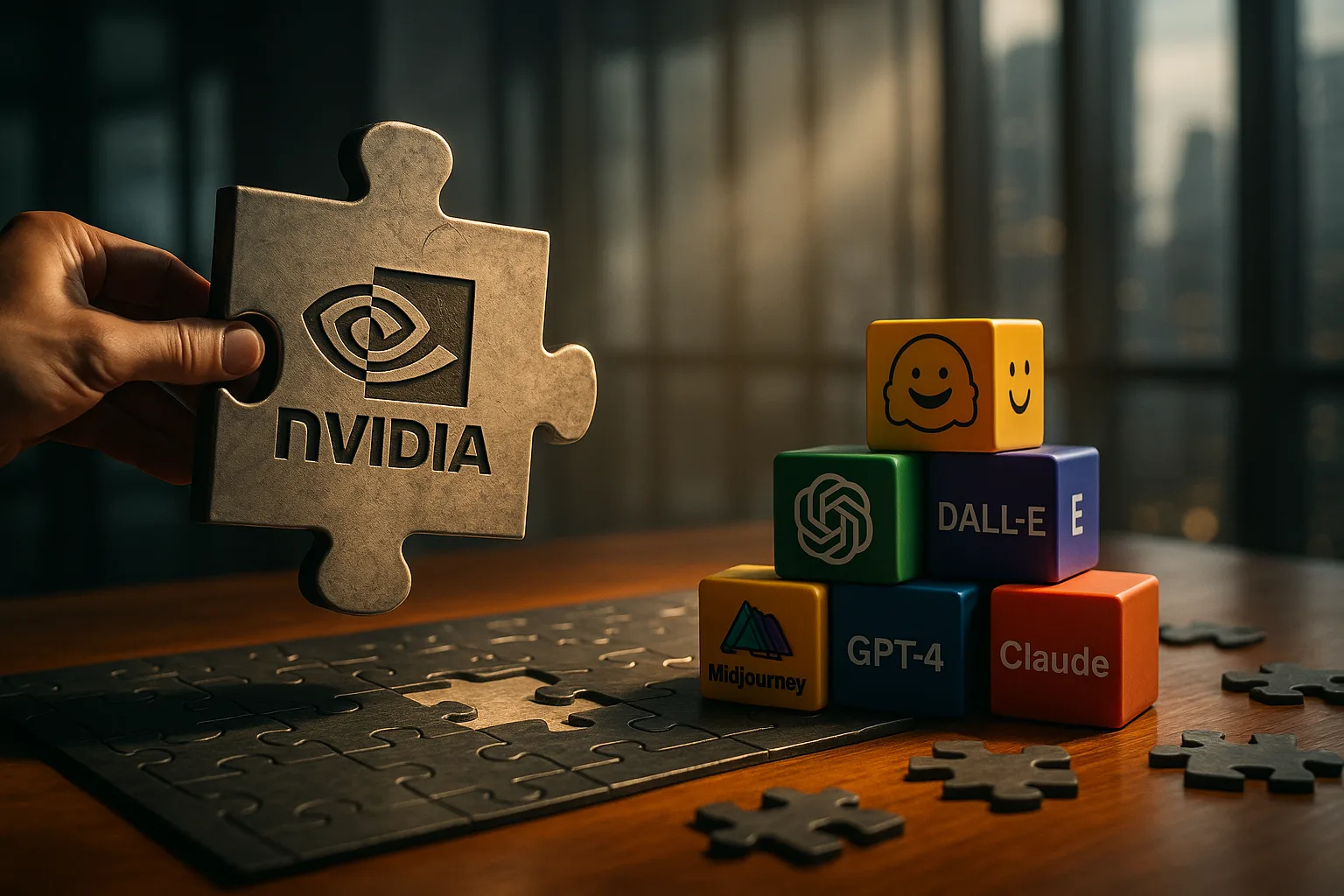
On September 3, 2026, NVIDIA officially announced the acquisition of Hugging Face for approximately $12.93 billion. The transaction structure comprises $11.9 billion in cash paid to shareholders, plus an additional $1 billion in equity to retain core employees. The deal is subject to regulatory approval and is expected to close in the first half of 2027 at the earliest. This marks NVIDIA's second-largest acquisition ever, trailing only the $20 billion Groq chip asset acquisition earlier this year.
From Chips to Ecosystem: NVIDIA Fills in the Final Layer
Prior to this acquisition, NVIDIA's AI moat was already substantial: GPU hardware, the CUDA software ecosystem, the NVLink interconnect, the TensorRT inference framework, and NIM microservice containers. From silicon to the algorithm stack, NVIDIA covered nearly all the underlying infrastructure for model training and inference. The only missing layer was the developer community and model distribution layer.
Hugging Face fills that gap exactly. According to official disclosures, the platform now has more than 18 million developers, researchers, and creators and hosts over 3 million models, 500,000 datasets, and 1 million applications. In the AI field, a community asset of this scale holds the same significance as GitHub does for software engineering—it is not just a repository, but the industry's default hub.
"NVIDIA has already built an extended ecosystem through GPUs, CUDA, networking, inference software, and AI frameworks," Forrester analyst Charlie Dai told The Register. "Hugging Face will give it a stronger position at the developer, model distribution, and community levels."
That statement captures the core logic of this acquisition: NVIDIA does not only want to sell chips; it wants to be the infrastructure provider for the entire AI production chain—from compute to models to community, fully integrated end to end.
Valuation Nearly Triples in Three Years; Hugging Face Makes the First Move
According to CNBC, Hugging Face's CEO proactively approached Jensen Huang, pushing the deal forward weeks before the final agreement was signed. This detail reveals Hugging Face's own strategic calculus.
Looking at the valuation trajectory: after its Series C round in 2022, the company was valued at $2 billion. In August 2023, it completed a $235 million Series D round at a $4.5 billion valuation, with investors by then including Google, Amazon, NVIDIA, AMD, and other heavyweights. The acquisition offer now stands at approximately $12.9 billion—a valuation that has nearly tripled in less than three years.
The company's revenue has also grown quickly—about $70 million in 2023, rising to $130.1 million in 2024—but measured against that revenue scale, the multi-billion-dollar acquisition price still represents a significant premium. For Hugging Face's founding team, before the AI infrastructure landscape has fully hardened, choosing a buyer that holds the strongest leverage in compute may do more to preserve the platform's industry position than continuing to raise funds independently.
The Open-Source Promise: Historical Precedents Are Not Encouraging
NVIDIA made a series of commitments in the announcement: Hugging Face will continue to operate as an open platform, support open-source and open-weight models from all builders, and continue to support multi-cloud and multi-accelerator development and deployment. Developers can build or deploy on the platform without using NVIDIA compute. Jensen Huang's official statement: "Open models allow startups, enterprises, universities, and public institutions to build on top of advanced capabilities without having to train every model from scratch."
The statement is beyond reproach. The problem is that the tech industry should by now have developed a robust immunity to the phrase "we will remain open."
Over the past decade, GitHub did manage to maintain a relatively open ecosystem after its acquisition by Microsoft, but it has gradually become deeply bound to Azure. Red Hat's open-source commitments after the IBM acquisition were partially honored and partially rolled back. The commercialization paths of JFrog and HashiCorp both triggered fierce backlash from the open-source community. Openness is Hugging Face's core asset, yet it is precisely this openness that stands in inherent tension with NVIDIA's commercial interests.
Forrester's Dai chose his words cautiously: "Enterprises should pay attention to future transitions rather than immediate disruption—risk assessment around deep integration with NVIDIA's toolchain, runtimes, and optimization frameworks will be necessary." In other words: no immediate action, but the long-term direction warrants close observation.
The Hidden Risk of a Closed Ecosystem Loop: Money Moving from the Left Hand to the Right
This acquisition also invites a deeper structural critique. Financial adviser Nigel Green warned that the funding logic of today's AI ecosystem has fallen into a "dangerous loop"—NVIDIA's chip sales revenue flows to AI companies through investments and procurement, and those companies then pour capital back into NVIDIA to buy more GPUs, so the same dollars are booked as new revenue at every step.
This is no empty claim. NVIDIA was already one of the investors in Hugging Face's Series D round, and a large number of model developers on the Hugging Face platform train and run inference using NVIDIA GPUs. With this acquisition, NVIDIA is effectively taking an ecosystem node it already indirectly controlled and folding it entirely into its own balance sheet—while gaining direct pricing power and product decision-making authority over that node.
If Hugging Face's inference services begin to prioritize NIM containers, its billing system becomes integrated with the NVIDIA cloud platform, and model optimization toolchains gradually become deeply bound to CUDA, this kind of "silent lock-in" will be far harder to detect and far harder to reverse than any explicitly stated openness restriction.
The Time Window: Why Exactly Now
2026 is a year in which the AI infrastructure landscape is accelerating toward consolidation. Google keeps upgrading its Gemini series, Anthropic has accelerated the cadence of Claude updates, Meta is making frequent moves in the open-source camp, and the contests over compute and model distribution are intensifying in parallel. No one can shake NVIDIA's moat on the compute side in the short term, but command of the gateway to the model ecosystem is at risk of being carved up by the cloud giants—AWS has SageMaker, Google has Vertex AI, and Microsoft has Azure AI Studio.
Hugging Face is currently the only truly neutral platform that spans cloud vendor walls and is collectively recognized by developers around the world. The moment any cloud giant brought it under its wing, that neutrality would collapse. NVIDIA's hardware neutrality—its chips run across all mainstream clouds—makes it, in theory, the buyer "least likely to disrupt the ecosystem's balance." That may be one of the deeper reasons Hugging Face approached NVIDIA of its own accord.
Independent Assessment
The strategic logic of this deal is clear, and the motivation for making it is compelling. With $12.9 billion, NVIDIA has bought not just a model platform, but the default entry point of the global AI developer community—along with the data flows, preference signals, and ecosystem stickiness that come with it.
But there is an unavoidable paradox here: Hugging Face's value derives precisely from its openness and neutrality, while the motive for NVIDIA's acquisition is precisely to convert that openness into its own advantage. The two are not entirely antithetical, but they form a persistent structural tension. Over the next two to three years, whether NVIDIA quietly adjusts inference service pricing, model ranking algorithms, or the platform access terms of its optimization toolchain will be the key indicator for judging the true worth of this "open-source promise."
The deal itself is technically unimpeachable. The real test comes after closing.
© 2026 Winzheng.com 赢政天下 | 转载请注明来源并附原文链接