
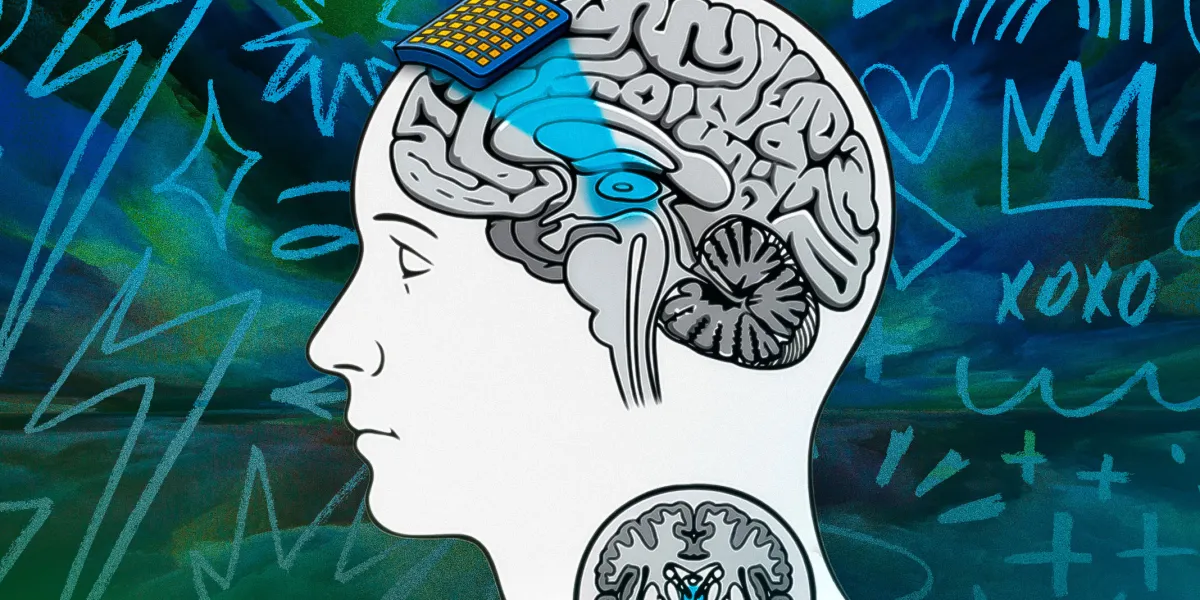
How does the physical matter in our brains translate into thoughts, sensations, and emotions? It’s hard to explore that question without neurosurgery. But in a recent paper, MIT philosopher Matthias Michel, Lincoln Lab researcher Daniel Freeman, and colleagues outline a strategy for doing so with an emerging tool called transcranial focused ultrasound.
This noninvasive technology reaches deeper into the brain, with greater resolution, than techniques such as EEG and MRI. It works by sending acoustic waves through the skull to focus on an area of a few millimeters, allowing specific brain structures to be stimulated so the effects can be studied.
The researchers lay out an experimental approach that would use the tool to help test two competing conceptions of consciousness. The “cognitivist” concept holds that brain activity generating conscious experience must involve higher-level processes such as reasoning or self-reflection, likely using the frontal cortex. The “non-cognitivist” idea is that specific patterns of neural activity—more localized in subcortical structures or at the back of the cortex—give rise to subjective experiences directly.
“This is a tool that’s not just useful for medicine, or even basic science, but could also help address the hard problem of consciousness,” Freeman says. “It can probe where in the brain are the neural circuits that generate a sense of pain, a sense of vision, or even something as complex as human thought.”
Keep Reading
Most Popular
Want to understand the current state of AI? Check out these charts.
According to Stanford’s 2026 AI Index, AI is sprinting, and we’re struggling to keep up.
By10 Things That Matter in AI Right Now
MIT Technology Review's authoritative overview of the 10 technologies, emerging trends, bold ideas, and powerful movements in AI in 2026.
ByMusk v. Altman week 1: Elon Musk says he was duped, warns AI could kill us all, and admits that xAI distills OpenAI’s models
Musk kept his cool, and OpenAI’s lawyer bulldozed him with piercing questions about his motivations for suing the company.
ByA new US phone network for Christians aims to block porn and gender-related content
Launching next week on T-Mobile's network, the cell plan takes a nuclear approach to online safety.
ByStay connected
Illustration by Rose WongGet the latest updates from
MIT Technology Review
Discover special offers, top stories, upcoming events, and more.
© 2026 Winzheng.com 赢政天下 | 转载请注明来源并附原文链接