
On the main stage of Build 2026 today, Microsoft Technical Fellow Steven Bathiche unveiled Project Solara—a "chip-to-cloud" device platform built for a new class of hardware: devices that don't run traditional apps, only AI agents.
It is not a product, but a foundation + a proposition. The proposition is simple: the interaction entry point for next-generation computing will shift from "open an app, click a menu" to "invoke an agent, assign a task." Microsoft is betting an entire tech stack on this judgment, and made an unexpected choice—this foundation is not built on Windows.
1. What Exactly Is It
Project Solara consists of three layers: the underlying OS, the agent runtime layer in the middle, and a contextually generated interface layer on top.
The underlying OS is called MDEP (Microsoft Device Ecosystem Platform), an enterprise-grade fork based on AOSP (Android Open Source Project). On top of it, Microsoft layers its own Agent Shell—a "shell" that can dynamically load and trim multiple cloud-based agents on demand. The topmost layer is what Microsoft calls just-in-time UI, where the interface is no longer a fixed, pre-designed app but is dynamically rearranged or even instantly generated by the agent based on the current device form factor and task.
Accompanying this is a complete enterprise governance stack: device management via Intune, identity via Entra ID, biometrics via Hello for Business, and hardware-level privacy toggles like microphone mute.
Microsoft also demonstrated two reference designs, explicitly stating they will not mass-produce them:
- Desktop device: A touch screen with a camera, microphone, presence sensor, and USB-C expansion. After face unlock, the agent is presented directly. The form is reminiscent of an Echo Show.
- Badge: A wearable with a camera and fingerprint sensor. Press to wake the agent, which can record audio and instantly transcribe it, and the camera lets the agent "see" what the wearer sees.
On the chip side, it is tied to Qualcomm and MediaTek's Arm platforms. Early pilot customers include Best Buy, CVS Health, Levi's, Target, and AccuWeather. External pilots will launch in the coming months.
2. Three Key Design Choices
First, the foundation is Android, not Windows. This is the most intriguing move of the entire presentation. A company that treats Windows as its identity bypassed its flagship OS for a future-oriented device form factor. The reason is pragmatic: AOSP's hardware compatibility and driver ecosystem on low-power, small devices is far more mature than Windows's. Microsoft only needs to stack its own agent shell, security model, and management stack on top to gain ready-made hardware adaptation capabilities, avoiding the cost of building a new device OS from scratch. Windows Phone died from "no app ecosystem"—but an agent platform that doesn't rely on an app catalog neatly sidesteps that fatal flaw.
Second, the OS is deliberately thin. Microsoft used an unusual word to describe this layer—"liminal." The idea is that the OS remains minimal on edge devices, with real computation flowing between the device and the cloud through agents. In short, these devices are essentially thin clients + cloud brains: the device handles sensing and rendering, while intelligence primarily resides in the cloud.
Third, the interface is generated on the fly by the agent. Just-in-time UI eliminates the assumption that "an app = a fixed set of interfaces." The same agent rearranges its layout on different-sized devices and, when necessary, generates entirely new interfaces. The smallest unit of interaction shifts from "app" to "intent."
3. Commercial Path: Microsoft Won't Ship Hardware, Will Recruit OEMs
Microsoft repeatedly emphasized at the event that the two devices are reference designs, not products. Its strategy is to build the platform and attract hardware manufacturers: package the OS, shell, security stack, chip compatibility list, and reference designs, and let OEMs create actual terminals based on Solara. Solara also integrates with agents like Microsoft 365 Copilot and opens up to third-party agents through an open architecture.
This is a classic "platform first, ecosystem later" approach. The advantage is that Microsoft doesn't bear the risk of hardware inventory; the cost is that the pace of adoption depends on OEMs—optimistically, it will take months to a year before consumer or commercial Solara devices actually ship.
4. What This Means
Setting aside Microsoft itself, the real signal from this is: The "app → agent" entry point shift has been formally endorsed by a company on the Build main stage. Previously, "self-hosted / agent-first / model-as-entry-point" was mostly driven by the developer community and startups. Now, a corporate giant stepping in effectively educates the market on the entire direction.
But we need to recognize which path Microsoft chose. Solara's focus is clearly on enterprise IT governance + cloud-based agent orchestration: Intune, Entra, compliance, unified management, intelligence in the cloud, devices as terminals. This path serves the deployment and control needs of large organizations, which also means it has a natural blind spot—scenarios where data sovereignty is sensitive and requires both inference and data to remain local. In this blind spot, the "local-first / edge inference" route is precisely the complementary side to Solara, not a competitor.
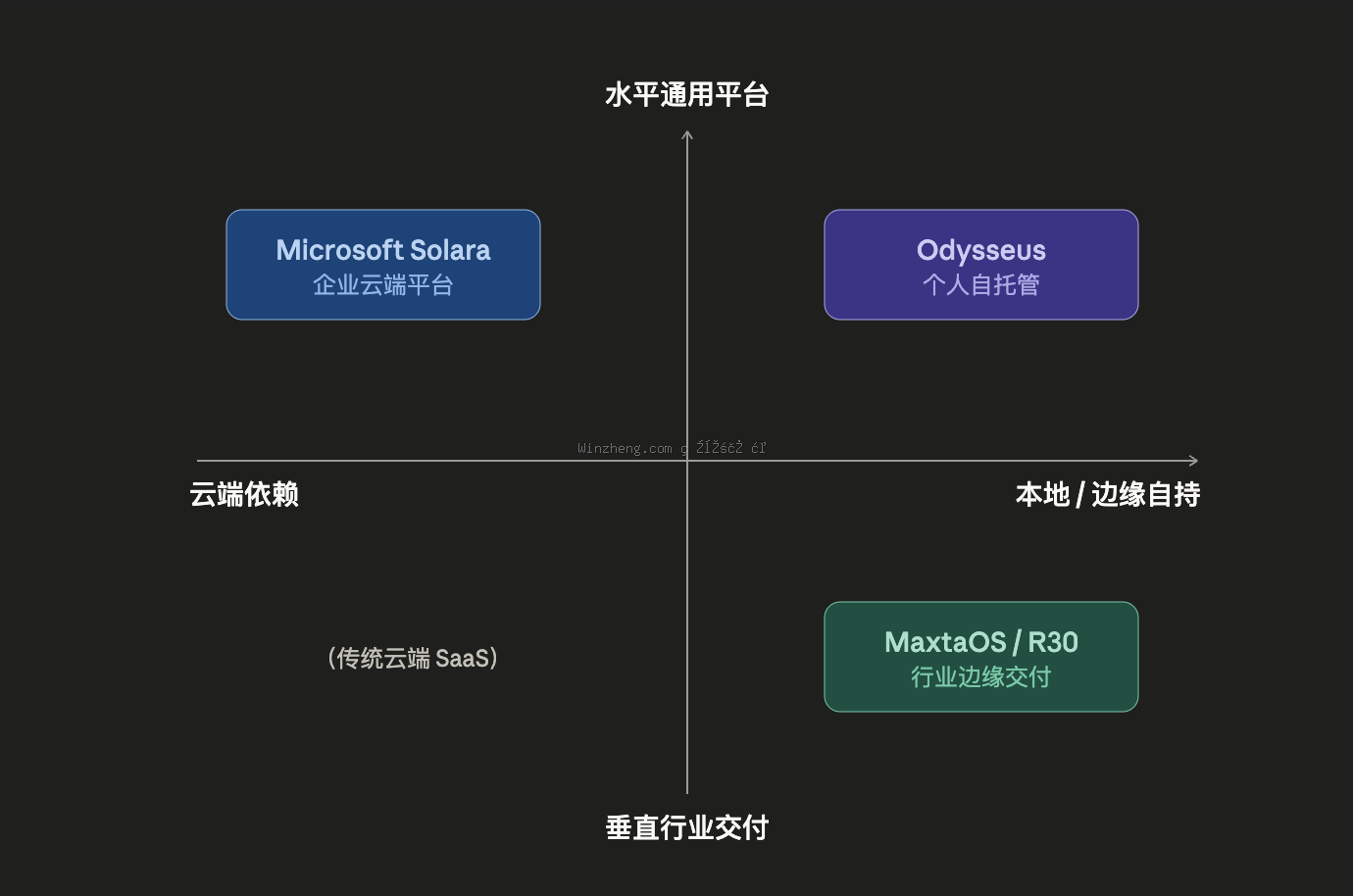
It is worth looking at another sample from the opposite end. Just two days before Build, a million-subscriber individual developer (YouTuber PewDiePie) open-sourced a self-hosted AI workbench called Odysseus, which quickly shot past 30,000 stars. It stuffs "model serving, agents, tools, email, research" all into a single local workbench running on your own hardware with zero telemetry. On one end, a corporate cloud platform (Solara); on the other, a personal self-hosted workbench (Odysseus)—both validating the same judgment, but with data and compute landing in diametrically opposite places.
5. Positioning Comparison: Solara / Odysseus / MaxtaOS·R30
Placing the three samples on the same table makes the boundaries clear:
| Dimension | Microsoft Solara | Odysseus | MaxtaOS / Max R30 |
|---|---|---|---|
| Positioning | Agent-first device platform | Personal self-hosted AI workbench | Industry-grade edge AI delivery |
| Target Users | Large enterprises / OEMs | Developers / Advanced individuals | Vertical clients like law firms, factories, professional services |
| OS Foundation | MDEP (AOSP fork) | Generic Linux/macOS/Win | Proprietary AI OS (multi-hardware) |
| Compute & Data Landing | Thin device + primarily cloud | Primarily local, can use external APIs | Local / edge self-contained, data never leaves |
| Data Sovereignty | Cloud-dependent, enterprise-controlled | Fully local, zero telemetry | Fully local, compliance-oriented delivery |
| Hardware | Qualcomm/MediaTek reference designs | BYO hardware | Delivery-grade edge box |
| Delivery Model | Platform + recruit OEMs | Self-install, self-maintain | Integrated hardware + software, out-of-the-box |
| Business Model | Platform / Ecosystem | Open source, free | Enterprise delivery + subscription |
| Maturity | Early, reference designs | Early, community-driven | Already has deployed customers |
The three are not substitutes for each other but tackle different facets: Solara addresses "how large organizations can centrally manage a fleet of agent devices"; Odysseus solves "how an individual can fully use AI on their own machine"; and industry-grade edge delivery answers "how to make something that works directly in specific industries while keeping data local." Solara makes the OS thin and puts intelligence in the cloud; the edge route does the opposite—embedding the brain into the device itself.
6. Points to Watch
- Adoption timeline: The gap between reference designs and mass-produced terminals depends on OEMs, making the schedule uncertain.
- Cloud dependency vs. offline capability: The thin device + cloud brain model's boundaries under weak networks, data compliance, and cross-border scenarios have not been fully demonstrated.
- Agent interoperability: The open architecture for third-party agents is a highlight, but how agents will be orchestrated, billed, and securely isolated was not covered in depth during the announcement.
- Security posture (applies to all self-hosted/edge players): Any AI system with "local privileges + network reachability" should have authentication enabled by default, backend services isolated on internal networks, a trusted gateway in front, and should never be directly exposed to the public internet.
© 2026 Winzheng.com 赢政天下 | 转载请注明来源并附原文链接